TfL Footway Parking PCN Appeal Refused: Key Lessons
Tribunal refused a TfL footway parking PCN appeal. Learn what evidence matters, how London’s pavement parking rules apply, and mistakes to avoid.

James Wilson
19 March 2026
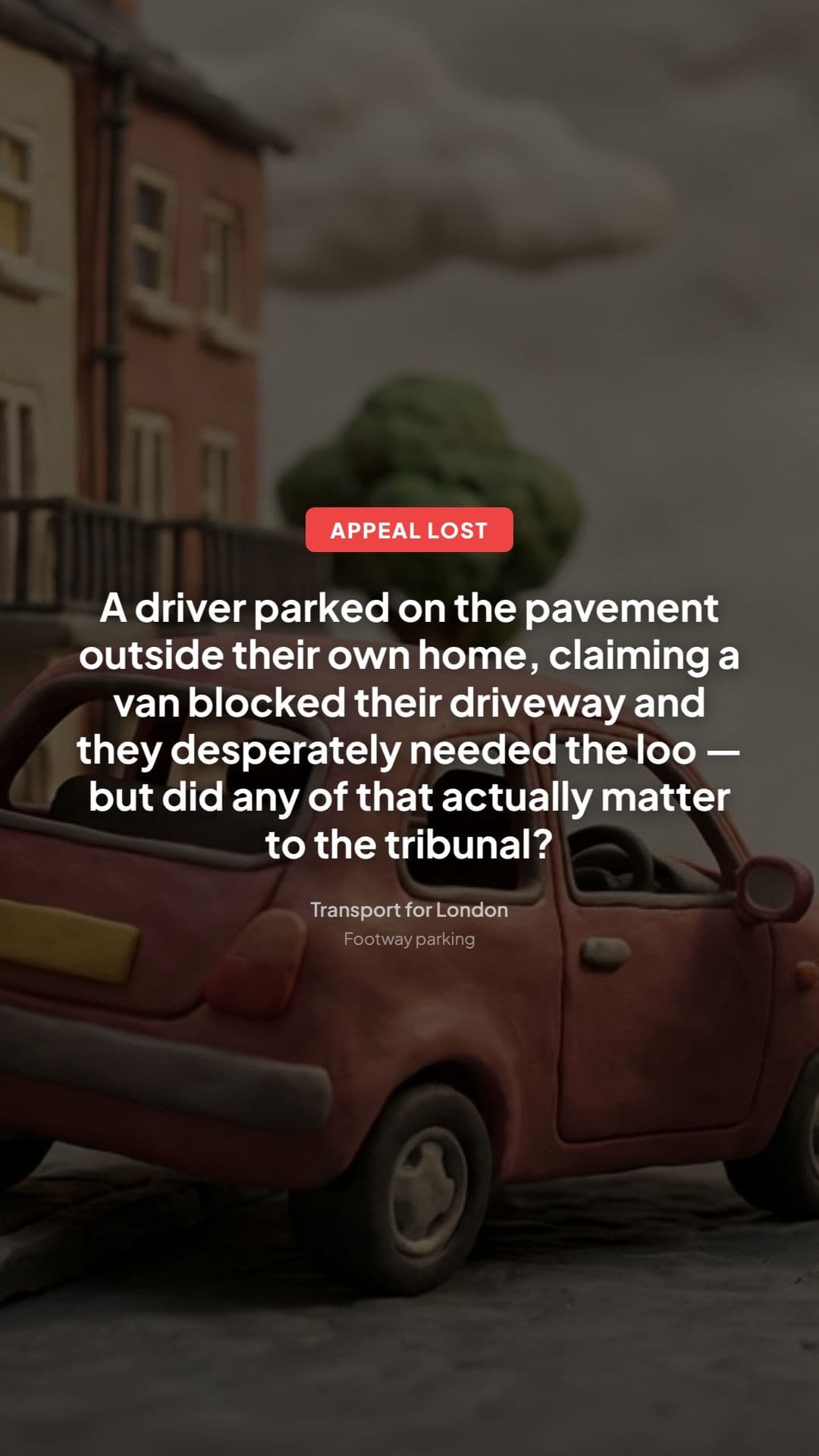
When "I Was Bursting for the Loo" Doesn't Beat a Pavement Parking Fine: A Valentine's Day Tribunal Case
Why This Case Should Make Every Driver Stop and Think
Picture the scene: it's Valentine's Day, you're in a rush, a van is blocking your driveway, and nature is calling — urgently. You make a split-second decision to park with two wheels on the pavement, just for a moment, just outside your own home. Surely that's forgivable?
Not according to a London parking tribunal. And the reason why this case matters to every driver in Greater London — whether you've ever parked on a pavement or not — is that the law involved is far older, far stricter, and far less flexible than most people realise. This isn't about a technicality or an overzealous traffic warden. It's about a rule that has been on the statute books since 1974, and which the adjudicator had absolutely no power to bend, no matter how sympathetic the circumstances.
The Case: A Resident, a Blocked Driveway, and a CCTV Camera
On 14 February 2025 at 4:22 in the afternoon, a vehicle was observed parked on Stafford Road in London with at least one wheel on the pavement. Transport for London (TfL) issued a Penalty Charge Notice (PCN) for footway parking — the formal term for parking on or over a pavement or any part of the road that isn't the carriageway itself.
The driver appealed to the independent tribunal. She was a resident of the block of flats on that very street, and she had a compelling human story to tell.
The Arguments: A Perfect Storm of Unfortunate Circumstances
The driver's appeal was, by any reasonable human measure, sympathetic. She explained that:
- A van was blocking her driveway, preventing her from accessing her car park
- She was rushing around dealing with various pressures that day
- She was urgently desperate to use the toilet
- She had deliberately avoided parking in a red box, knowing that would result in a fine
- She was a resident of the block of flats directly outside which she parked
- She submitted a utility bill as proof of her address
She wasn't trying to dodge responsibility entirely — she acknowledged the parking was intentional and apologised for what she called an "unforeseen situation." She was asking for understanding, not arguing that she hadn't done it.
TfL's case was straightforward: the vehicle was on the pavement, the restriction applies at all times, and no exemption applied.
The Decision: Appeal Refused
The adjudicator refused the appeal. The vehicle had been on the pavement — that much was not in dispute. But the adjudicator went further and examined the CCTV footage carefully, finding that it did not support the claim that a van was blocking the driveway. The footage showed the driver approaching her vehicle, removing something from it, and then driving away without any apparent obstruction preventing her from doing so.
In other words, not only did the legal defence fail — the factual basis for the appeal was also undermined by the evidence.
The Legal Reasoning: Why "It Was an Emergency" Simply Doesn't Work Here
This is where the case becomes genuinely instructive, because the adjudicator's reasoning reveals something that catches drivers off guard again and again.
The 1974 Rule That Most Londoners Don't Know About
Pavement parking in Greater London has been banned since 1974 under the Greater London (General Powers) Act 1974. This was originally a criminal offence. It is now enforced as a civil matter — meaning councils and TfL can issue PCNs rather than the police charging you — but the underlying prohibition is exactly the same.
This ban applies 24 hours a day, seven days a week, 365 days a year. There are no time-limited signs to look for, no yellow lines to check. The pavement itself is the restriction. Crucially, it covers not just pavements but crossovers and dropped kerbs — the bit of pavement that dips to allow vehicle access to a driveway counts too.
No Signs Required — At All
Many drivers assume that if there's no sign telling them not to do something, they're probably fine. Not here. The adjudicator made it explicit: there is no requirement for any signs to be displayed. The law simply applies everywhere in Greater London, always.
You Don't Have to Be Causing an Obstruction
Another common misconception: "I wasn't blocking anyone." It doesn't matter. The adjudicator confirmed that the vehicle need not be causing any obstruction, and it doesn't matter whether it was preventing anyone from passing. The act of being on the pavement is the offence, full stop.
Mitigation Is Not a Defence
This is perhaps the most important legal point of all, and it's one that trips up a huge number of appellants. The driver's circumstances — the blocked driveway, the urgency, the toilet emergency — were described by the adjudicator as mitigating circumstances. And mitigating circumstances had already been considered by TfL when they reviewed the appeal before it reached the tribunal.
But here's the crucial distinction: mitigation is not the same as a legal defence. A defence means the contravention didn't happen, or an exemption applies. Mitigation means "yes, it happened, but here's why you should go easy on me." Adjudicators at parking tribunals have no power to cancel a PCN on the basis of mitigation alone. They can only decide whether the contravention occurred and whether any legal exemption applies. If both answers go against the driver, the appeal must be refused — even if the adjudicator personally feels sorry for the appellant.
Lessons for Drivers: What to Take Away From This Case
1. In Greater London, the Pavement Is Always Off-Limits
No signs, no time restrictions, no exceptions for residents. If any part of your vehicle is on the pavement, you are committing a contravention. The rule applies on your own street, outside your own home, in the middle of the night. Plan accordingly.
2. CCTV Will Be Reviewed — Make Sure Your Account Matches It
The driver's claim about a van blocking the driveway was undermined by the CCTV footage. If you're going to appeal on the basis of specific factual circumstances, be aware that the adjudicator will examine any available footage carefully. An account that doesn't match the evidence weakens your entire appeal.
3. "I Had No Choice" Is Rarely a Legal Defence
Emergency circumstances, urgent needs, and genuine hardship are deeply human reasons for making the decisions we make. But unless the law specifically provides an exemption for emergencies — and footway parking law does not — these arguments will be treated as mitigation rather than defence. They won't cancel the fine.
4. Knowing the Law Saves Money
The driver in this case knew enough to avoid the red box. But she didn't know that the pavement outside her own flat was equally off-limits. A few minutes spent understanding the rules of the road you park on every day is worth far more than the cost of a PCN.
5. Residents Have No Special Status for Pavement Parking
Having a residents' permit, living in the block directly adjacent, or being a long-standing local makes no difference to the pavement parking rule. Residency is not an exemption. The utility bill submitted as evidence of address was legally irrelevant to the question of whether the contravention occurred.
The Key Takeaway
In Greater London, parking on the pavement is illegal everywhere, always — no signs needed, no obstruction required, no exceptions for emergencies. If your wheels leave the carriageway, you are at risk of a PCN, and "I had no other option" will not save you at tribunal. The adjudicator may well sympathise — but sympathy and legal power are two very different things.
The most expensive parking lessons are the ones we learn the hard way. This driver's Valentine's Day misfortune is a reminder worth keeping in mind every time you're tempted to nudge those wheels up onto the kerb, just for a moment, just this once.
Written by
James Wilson
Legal Counsel
Ready to Challenge Your Ticket?
Let our AI analyse your PCN and generate a professional appeal letter in minutes.
Start Free Appeal