
TfL Bus Lane PCN Appeal Refused: What Drivers Can Learn
A TfL bus lane PCN appeal was refused. Learn why evidence, signage checks and tribunal deadlines matter when challenging a London bus lane penalty charge.

The Parking Ticket Pal Editorial Team
27 September 2026
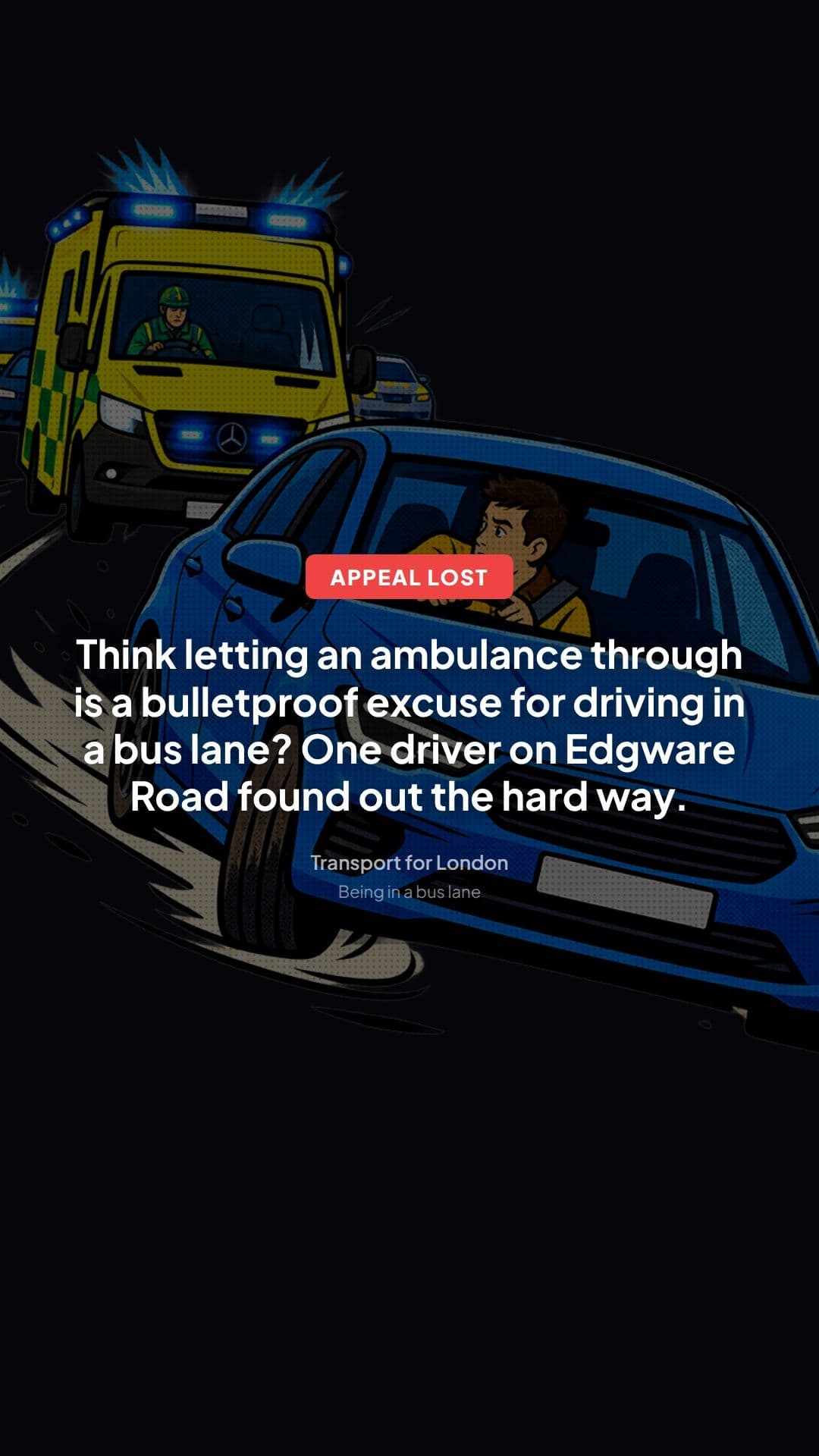
Bus Lane "Emergency Vehicle" Defence Fails: Why This Edgware Road Appeal Was Refused
Why This Case Matters
Picture the scene: you're driving along a busy London road, traffic is bumper to bumper, and you spot flashing blue lights in your mirror. Instinct kicks in. You edge into the bus lane to let the ambulance or fire engine through, thinking you're doing the right thing. Then, weeks later, a Penalty Charge Notice lands on your doormat.
This is exactly what happened to a driver on Edgware Road, and it's a scenario that could catch out any well-meaning motorist. The case is a useful reminder that good intentions do not automatically equal a valid excuse in the eyes of a parking adjudicator, and that the burden of proof in these disputes sits firmly with the driver.
The Case
Transport for London issued a Penalty Charge Notice (PCN) to a driver whose vehicle was caught on camera sitting in a bus lane on Edgware Road. There was no argument about whether the car was actually in the bus lane. TfL's photographic evidence settled that point beyond dispute.
The driver appealed, arguing that they had entered the bus lane specifically to allow an emergency vehicle to pass. It's a defence that sounds entirely reasonable on the surface, and one many of us assume would be accepted without much fuss.
The adjudicator disagreed, and refused the appeal.
The Arguments
The driver's case: the vehicle moved into the bus lane because an emergency vehicle needed to get past. This is a genuinely recognised exemption under UK traffic law. Drivers are allowed, and in some cases expected, to make way for police cars, ambulances and fire engines using blue lights and sirens, even if that means temporarily breaching a normal traffic restriction such as a bus lane.
TfL's case: the photographic evidence from the enforcement camera showed no emergency vehicle anywhere near the scene. The all-traffic lane, meanwhile, was completely full of stationary or slow-moving traffic.
The Decision
The adjudicator refused the appeal, finding as fact that a contravention had occurred and that the PCN had been properly issued.
Crucially, the reasoning didn't hinge on doubting the driver's honesty outright. Instead, it hinged on the evidence, or rather, the lack of it. The written decision noted that "no such vehicle is shown in the photographs/digital images, although there may be one some distance in front of this vehicle." In other words, even giving the driver some benefit of the doubt that an emergency vehicle might have existed somewhere up the road, that alone wasn't enough.
The adjudicator then made a telling logical point: if the ordinary traffic lane was completely full, an emergency vehicle would have had a clear, unobstructed run straight down the empty bus lane. The only thing standing in its way would have been an unauthorised car, like the appellant's, sitting in that same bus lane. In effect, the driver's own explanation undermined itself. If the story were true, the manoeuvre would have hindered the emergency vehicle rather than helped it.
The Legal Reasoning, Decoded
There's quite a lot packed into this short decision, so let's unpick it in plain English.
Bus lane contraventions are largely fact-based, not intent-based. The rule is simple: if your vehicle is in a bus lane and you're not one of the permitted or exempted vehicle types (buses, taxis, cyclists, and in defined circumstances, vehicles giving way to genuine emergencies), a contravention has occurred. The adjudicator isn't primarily interested in why you think you were justified. They're interested in whether the facts support an actual exemption applying to you, on that occasion.
Photographic and camera evidence carries significant weight. TfL enforces bus lanes largely through fixed or mobile CCTV cameras. Because the camera captures a sequence of images, it becomes the primary factual record of the event. If your account of what happened isn't reflected anywhere in that visual evidence, an adjudicator is entitled to conclude it didn't happen the way you describe, or at least that you haven't proven it did.
The burden of proof sits with the appellant. Once TfL has shown the vehicle was in the bus lane (which the photos did, without dispute), it falls to the driver to demonstrate they were exempt or permitted. Simply asserting "there was an emergency vehicle" isn't enough. There needs to be something to substantiate it, whether that's the emergency vehicle actually appearing in the footage, dashcam footage from the driver's own car, a witness statement, or some other corroborating detail.
Adjudicators apply logic to test plausibility. This case shows adjudicators don't assess evidence in isolation. They look at the whole picture and ask whether the story holds together. Here, the observation that a queuing all-traffic lane would leave the bus lane clear for a genuine emergency vehicle, meaning the appellant's presence in it would obstruct rather than assist, was a piece of common-sense reasoning that undercut the entire defence. It's a good example of how tribunals weigh not just what's presented, but whether it makes sense.
Emergency vehicle exemptions are narrow and situational. UK traffic law does allow drivers to deviate from normal restrictions to let genuine emergency vehicles through, but this exemption applies at the moment it's genuinely necessary, not as a general licence to use a bus lane whenever traffic is heavy. Adjudicators will scrutinise these claims carefully precisely because the exemption could otherwise be used as an easy excuse for any bus lane infringement.
Lessons for Drivers
1. If you genuinely move for an emergency vehicle, try to capture evidence. A dashcam is invaluable here. If you don't have one, note the time, location, and any details you can, such as the type of emergency vehicle, its direction of travel, and roughly how long you were in the bus lane. This information can support a later appeal.
2. Understand that camera enforcement gives councils a strong evidential position. TfL and other authorities rely heavily on ANPR and CCTV to prove contraventions. Assume that whatever the footage shows (or doesn't show) will heavily influence the outcome of any dispute.
3. A plausible story is not the same as a proven one. Adjudicators are required to weigh evidence, not simply accept an appellant's account at face value, however reasonable it sounds. If you're appealing on the basis of an exemption, think about what independent evidence supports your version of events.
4. Consider the practical logic of your explanation. Before submitting an appeal, it's worth asking whether your account holds up to scrutiny in the same way an adjudicator might test it. In this case, the very reasoning the driver offered contained a flaw that worked against them once examined closely.
5. Bus lane rules are enforced strictly, with limited exemptions. It's always worth checking the specific signage and times for any bus lane you're navigating, since permitted hours and vehicle types can vary between routes. Confusing or unclear signage can sometimes form the basis of a separate line of appeal, so it's worth understanding how the rules apply to your particular route.
Key Takeaway
Believing you had a good reason to enter a bus lane isn't enough on its own. If you want a genuine emergency vehicle exemption to stand up on appeal, you need something beyond your own recollection to back it up, because adjudicators will test your account against the evidence, and against common sense.
If you've received a bus lane PCN and believe there are genuine grounds for appeal, it's worth reviewing the official contravention code and evidence carefully, and seeking guidance from a consumer advice service or legal professional if the penalty is substantial or the circumstances are complex.
Written by
The Parking Ticket Pal Editorial Team
Source-checked parking guidance
Ready to Challenge Your Ticket?
Let our AI analyse your PCN and generate a professional appeal letter in minutes.
Start Free Appeal