TfL Box Junction Appeal Allowed: A Lesson for Drivers
How a driver won a TfL box junction appeal for entering and stopping in a yellow box, and the evidence motorists should use to challenge a PCN successfully.

The Parking Ticket Pal Editorial Team
7 September 2026
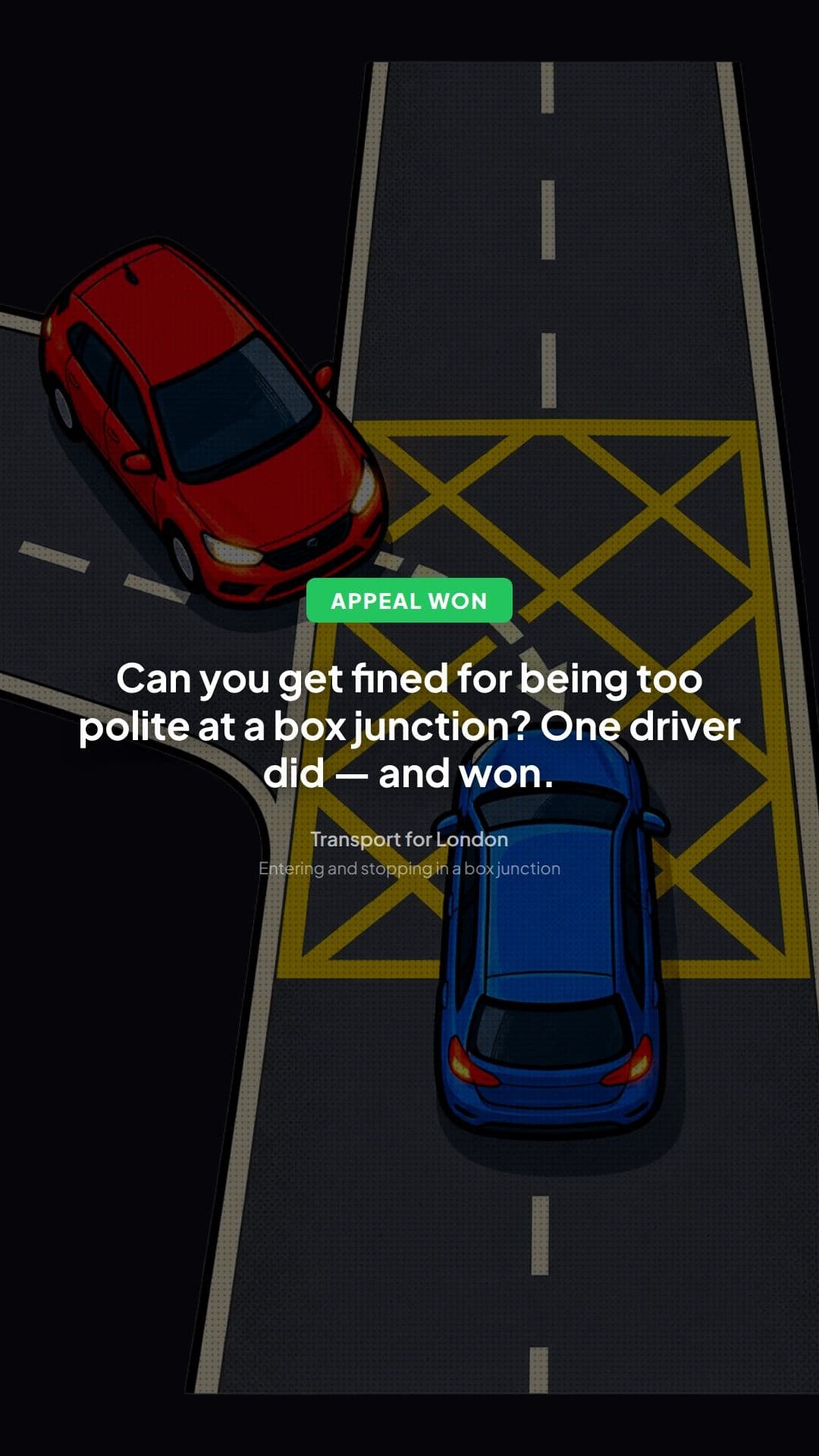
When "Giving Way" Gets You a Parking Ticket: The TfL Box Junction Case That Shows Courtesy Isn't a Crime
Why This Case Matters
Picture the scene: you're driving through a busy junction with a clear road ahead, you have right of way, but you spot someone struggling to pull out from a side road on your left. Being a decent human being, you pause to let them out, even though technically you didn't have to.
Now imagine getting a parking ticket for it.
That's exactly what happened to a driver caught by Transport for London's box junction cameras, and it raises a genuinely important question for every UK motorist: can you be penalised for stopping in a yellow box junction if you didn't need to stop, but chose to as a courtesy? This case, decided by an independent adjudicator, says no, and the reasoning behind that decision is worth understanding.
The Case: What Actually Happened
The contravention here was "entering and stopping in a box junction", one of the most commonly issued PCNs in London and a frequent source of driver frustration. Box junctions, those criss-crossed yellow grids painted at busy intersections, exist for one simple reason: to stop traffic gridlocking the junction itself. The rule is straightforward on paper. You must not enter the box unless your exit road is clear, unless you're turning right and are only prevented from doing so by oncoming traffic or other vehicles waiting to turn right.
TfL's automated cameras monitor these junctions constantly, and when a vehicle is caught entering and then stopping inside the yellow grid, a Penalty Charge Notice typically follows. Enforcement is largely mechanical, a camera captures the vehicle, an operator reviews the footage, and a ticket is issued if the vehicle appears to have breached the rule.
In this instance, the Appellant's vehicle was recorded entering the box junction and coming to a stop within it. On the face of it, this looks like a textbook contravention. But the driver challenged the ticket, and the case went to appeal, where it was represented by Mr Poster on the Appellant's behalf.
The Arguments: Two Very Different Readings of the Same Footage
TfL's position would have been the conventional one in these cases: the vehicle entered the box junction and stopped inside it. Under the strict wording of the rule, that's a contravention, full stop. The reason for stopping doesn't usually feature heavily in how these tickets are issued, because the enforcement system is designed to catch the outcome (a stationary vehicle in the box) rather than to investigate the motivation behind it.
The Appellant's case, however, hinged entirely on motivation and circumstance. The argument, put forward by Mr Poster, was that the driver hadn't stopped in the junction because he was trapped there by traffic ahead. He had right of way. His exit was clear. He stopped voluntarily, and only briefly, to allow another vehicle to emerge from a side road on his left.
This is a critical distinction. The whole point of the box junction rule is to prevent vehicles becoming stuck in the junction because the road ahead is blocked, causing gridlock for traffic flowing in other directions. If a driver stops in the box not because they're blocked, but because they've made a considerate decision to let someone else move, the purpose behind the restriction arguably isn't being undermined in the same way.
The Decision: Appeal Allowed
The adjudicator sided with the driver. Having reviewed the CCTV footage carefully, the adjudicator accepted the submission that the contravention wasn't made out. The key finding was this: the vehicle stopped in the junction not because it had to (due to a stationary vehicle or blocked exit ahead), but because the driver chose to stop, despite having right of way, in order to let another vehicle emerge from his left.
On those particular facts, the adjudicator wasn't satisfied that a contravention had been proved, and the appeal was allowed.
The Legal Reasoning, Unpacked
This decision turns on a subtle but important point of interpretation: not every vehicle stopping in a box junction is automatically committing a contravention.
The box junction rule, as set out in the Highway Code and enforced through traffic regulation, is designed to penalise drivers who enter a junction when their exit isn't clear, and then get stuck there, blocking cross-traffic. It's fundamentally about preventing the kind of gridlock where nobody can move in any direction.
What the adjudicator's reasoning highlights is that the rule isn't simply "if your wheels are inside the yellow grid and stationary, you're guilty." Context matters. If a driver's exit was genuinely clear, and they had every right and ability to proceed without stopping, but chose to pause briefly as a courtesy, that's a fundamentally different scenario to a driver who misjudged the traffic ahead and became trapped.
This doesn't mean adjudicators will always accept a "I was being polite" defence. Far from it. Many box junction appeals fail precisely because the driver genuinely did enter when the way wasn't clear, and the CCTV evidence shows exactly that. Indeed, other TfL box junction appeals have gone the opposite way when the footage told a different story. What made the difference here was the adjudicator's careful, fact-specific review of the CCTV footage, which supported the driver's account that he had right of way and stopped voluntarily, not because he was boxed in by circumstances beyond his control.
This is a good example of how adjudicators approach these cases: not as a mechanical checklist, but as a genuine assessment of what happened and why, based on the actual evidence. For anyone wanting a broader understanding of how box junction contraventions work and what typically gets challenged, it's worth exploring how box junction fines are defined and typically enforced under PCN code 31, as the specifics of wording and evidence matter enormously in these cases.
Lessons for Drivers
1. CCTV evidence can work in your favour, not just against you. Many drivers assume that camera footage of a box junction contravention is damning by default. This case shows that the same footage can, when reviewed properly, actually support a driver's account of events. If you receive one of these tickets and genuinely believe the footage doesn't show what the council claims, requesting and reviewing that footage carefully is essential.
2. Context and intent can matter in box junction cases. This wasn't a case of "any stop equals a fine." The adjudicator specifically weighed up why the vehicle stopped and whether the driver had a genuine alternative. If you find yourself in a similar situation, being able to clearly explain the sequence of events, and ideally point to what the footage shows, is far more persuasive than a vague objection.
3. Having right of way is a relevant fact, not just a courtesy point. The adjudicator noted specifically that the driver had right of way when he chose to stop. This detail was central to the reasoning. It reinforces that these cases are decided on very particular facts, not sweeping generalisations.
4. Not every box junction PCN is correctly issued, but not every appeal succeeds either. This case is a genuine win for the driver, but it's not a green light to assume all box junction tickets are unfair. Automated enforcement does catch plenty of genuine contraventions. The lesson here is about knowing when your specific circumstances might justify a challenge, not assuming every ticket is wrong.
5. Professional representation can help articulate the right argument. The Appellant in this case had representation from Mr Poster, who framed the argument precisely around intent and circumstance rather than simply disputing that the vehicle stopped. If you're facing a PCN with genuinely unusual circumstances, seeking guidance, whether from a formal adviser or through official channels such as the London Tribunals service, can help you present your case in the way that actually matters to an adjudicator.
Key Takeaway
A box junction PCN isn't automatically valid just because your vehicle was caught stationary inside the yellow grid. If you had a clear exit, had right of way, and stopped by choice rather than necessity, such as to let another road user out, that's a meaningfully different scenario in the eyes of an adjudicator than being trapped by traffic ahead. The lesson isn't that courtesy is always a legal defence, but that these cases are judged on the specific facts and footage, not a blanket rule that any stop equals a fine. If you believe your circumstances were genuinely different from the standard contravention, it's worth understanding your right to challenge the ticket through the proper appeals process rather than assuming it's a lost cause.
Written by
The Parking Ticket Pal Editorial Team
Source-checked parking guidance
Ready to Challenge Your Ticket?
Let our AI analyse your PCN and generate a professional appeal letter in minutes.
Start Free Appeal