Tesla Full Self-Driving approved in Europe — why not UK?
Tesla’s Full Self-Driving gets Dutch approval first in Europe, but not the UK. What it means for drivers, rules, liability and when it may arrive.

Tariq Khan
13 April 2026
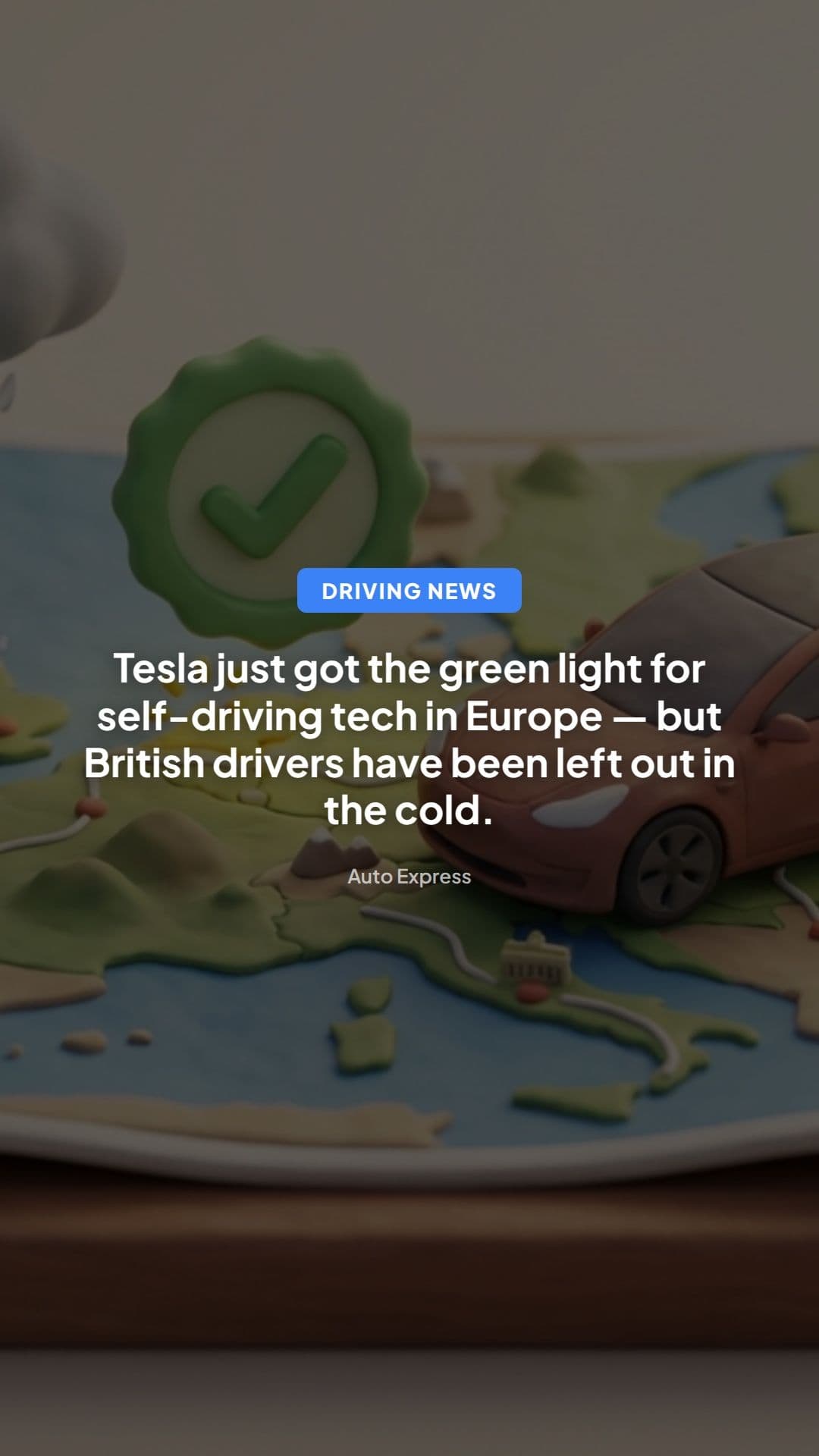
Tesla's Full Self-Driving Comes to Europe — So Why Is the UK Being Left Behind?
A milestone moment for autonomous driving has arrived on the Continent, but British drivers are watching from the sidelines. Here's what's really going on — and what it means for the road ahead.
The Netherlands has just made automotive history. As reported by Auto Express, it has become the first European country to grant regulatory approval for Tesla's Full Self-Driving (FSD) supervised autonomous system, allowing the technology to operate legally on its public roads. It's a landmark moment — one that will reverberate across boardrooms, government departments, and driving seats for years to come.
But here in the UK, the story is rather different. Despite being home to one of Europe's most enthusiastic EV markets, Britain hasn't yet approved FSD for use on its roads. And that gap — between where the Netherlands now sits and where the UK currently stands — tells us a great deal about how we regulate emerging technology, who makes the decisions, and what British drivers can realistically expect from autonomous vehicles in the near future.
What Actually Happened
Tesla's Full Self-Driving system — somewhat controversially named, given that it still requires a human driver to remain attentive and in control at all times — has been available in North America for several years. The system uses a combination of cameras, neural networks, and real-time processing to handle steering, acceleration, braking, and navigation tasks. Tesla itself describes it as a "supervised" system, meaning the driver must be ready to intervene at any moment.
The Netherlands' approval marks the first time a European regulatory body has formally sanctioned FSD for road use, a significant step that required rigorous assessment under the United Nations Economic Commission for Europe (UNECE) framework — specifically UN Regulation 157, which governs Automated Lane Keeping Systems (ALKS), and broader type-approval standards that apply across the EU.
The UK, meanwhile, has not granted equivalent approval. Post-Brexit, Britain operates its own vehicle approval regime through the Driver and Vehicle Licensing Agency (DVLA) and the Vehicle Certification Agency (VCA), meaning it must independently assess and authorise technologies of this kind — it can no longer simply adopt EU approvals automatically.
Why This Matters More Than You Might Think
On the surface, this might seem like a niche story for Tesla owners. In reality, it touches on something far bigger: the regulatory race to define who gets to deploy autonomous driving technology, when, and under what rules.
The Netherlands' decision signals that European regulators are willing to move forward with supervised autonomy — a category of driving assistance that sits meaningfully above cruise control or lane-keeping assist, but stops short of fully driverless operation. That's a significant line to cross.
For the UK, the implications are pointed. Britain spent considerable political capital after Brexit positioning itself as a global leader in autonomous vehicle development. The government's 2022 Connected and Automated Mobility (CAM) framework and the subsequent Automated Vehicles Act 2024 were both presented as evidence that the UK would lead, not follow, on this technology. The AV Act — which received Royal Assent in May 2024 — created a new legal framework specifically designed to enable self-driving vehicles on UK roads, including provisions around liability and safety standards.
So the question becomes: if the legal architecture is largely in place, why hasn't Tesla's FSD been approved here yet?
The Legal Angle: What UK Law Actually Says
The Automated Vehicles Act 2024 is the cornerstone of Britain's approach. It establishes a new category of "authorised self-driving entity" (ASDE) — the company or body responsible for a vehicle's automated behaviour — and crucially shifts liability away from the human driver when the vehicle is operating in self-driving mode. That's a profound legal change.
However, the Act also makes clear that no vehicle can operate in a self-driving capacity on UK roads without explicit authorisation from the Secretary of State for Transport, following assessment by a newly established regulatory body. That process takes time — and Tesla has not yet received that authorisation for FSD.
It's also worth noting a critical distinction. Tesla's FSD, as currently deployed, is categorised as Level 2 automation under the SAE International scale — meaning the driver must remain engaged and responsible at all times. This is the same level as many existing driver assistance systems. Under the AV Act's definitions, Level 2 systems don't technically qualify as "self-driving" and therefore don't trigger the Act's liability provisions.
What this means practically is that a Tesla driver using FSD in the UK today remains fully legally responsible for the vehicle's actions, just as they would be using adaptive cruise control. The technology isn't banned — but it also hasn't been formally approved as an autonomous system. It occupies a grey zone that neither fully protects drivers nor explicitly prohibits the technology.
What Drivers Should Know Right Now
If you own a Tesla with FSD capability, or you're considering buying one, here's what you genuinely need to understand:
- FSD is not a hands-free system in the UK. Regardless of what the software can do, you are legally required to remain in proper control of your vehicle at all times under the Road Traffic Act 1988, Section 3. Failing to do so could result in prosecution for careless or dangerous driving.
- The Highway Code still applies in full. Rule 150 of the Highway Code makes clear that drivers must not allow any in-car technology to distract them from the road. Using FSD as a substitute for attention — rather than a supplement to it — could expose you to significant legal risk if something goes wrong.
- Insurance matters enormously here. Most UK motor insurance policies are written on the assumption that a human driver is in control. If you're involved in a collision while using FSD and your insurer determines you were not exercising adequate supervision, you could find your claim challenged or refused. Check your policy wording carefully.
- Don't assume European approval means UK approval. Post-Brexit, these are entirely separate regulatory processes. The Netherlands' green light carries no legal weight on British roads.
- Keep software updates documented. Tesla pushes FSD updates over the air. If your system's behaviour changes significantly between updates and you're involved in an incident, having a record of which software version was active could be relevant to any legal proceedings.
Looking Ahead: What This Means for British Drivers
The Netherlands' approval will almost certainly accelerate pressure on the UK government to move faster. There's a genuine economic argument here: if European drivers can access supervised autonomous technology and British drivers cannot, it creates a competitive disadvantage for the UK's automotive sector and a frustrating gap for consumers.
The Department for Transport has signalled that it expects the first formally authorised self-driving vehicles to appear on UK roads in the coming years — with motorway driving cited as the most likely early use case. Several manufacturers beyond Tesla are also working through the approvals process, including those developing automated motorway systems for commercial vehicles.
But the pace of regulatory approval will likely remain cautious, and rightly so. The AV Act's framework demands rigorous safety evidence before any system is authorised, and the consequences of getting it wrong — legally, politically, and in terms of public trust — are severe.
What the Netherlands has shown is that it can be done. The regulatory pathway exists. The question for the UK is whether it moves with the urgency its post-Brexit ambitions demand, or whether bureaucratic caution sees Britain watching yet another European first from a distance.
For now, British Tesla owners have a sophisticated piece of technology in their cars that they can use — carefully, attentively, and with full legal responsibility squarely on their shoulders. The future of autonomous driving is arriving. It's just taking the scenic route to get here.
Source: Auto Express — "Tesla's Full Self-Driving tech finally approved for Europe, but not the UK"
Written by
Tariq Khan
Bailiff Procedures Expert
Ready to Challenge Your Ticket?
Let our AI analyse your PCN and generate a professional appeal letter in minutes.
Start Free Appeal