Telegraph pole collapse injures woman in station car park
A woman was seriously injured after a telegraph pole fell in Pontyclun railway station car park. What happened, safety duties, and liability questions.

Amara Okafor
19 June 2026
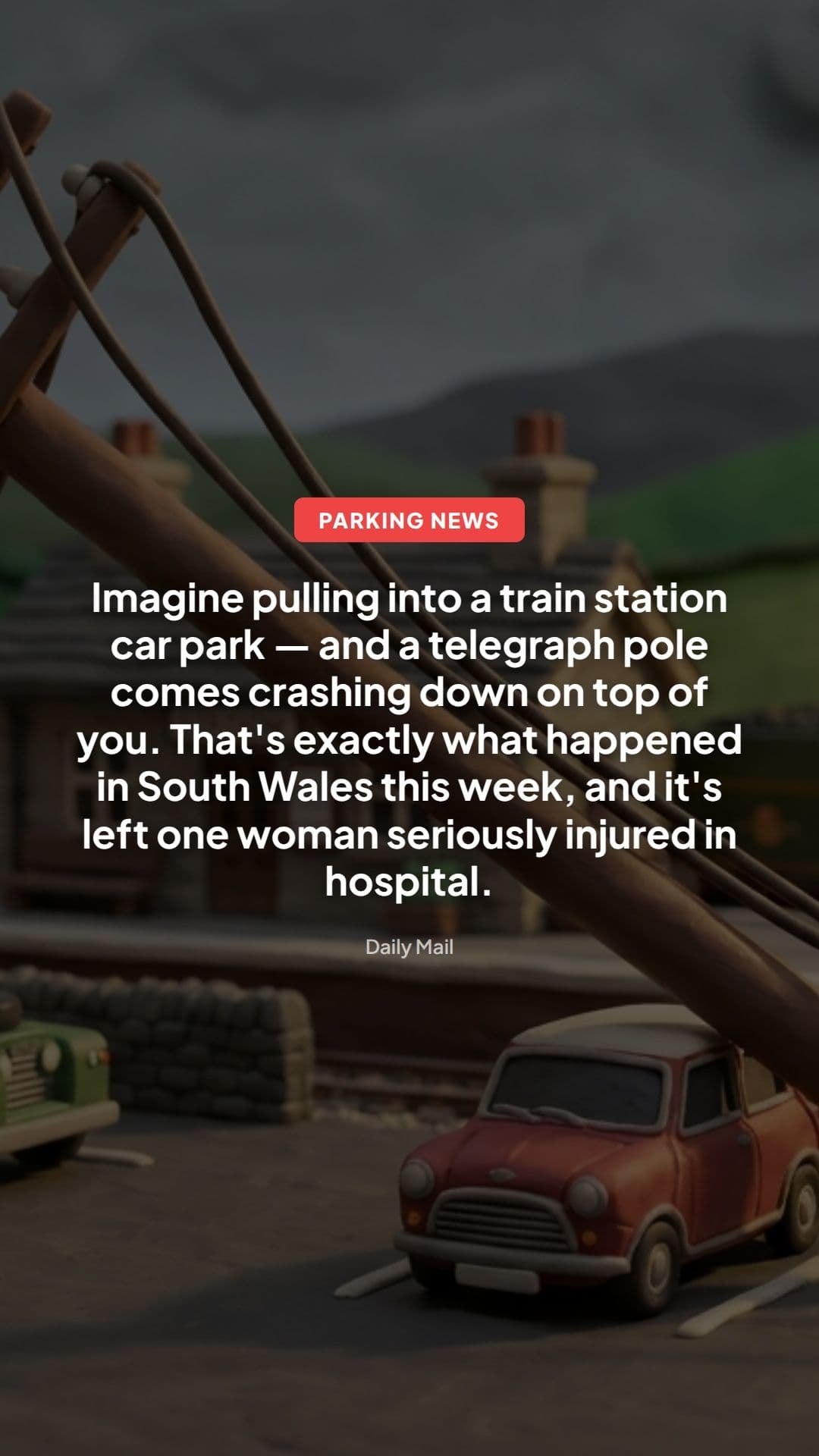
When Car Parks Become Danger Zones: The Telegraph Pole Collapse That Raises Serious Questions About Duty of Care
A woman is fighting for her life after a telegraph pole fell on her in a railway station car park. But beyond the tragedy itself lies a web of legal responsibility, infrastructure neglect, and questions every driver should be asking about the places they park.
What Happened at Pontyclun Station
On a seemingly ordinary day at Pontyclun railway station in South Wales, a routine visit to the car park turned catastrophic. A telegraph pole collapsed without warning and struck a woman, leaving her with serious injuries serious enough to require the attendance of an air ambulance alongside ground-based emergency services.
The scene that greeted paramedics was one no driver or commuter should ever encounter. Emergency responders worked quickly, and the woman was airlifted to hospital, where she remained seriously injured. The car park — the kind of unremarkable, everyday space that millions of Britons use without a second thought each morning — had become the site of a life-threatening incident.
Pontyclun is a small commuter village in Rhondda Cynon Taf, and its railway station serves passengers travelling into Cardiff and beyond. Like countless station car parks across the UK, it is a functional, often unglamorous space: tarmac, white lines, a pay machine, and the kind of infrastructure that blends into the background. Until, that is, something goes catastrophically wrong.
Why This Matters Far Beyond One Car Park
At first glance, this might read as an isolated tragedy — a freak accident in an obscure Welsh village. But that interpretation misses the deeper significance of what happened at Pontyclun.
Telegraph poles are a ubiquitous feature of the British landscape. There are estimated to be around three million wooden utility poles across the UK, many of which are decades old. These structures carry telephone lines, broadband cables, and in some cases electrical infrastructure. They stand in fields, along roadsides, in residential streets — and yes, in car parks.
The problem is that wooden poles rot. They deteriorate from the base upward, often invisibly. A pole can appear structurally sound from the outside while being dangerously compromised internally. Industry guidance from Openreach and other network operators acknowledges that poles have a typical service life of around 40 years, but many in service across the UK are considerably older than that.
What makes this incident particularly troubling is the setting. A railway station car park is not a remote field or a country lane — it is a managed, commercial space where members of the public are actively invited. People pay to park there. They walk to and from their vehicles. Children accompany parents. The footfall is predictable, regular, and often dense during peak commuting hours.
The question that must now be asked is straightforward: who was responsible for ensuring that pole was safe, and did they fulfil that responsibility?
The Legal Framework: Who Carries the Can?
This is where things become legally complex — and potentially significant for the woman involved and her family.
Occupiers' Liability Act 1957
The most directly relevant piece of legislation here is the Occupiers' Liability Act 1957, which imposes a "common duty of care" on occupiers of premises towards their lawful visitors. A car park user paying to leave their vehicle is unambiguously a lawful visitor. The occupier — whether that is Transport for Wales, Network Rail, a private car park operator, or a local authority — has a legal obligation to take reasonable steps to ensure that the premises are safe.
Crucially, this duty is not passive. It is not enough to say "nothing had gone wrong before." The Act requires that the occupier takes active steps to identify and address hazards. A rotting or structurally compromised telegraph pole in a public car park is precisely the kind of hazard that a reasonable inspection regime should identify.
The Highways Act 1980 and Infrastructure Ownership
Responsibility for telegraph poles is not always straightforward. Poles may be owned and maintained by Openreach (part of BT Group), Virgin Media O2, or other telecoms operators, depending on the network they support. In some cases, older poles may carry equipment from multiple operators under shared access arrangements.
Under the Communications Act 2003 and associated regulations, telecoms operators with apparatus on public or private land have obligations regarding the maintenance of that apparatus. If a pole owned by a telecoms company collapses and injures a member of the public, liability could potentially attach to that operator rather than — or in addition to — the car park owner.
This creates a potential situation where multiple parties point at one another. The car park operator may argue the pole was the telecoms company's responsibility. The telecoms company may argue the car park operator should have flagged concerns. In practice, personal injury litigation in cases like this often names multiple defendants and lets the courts apportion liability.
Health and Safety at Work etc. Act 1974
Where the car park is operated commercially, the Health and Safety at Work etc. Act 1974 is also relevant. Employers and those who control workplaces — including spaces to which the public has access — have duties to ensure, so far as reasonably practicable, that persons not in their employment are not exposed to risks to their health and safety. A collapsing telegraph pole in a public car park is a clear breach of that principle if it can be shown that the risk was foreseeable and not adequately managed.
The Health and Safety Executive (HSE) may well investigate this incident. Where serious injury results from a foreseeable structural failure, enforcement action — including prosecution — is possible.
What Drivers Should Know: Practical Takeaways
Most of us walk through car parks without giving a moment's thought to overhead or adjacent structures. This incident is a reminder that the environment around your vehicle matters, not just the painted lines and payment machines.
Here is what drivers can do to protect themselves — and what to know if something goes wrong:
- Look up as well as around. When parking near telegraph poles, trees, lighting columns, or other vertical structures, take a moment to assess their condition. Visible rot at the base, leaning, or cracked concrete are warning signs worth heeding.
- Report concerns immediately. If you notice a telegraph pole that appears damaged, leaning, or rotten in a car park or public space, report it. For Openreach poles, you can report faults via their website. For Network Rail property, use their public safety reporting line. For council-managed car parks, contact the local authority directly.
- Document everything if you are involved in an incident. If you or your vehicle are damaged by a structural failure in a car park, photograph the scene extensively before anything is moved. Note the time, date, and location precisely. Obtain witness details. This evidence will be critical in any subsequent claim.
- Understand your rights as a paying customer. If you have paid to park — whether via a ticket machine, an app, or a season ticket — you have entered into a contract with the car park operator. That contract carries implied terms about the safety of the premises under both contract law and the Consumer Rights Act 2015. A car park operator cannot simply disclaim responsibility for structural hazards through small print on a ticket.
- Personal injury claims have a time limit. Under the Limitation Act 1980, personal injury claims must generally be brought within three years of the date of the incident or the date of knowledge of injury. If you are injured in a car park through no fault of your own, seek legal advice promptly.
Looking Ahead: Infrastructure, Accountability, and the Car Parks We Take for Granted
The Pontyclun incident should prompt a broader conversation about the state of infrastructure in and around UK car parks — particularly those associated with railway stations, which often sit at the intersection of multiple organisations' responsibilities.
Railway station car parks occupy a peculiar administrative grey zone. Network Rail owns much of the rail estate. Train operating companies — or, increasingly, publicly managed operators like Transport for Wales — may run the station. Car parks may be operated by third-party contractors. Telecoms infrastructure may be owned by yet another entity entirely. When something goes wrong, this fragmentation of responsibility can make accountability genuinely difficult to establish.
There is also a wider question about ageing infrastructure. The UK's telegraph pole network is old, and investment in replacement has not always kept pace with deterioration. As more above-ground infrastructure is installed — from EV charging equipment to 5G small cells, many of which are being attached to existing poles — the load and scrutiny on these structures is increasing without a corresponding increase in inspection frequency.
For commuters and drivers, the lesson is uncomfortable but important: the spaces we use every day are not automatically safe simply because we use them every day. The mundane familiarity of a station car park can mask real and serious hazards. Operators and infrastructure owners have legal duties of care, but those duties are only meaningful if they are actively discharged — through regular inspection, prompt maintenance, and genuine accountability when things go wrong.
The woman injured at Pontyclun deserves a full recovery. She also deserves answers. And so does every driver who parks their car and walks away assuming the ground beneath their feet — and the structures around them — are safe.
Sources: Daily Mail; Occupiers' Liability Act 1957; Health and Safety at Work etc. Act 1974; Communications Act 2003; Limitation Act 1980; Openreach pole maintenance guidance.
Written by
Amara Okafor
Council Liaison Officer
Ready to Challenge Your Ticket?
Let our AI analyse your PCN and generate a professional appeal letter in minutes.
Start Free Appeal