Swindon council warden sacked after 50 PCNs overturned
Swindon Borough Council dismissed a parking warden after 50 disputed PCNs in a residents’ parking blitz. Refunds issued and body cameras rolled out.

Hannah MacLeod
14 May 2026
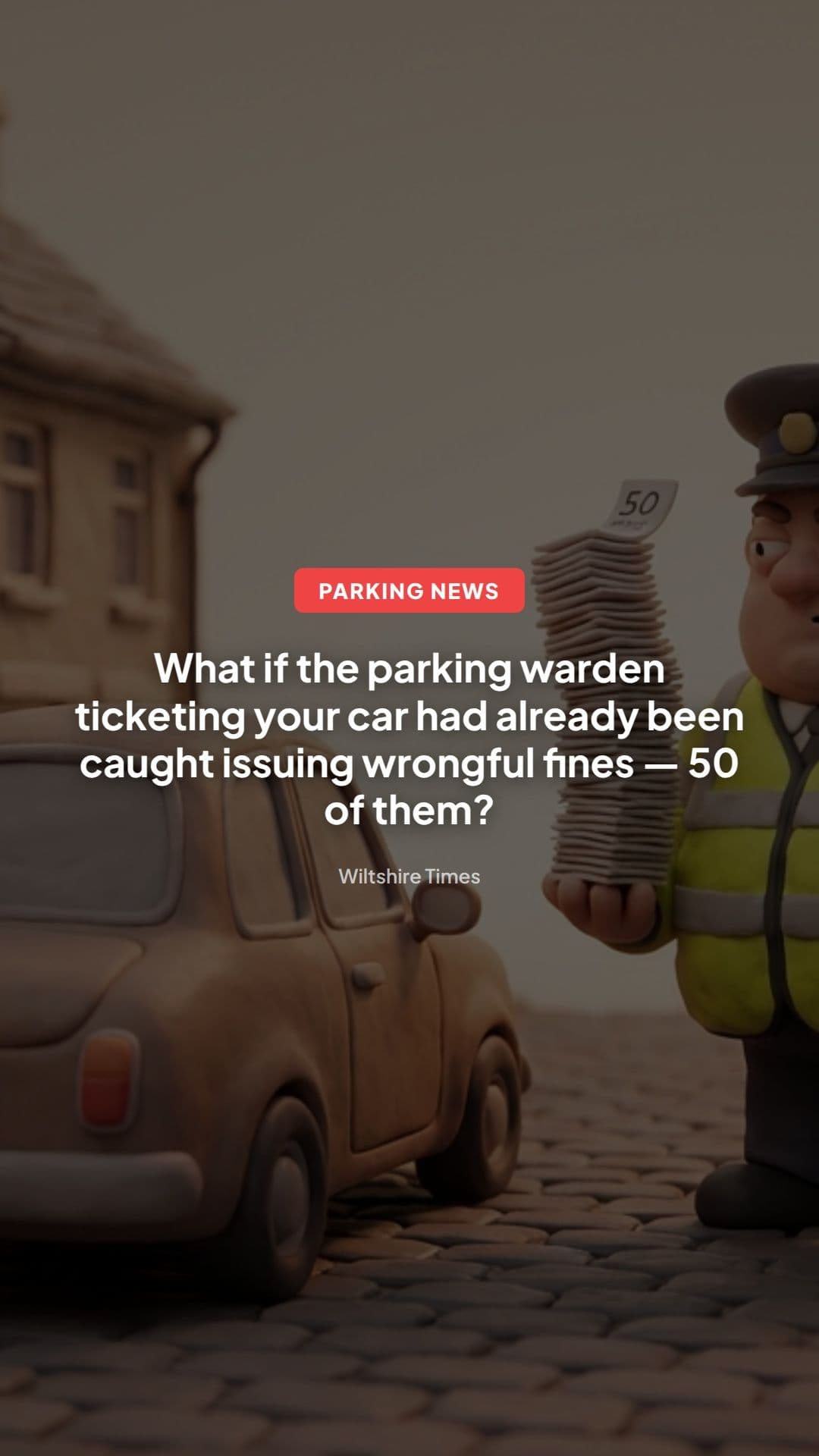
Swindon Parking Warden Sacked Over 50 Wrongful Tickets: What It Really Tells Us About Parking Enforcement in Britain
A dismissed council warden, 50 disputed fines, and a rush to install body cameras — the story from Swindon is more than a local scandal. It's a window into the systemic pressures driving wrongful parking enforcement across the UK.
The Story That Should Make Every Driver Sit Up
Imagine returning to your car to find a parking ticket tucked under your wiper. You're certain you haven't broken any rules, but the ticket says otherwise. You pay up — because fighting it feels complicated, time-consuming, and frankly a bit intimidating. Now multiply that experience by fifty, and you have the situation that recently unfolded in Swindon.
According to reporting by the Wiltshire Times, a parking warden employed by Swindon Borough Council was dismissed following an internal investigation into 50 disputed Penalty Charge Notices (PCNs) issued during what was described as a residents' parking enforcement blitz. The council subsequently refunded affected motorists and announced the introduction of body-worn cameras for its enforcement officers. On the surface, it looks like the system worked — rogue warden caught, victims compensated, lesson learned. But dig a little deeper and the story raises some deeply uncomfortable questions about how parking enforcement operates in this country.
What Happened in Swindon
The dismissed warden was operating during a targeted clampdown on residents' parking zones — the kind of enforcement drive that councils periodically launch to address complaints from permit holders about non-residents clogging up their bays.
These blitzes are legitimate in principle. Residents' parking schemes exist precisely to protect local people from commuters and visitors monopolising spaces, and enforcement is necessary to make them work. The problem in this case, however, appears to have been the quality — or rather the accuracy — of that enforcement.
Fifty tickets were disputed. Fifty. That's not a rounding error or a handful of edge cases. That's a pattern. The internal probe found sufficient grounds not just to uphold the appeals, but to dismiss the officer responsible and issue blanket refunds. The council's decision to introduce body cameras in the wake of the investigation strongly implies that a lack of contemporaneous evidence was part of the problem — and perhaps part of what allowed the wrongful ticketing to continue unchecked for as long as it did.
The council deserves some credit for acting decisively once the issue came to light. Refunds are not always forthcoming even when appeals succeed, and dismissal signals that this was treated as a serious disciplinary matter rather than a minor administrative hiccup. But the more pressing question is: how did it get this far in the first place?
Why This Matters Beyond Swindon
This isn't simply a Wiltshire story. It reflects broader tensions running through parking enforcement across England and Wales.
Since the Traffic Management Act 2004 transferred the bulk of on-street parking enforcement from the police to local authorities — a process known as Civil Parking Enforcement (CPE) — councils have had both the power and, crucially, the financial incentive to issue PCNs. While the legislation explicitly states that enforcement should not be operated as a revenue-raising exercise, the reality is that parking income contributes meaningfully to council budgets at a time of severe financial pressure.
That pressure filters down. Enforcement officers are often working to targets — whether formal or informal — and in some councils, performance metrics can create an environment where issuing tickets is prioritised over issuing them correctly. The Department for Transport's own guidance under the Traffic Management Act is clear that enforcement must be proportionate and evidence-based, but oversight of individual officers in the field is inherently difficult without tools like body cameras.
It's also worth noting that the majority of people who receive a wrongful PCN simply pay it. The 50% discount for early payment — a feature of the PCN system designed to encourage swift resolution of genuine contraventions — acts as a powerful deterrent to challenging a ticket, even when the driver has a strong case. Many motorists calculate that the time and effort of an appeal isn't worth it for a £35 or £50 discounted penalty. That calculation, repeated thousands of times across the country, means that wrongful tickets frequently go unchallenged and unpunished.
The Legal Angle: Your Rights When a Ticket Is Wrong
Under the Traffic Management Act 2004 and the associated Civil Enforcement of Parking Contraventions (England) General Regulations 2007, motorists have a clearly defined right to challenge a PCN through a two-stage process:
- Informal representation — made within 14 days of the PCN being issued (or 28 days if a Notice to Owner has been served). If successful, the PCN is cancelled. If rejected, the council must issue a formal Notice to Owner.
- Formal representation — made in response to the Notice to Owner. If this is also rejected, the council must issue a Notice of Rejection, which gives the motorist the right to appeal to an independent adjudicator — the Traffic Penalty Tribunal (for councils outside London) or London Tribunals (for TfL and London boroughs).
The independent adjudicator stage is crucial. These tribunals are genuinely independent of local authorities, and adjudicators are legally trained. Councils lose a significant proportion of cases that reach this stage — a fact that ought to concentrate minds during the earlier stages of the process.
In the Swindon case, the fact that 50 tickets were disputed and subsequently refunded suggests that the evidence base for those PCNs was simply insufficient to withstand scrutiny. Under the regulations, the burden of proof lies with the enforcing authority — the council must demonstrate that a contravention occurred. If an officer cannot produce adequate photographic evidence, contemporaneous notes, or other documentation, the PCN should not stand.
The introduction of body cameras is a direct response to this evidential gap. Many councils across England already require their enforcement officers to wear them, and the footage can work both ways — protecting officers from false accusations whilst also ensuring that the evidence base for any ticket is robust and reviewable.
What Drivers Should Know: Practical Takeaways
If there's one thing the Swindon case illustrates, it's that wrongful tickets happen, and challenging them is worth it. Here's what every driver should bear in mind:
- Always photograph the scene. If you believe a ticket has been issued incorrectly, take photos of your vehicle's position, any relevant signs, your permit or pay-and-display receipt, and any markings on the road. Time-stamped photos are particularly valuable.
- Act quickly but don't panic. You have 28 days from the date of the PCN to make an informal representation. Missing this window doesn't end your options, but it may affect the discount available.
- Request the council's evidence. When making a formal representation, you are entitled to see the evidence the council holds — including any photographic evidence taken by the enforcement officer. If that evidence is thin, say so explicitly in your appeal.
- Don't assume paying is easier. The discounted early payment rate is designed to look attractive. But if you genuinely believe the ticket is wrong, paying is an admission of liability. It also funds a system that — as Swindon demonstrates — is not always operating correctly.
- Escalate if necessary. If your formal representation is rejected and you still believe the ticket is wrong, take it to the independent adjudicator. The process is free, can be done online, and councils do lose cases. An adjudicator can cancel a PCN entirely.
- Keep records of everything. Dates, correspondence, evidence submitted — if a case escalates, a clear paper trail is invaluable.
Looking Ahead: Body Cameras, Accountability, and What Needs to Change
Swindon's decision to equip wardens with body cameras is welcome, but it shouldn't take a scandal to prompt it. Body cameras should be standard issue for civil enforcement officers, full stop. They protect honest officers from vexatious complaints, they provide a reliable evidence base for legitimate tickets, and — critically — they act as a deterrent against the kind of behaviour alleged in this case.
There is also a broader conversation to be had about accountability and oversight in parking enforcement. The internal probe that uncovered the wrongdoing in Swindon was, by definition, internal. Councils investigating themselves is not a robust safeguard. The Traffic Penalty Tribunal system provides some external check on the quality of enforcement decisions, but only for the minority of motorists who appeal.
Some campaigners and motoring organisations have long argued for a more systematic approach: regular auditing of enforcement officers' ticketing records, anonymised reporting of appeal outcomes at officer level, and clearer whistleblowing protections for colleagues who observe malpractice. None of these are radical ideas. They are simply the kind of quality controls you would expect in any public-facing enforcement role.
The Swindon case is, in one sense, a success story — a bad actor identified, victims compensated, processes improved. But fifty wrongful tickets represent fifty people who had to fight for their money back, or who simply paid up and absorbed the loss. The real measure of progress won't be the sacking of one warden. It will be whether councils across the country use this as a prompt to ask themselves: could this happen here?
Source: Wiltshire Times — "Swindon parking warden sacked after 50 wrongful tickets in clampdown probe"
Written by
Hannah MacLeod
Traffic Law Specialist
Ready to Challenge Your Ticket?
Let our AI analyse your PCN and generate a professional appeal letter in minutes.
Start Free Appeal