Stansted Airport drop-off fees hit £28: what drivers can do
Stansted Airport’s drop-off fee has jumped to up to £28 for 30 minutes. We explain the new charges, alternatives, and what UK drivers should check before paying.

Grace O'Sullivan
27 March 2026
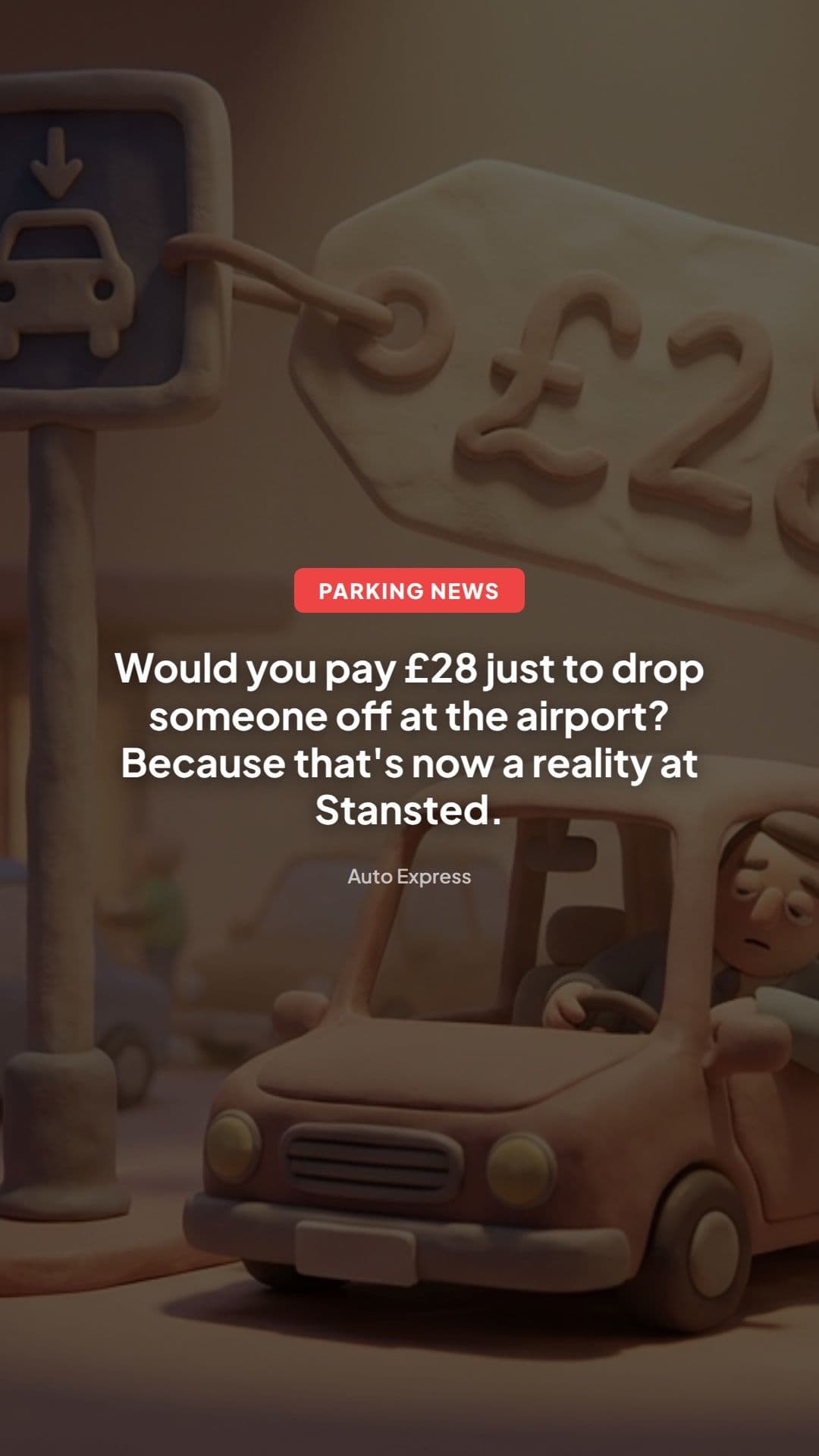
Stansted's £28 Drop-Off Fee: Sustainability Spin or Straightforward Cash Grab?
There's a particular kind of frustration that comes from being charged a premium for something you used to do for free — or at least cheaply. Ask anyone who's recently pulled up outside a major UK airport to wave off a family member, and they'll tell you the experience has become less about the goodbye and more about the clock ticking, the wallet thinning, and the nagging sense that someone, somewhere, is laughing all the way to the bank.
Stansted Airport's latest pricing update has crystallised that frustration perfectly. A 15-minute drop-off now costs around £10. Fancy lingering for half an hour? That'll be up to £28, thank you very much. And the justification offered? Sustainability.
Let's unpack that.
What's Actually Happening at Stansted?
Manchester Airports Group (MAG), which operates London Stansted, has significantly increased its short-stay drop-off charges at the airport's designated set-down areas. As reported by Auto Express, drivers stopping for up to 15 minutes are now facing charges of approximately £10, while a 30-minute stop can cost as much as £28.
These aren't fines. They're not penalties for doing something wrong. They are the published, upfront tariffs for using the airport's official drop-off facilities — the very infrastructure that exists specifically to allow passengers to arrive at the terminal.
The airport has framed these charges as part of its commitment to sustainability and traffic management, suggesting that pricing pressure will encourage people to use public transport instead of being driven to the airport by friends or family. It's a line that sounds reasonable in a press release. In practice, it's considerably more complicated.
Why This Matters Well Beyond Stansted
Stansted is far from alone in pursuing this approach. Heathrow, Gatwick, Birmingham, Manchester, and Edinburgh airports have all introduced or substantially increased drop-off fees in recent years. What makes Stansted's current pricing particularly striking is the sheer scale of the charge for what is, in practical terms, a very brief stop.
To put £28 into context: that's more than the average cost of a full tank of petrol for a small car. It's more than many rail fares to the airport itself. And it's being charged for thirty minutes of standing still in a car park.
The sustainability argument deserves scrutiny. Airports are major generators of surface transport emissions, and encouraging modal shift away from private cars is a legitimate policy goal. But there's a meaningful difference between genuinely incentivising greener travel and simply monetising a captive audience.
If sustainability were truly the primary driver, you'd expect to see the revenue ring-fenced and directed towards public transport improvements, shuttle services, or carbon offset programmes. Airports are not legally required to do this, and there is little public transparency about where drop-off fee revenue actually goes. When sustainability becomes a brand story rather than a binding commitment, scepticism is warranted.
There's also a social equity dimension that rarely gets discussed. Not every passenger has the option to take a train. Rural travellers, those with disabilities, passengers travelling with young children and significant luggage, and people flying at unsociable hours when public transport is unavailable or infrequent — these are the people for whom being dropped off by car isn't a lifestyle choice. It's a necessity. Blanket pricing that doesn't account for circumstances hits the most vulnerable travellers hardest.
The Legal Angle: What Rights Do Drivers Actually Have?
This is where things get interesting — and where many drivers are surprised to discover how limited their formal protections are in this context.
Airport drop-off zones are private land. Unlike parking on a public highway, where enforcement is governed by the Road Traffic Act 1991, the Traffic Management Act 2004, and associated regulations, airport forecourts and drop-off facilities operate under private contract law. The airport sets the terms; you either accept them or go elsewhere.
Under the Consumer Rights Act 2015, terms must be transparent and not unfair. However, courts have consistently interpreted "unfair" in a commercial context quite narrowly. A high price is not, in itself, an unfair term — provided it is clearly displayed before the contract is formed (i.e., before you drive in). Provided the signage at Stansted meets the requirements of the British Parking Association (BPA) Code of Practice or the International Parking Community (IPC) Code of Practice, the charges are likely to be legally enforceable.
The Parking (Code of Practice) Act 2019 established a framework for a single statutory code of practice for private parking operators in England, Scotland, and Wales. However, this legislation was primarily designed to address predatory enforcement practices — excessive fines, aggressive debt collection — rather than to cap the headline tariffs that airports can charge. In short, Parliament has given drivers meaningful protection against unfair penalties, but relatively little protection against high prices.
One area worth watching is the Competition and Markets Authority (CMA). The CMA has previously scrutinised airport car parking charges and has the power to investigate markets where it believes consumers are being treated unfairly. Whether drop-off fees at this level attract regulatory attention remains to be seen, but the precedent exists.
What Drivers Should Know: Practical Advice
If you're travelling through Stansted — or any major UK airport — in the coming months, here's how to navigate the new reality without paying more than you need to:
- Use the free pick-up and drop-off points. Many airports, including Stansted, maintain free or lower-cost zones away from the main terminal. These typically require a short walk, but they are a legitimate and legal alternative. Check the airport's website before you travel.
- Time your drop-off precisely. If you do use the official zone, know exactly how long you have. Overstaying even slightly can push you into a higher pricing band. Set a timer the moment you enter.
- Consider the rail option seriously. Stansted Express runs a direct service from London Liverpool Street with a journey time of around 47 minutes. For passengers travelling from the right direction, it's genuinely competitive on both time and cost — especially now that the alternative involves a £28 drop-off fee.
- Pre-book where possible. If you must park, pre-booked parking is almost always cheaper than turning up on the day. The same principle applies to some short-stay facilities — check whether pre-booking the drop-off zone offers a reduced rate.
- Don't stop on the public highway. It might be tempting to pull up on the road outside the airport boundary to avoid charges. Be aware that this is likely to attract enforcement — either from the local authority or from traffic officers — and could result in a Penalty Charge Notice or worse. The airport approach roads are heavily monitored.
- If you receive a charge you believe is wrong, challenge it. If you're issued a charge that you believe was incorrectly applied — wrong vehicle, wrong time, faulty signage — you have the right to appeal through the operator's internal process and, if unsuccessful, through the independent appeals service (POPLA for BPA members, or the IAS for IPC members).
Looking Ahead: A Trend That's Only Going One Way
The honest truth is that airport drop-off fees are not going to get cheaper. The economics are too attractive, the legal framework too permissive, and the political will to intervene too limited for the trajectory to reverse without significant external pressure.
What could change things? A few possibilities:
Regulatory intervention is the most obvious lever. If the CMA were to determine that airport drop-off pricing constitutes an abuse of market dominance — airports are, after all, natural monopolies in their catchment areas — it could impose pricing controls. That's a significant step, but not an inconceivable one given the direction of travel in consumer regulation.
Political pressure may also play a role. Airport charges are a perennial topic for MPs with large constituencies near major airports. As fees escalate, the likelihood of parliamentary questions, select committee scrutiny, and eventually legislative action increases.
Consumer behaviour will ultimately be the most powerful force. If enough passengers shift to rail, coach, and other public transport options — whether out of environmental conviction or simple cost avoidance — the revenue model for drop-off fees becomes less compelling. Airports need passengers to arrive; if the drop-off experience becomes punitive enough, the feedback loop will eventually register.
In the meantime, the £28 drop-off fee at Stansted stands as a vivid illustration of a broader truth about modern travel in the UK: the headline ticket price is rarely the whole story, and the costs that accumulate around the edges of a journey can be just as significant as the fare itself. Calling it sustainability doesn't change what it is. Drivers deserve to know exactly what they're paying for — and why.
Written by
Grace O'Sullivan
Municipal Enforcement Expert
Ready to Challenge Your Ticket?
Let our AI analyse your PCN and generate a professional appeal letter in minutes.
Start Free Appeal