Southwark Route Restriction PCN Appeal Refused: Lesson
London Borough of Southwark route restriction PCN appeal refused. Learn what evidence wins at tribunal, common mistakes and how to avoid this contravention.

Yuki Tanaka
6 July 2026
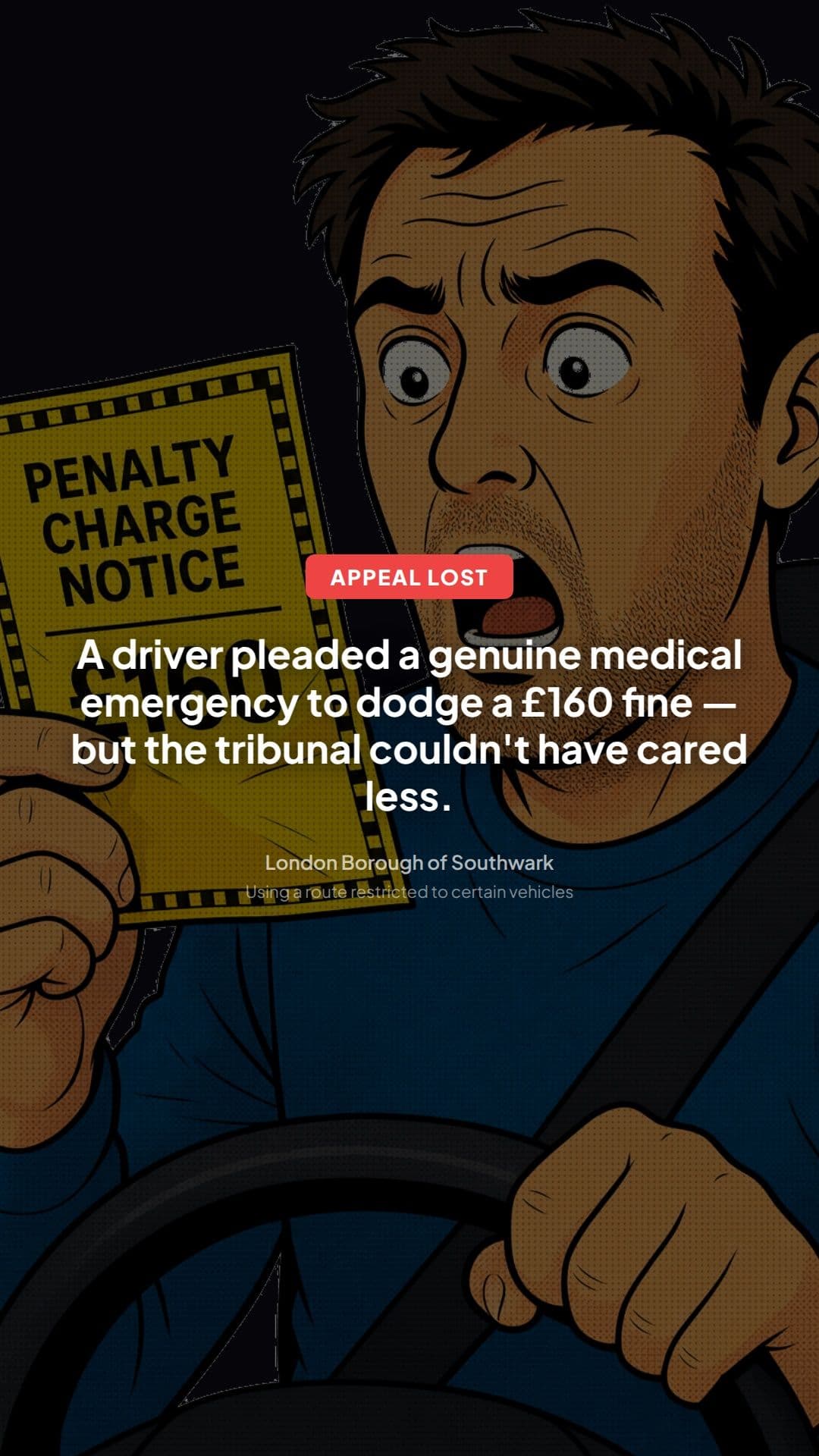
When Nature Calls at the Wrong Moment: The Southwark IBS Parking Case That Every Driver Should Read
A Story That Will Make You Wince — For More Than One Reason
Picture this: you're stuck in morning traffic, your stomach is cramping, and you have a medical condition that means when you need a toilet, you really need one. In desperation, you turn down a restricted road to reach the nearest public facilities. You get a Penalty Charge Notice. You appeal, explaining everything honestly. And you lose.
That is exactly what happened to Ms Courtenay in a recent appeal heard by the London Borough of Southwark. Her case is not just a cautionary tale about bus gates and restricted routes — it is a window into one of the most misunderstood aspects of UK parking law: the hard boundary between a legal defence and a sympathetic excuse. The two are not the same thing, and the difference can cost you £130.
The Case: A Restricted Route, a Medical Condition, and a Missing Driver
The contravention in question was "using a route restricted to certain vehicles" — one of those contraventions that catches thousands of drivers every year, usually via an automatic camera mounted at the entrance to a bus gate or restricted zone.
In Southwark's case, the road in question was restricted to buses, cycles, and taxis only, Monday to Friday, between 8–9am and 3–4.30pm. Ms Courtenay drove through it during one of those restricted periods.
She did not dispute that she had seen the signs. She knew she was entering a restricted route. Her argument was not that the signs were unclear or that she had made an innocent mistake — it was that she had a compelling reason to do what she did.
Ms Courtenay explained that she has irritable bowel syndrome (IBS), a chronic condition that can cause sudden, urgent and severe stomach cramps. On the day in question, she had been stuck in traffic for some time. The cramps had become acute. She needed a toilet urgently, and she used the restricted route to reach facilities more quickly.
She described it, plainly and honestly, as an emergency.
The council, represented by Ms Chan, attended the online hearing. Ms Courtenay did not — the adjudicator therefore heard the case in her absence, based on her written submissions. The council's position was straightforward: it wanted to enforce the Penalty Charge Notice, and it noted that a park with public toilets was available from Gallery Road, the road Ms Courtenay had been travelling along before she turned onto the restricted route.
The Arguments: Genuine Distress Versus Legal Jurisdiction
What Ms Courtenay argued:
- She was suffering a genuine medical emergency caused by her IBS
- She had been stuck in traffic, making the situation worse
- She used the restricted route out of urgent necessity, not convenience or disregard for the rules
- The circumstances amounted to an emergency that justified her actions
What the council argued:
- The Penalty Charge Notice was validly issued
- Ms Courtenay drove past signs she acknowledged seeing and understanding
- Public toilet facilities were accessible from Gallery Road, the road she had been on immediately beforehand
- The PCN should be enforced
The Decision: Appeal Refused
The adjudicator refused the appeal. The reasoning was brief but legally precise: the reasons Ms Courtenay gave do not provide her with a ground of appeal. Furthermore, the adjudicator stated that they had no jurisdiction to take into account the mitigating circumstances raised.
Ms Courtenay lost her appeal, and the PCN stands.
The Legal Reasoning: Why "It Was an Emergency" Is Not a Legal Defence
This is the part that surprises most people, and it is worth taking the time to understand it properly.
Grounds of appeal are fixed by law
When you appeal a Penalty Charge Notice issued by a local authority in England and Wales, the grounds on which you can appeal are set out in statute — specifically in the Traffic Management Act 2004 and the associated regulations. They include things like:
- The contravention did not occur
- The PCN was not properly served
- The vehicle had been taken without your consent
- You were not the owner of the vehicle at the time
- There are procedural errors in how the PCN was issued
What the law does not include as a formal ground of appeal is: "I had a very good reason for doing what I did."
The distinction between a defence and mitigation
In legal terms, there is a crucial difference between a defence (a reason why the contravention did not technically occur, or why the PCN is invalid) and mitigation (a reason why, even though the contravention did occur, the circumstances deserve sympathy).
Ms Courtenay was not arguing that she hadn't driven down the restricted road. She wasn't arguing the signs were wrong, or that the PCN was served incorrectly. She was offering mitigation — an explanation for why she did what she did. And parking adjudicators, operating within the statutory framework, simply do not have the power to cancel a valid PCN on the basis of mitigation alone.
This is not a matter of the adjudicator being heartless. It is a matter of jurisdiction. The adjudicator said it clearly: "I have no jurisdiction to take into account the mitigating circumstances raised." They are bound by the law as it stands.
The council's counter-argument carries weight
The council's observation that public toilets were available from Gallery Road — the very road Ms Courtenay had been travelling on — is significant. It suggests that the restricted route was not, in fact, the only option available to her. Had she been able to demonstrate that no alternative existed whatsoever, it might have supported an argument of genuine necessity, though even then, parking law offers very limited scope for such arguments.
What about emergency vehicle exemptions?
It is worth noting that UK traffic law does contain specific exemptions for emergency vehicles — police cars, ambulances, fire engines — but these apply to designated emergency services vehicles, not to private motorists experiencing personal emergencies. There is no general "necessity" defence baked into parking and traffic enforcement law for ordinary drivers.
Lessons for Drivers: What This Case Teaches Us
1. Mitigation is not the same as a legal defence
If you appeal a PCN by explaining why you did something rather than arguing that the contravention didn't happen or the PCN is invalid, you are likely to lose. Adjudicators can only act within their legal powers. Save your mitigating circumstances for a discretionary review by the council before you reach the tribunal stage.
2. Know where the toilets are before you need them urgently
This sounds flippant, but it is genuinely practical advice for anyone with a condition like IBS. Knowing the locations of public facilities on your regular routes means you are less likely to make a split-second decision that results in a PCN.
3. Not attending your hearing is a risk
Ms Courtenay did not attend the online hearing. While adjudicators can and do decide cases in a party's absence, attending — even virtually — gives you the opportunity to answer questions, provide further detail, and make a stronger impression. If you have a compelling personal story, being present to tell it in your own words matters.
4. Restricted route signs mean what they say
Bus gates and restricted routes are increasingly enforced by automatic cameras with no human discretion at the point of capture. If you see a sign saying a route is for buses, cycles, and taxis only, assume a camera is watching. There is no leniency built into the system.
5. Contact the council directly if you have exceptional circumstances
Before escalating to a formal appeal at the tribunal, write to the council and explain your situation fully. Councils do have discretion to cancel PCNs outside the formal appeals process, particularly where there are genuine exceptional circumstances. That discretion does not exist at tribunal level — but it does at the council level.
The Key Takeaway
Parking adjudicators cannot cancel a PCN just because you had a good reason for what you did. The law sets out specific grounds of appeal, and personal emergency — however genuine and however serious — is not one of them. If you find yourself in exceptional circumstances, your best chance of having a PCN cancelled is to make your case directly to the council at the earliest opportunity, before the matter reaches a tribunal where the adjudicator's hands are legally tied.
Ms Courtenay's situation was undeniably difficult. Her condition is real, her distress was real, and most reasonable people reading her account would feel sympathy. But sympathy and legal jurisdiction are two entirely different things — and in the world of parking appeals, only the latter counts.
Written by
Yuki Tanaka
Urban Planning Researcher
Ready to Challenge Your Ticket?
Let our AI analyse your PCN and generate a professional appeal letter in minutes.
Start Free Appeal