Southwark PCN: Prohibited Vehicle Ban Appeal Allowed
A London Borough of Southwark PCN for failing to comply with a prohibited vehicle restriction was overturned. Learn the key evidence and arguments to use.

Sarah Mitchell
15 July 2026
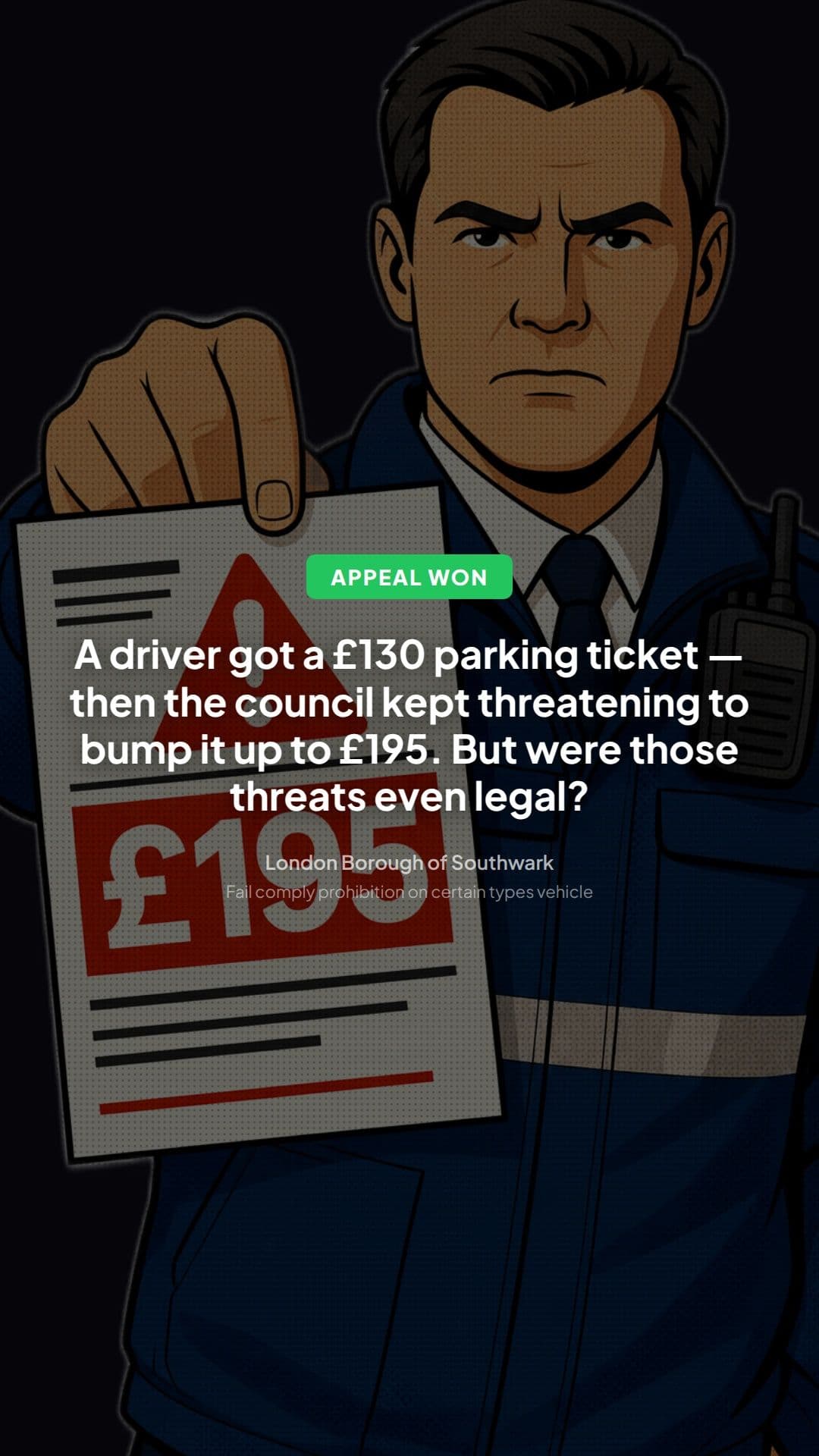
When a Council's Own Threatening Letters Cancelled a Valid Parking Fine
A Southwark Case That Every Driver Should Know About
Here is a scenario that might surprise you. A driver enters a pedestrian zone. The signs are clear. The restriction is real. The council has video evidence, library images, and a site plan to prove it. By every measure, this looks like an open-and-shut case for the authority.
And yet the driver won.
Not because the contravention did not happen. It did. The adjudicator was quite clear on that point. The driver lost on the facts of the alleged offence. But the council lost the case anyway, because of what it wrote in its letters.
This is the story of a Southwark pedestrian zone penalty charge notice that was cancelled not because of a faulty sign or a missing camera, but because the council repeatedly threatened to demand more money than it was legally entitled to ask for, at a time when it had no right to do so at all.
What Happened
Mr Miah received a penalty charge notice from the London Borough of Southwark. The contravention was "fail to comply with prohibition on certain types of vehicle," which is the standard code used when a vehicle enters a road or zone restricted to particular vehicle types, such as a pedestrian zone.
The evidence against Mr Miah was solid. The council had video footage, library photographs of the location, and a site plan showing adequate signage. On the facts, his vehicle had entered a pedestrian zone in breach of the restriction.
Mr Miah appealed, represented by Mr Morgan. Southwark did not participate in the tribunal hearing.
The Argument That Won the Case
Mr Morgan did not contest the signage or the footage. Instead, he focused on something printed on the face of the penalty charge notice itself, and on a series of letters the council sent during the appeal process.
The PCN contained the following statement: "If full payment has not been made before the end of the period of 28 days beginning with the date of this notice, a Charge Certificate may be issued increasing the amount outstanding by 50% to £195.00."
At first glance, this looks like standard boilerplate. Councils routinely include this kind of warning on penalty charge notices. But Mr Morgan argued that the wording was legally wrong, and that the council had compounded the problem through its subsequent conduct.
He pointed to Schedule 1 of the London Local Authorities and Transport for London Act 2003, which sets out precisely when a council can issue a Charge Certificate and increase the outstanding penalty by 50 per cent. The legislation is specific. The 28-day countdown does not automatically begin from the date of the notice in all circumstances. Where a motorist makes representations, the relevant period begins from a different point entirely, such as the date a Notice of Rejection is served, or the date an appeal decision is issued.
In other words, the council cannot simply threaten to escalate to a Charge Certificate while an appeal is live. The clock does not run during that period.
Yet Southwark sent letters on 4 February, 12 March, 4 April, and 9 May 2025, each warning that the outstanding amount "will increase to £195 very soon." Mr Miah had lodged his appeal on 6 February 2025. The council was threatening financial escalation throughout the entire appeal process, at a time when it had no legal authority to do so.
What the Adjudicator Decided
The adjudicator allowed the appeal on the basis that the council had sought a sum beyond the prescribed amount. The finding was blunt: it is not open to an authority to seek any sum beyond what is legally prescribed at any particular point in time.
The adjudicator noted that this issue had already been considered in earlier tribunal cases, indicating that this is not an isolated problem and that adjudicators have developed a consistent approach to it.
Crucially, the adjudicator did not find that the contravention had not occurred. The video evidence and signage were accepted as adequate. The appeal succeeded purely on procedural and legal grounds relating to the council's conduct during the enforcement process.
The Legal Reasoning in Plain English
Under civil parking enforcement in London, when a council issues a penalty charge notice, there is a strict legal framework governing what happens next. If a driver pays within 14 days, they typically receive a 50 per cent discount. If they do not pay and do not appeal, the council can eventually issue a Charge Certificate after 28 days, which adds 50 per cent to the outstanding sum.
But that 28-day window is not a fixed countdown from the date of the notice in every situation. The legislation sets out three distinct starting points depending on what the driver does. If no representations are made, the period runs from the date of service. If representations are made and rejected, the period runs from the expiry of the window to appeal that rejection. If there has been an unsuccessful appeal, it runs from the date the adjudicator's decision is served.
The practical effect is clear. Once a driver makes representations or lodges an appeal, the council cannot threaten to issue a Charge Certificate or demand the escalated sum. The legal machinery is paused. Threatening otherwise is not just misleading. It is unlawful.
The PCN wording itself was problematic because it implied the 28-day clock ran solely from the date of the notice, without acknowledging the different starting points that apply when a driver challenges the fine. And then the council's follow-up letters made things considerably worse by repeating the escalation threat while an appeal was actively in progress.
Practical Lessons for Drivers
1. Read the PCN wording carefully, not just the amount
Most drivers focus on the penalty figure and the deadline. But the language used on a PCN is subject to legal requirements. If the notice misstates the conditions under which a Charge Certificate can be issued, that may itself be a ground of challenge. You do not need to be a lawyer to spot wording that does not match what the law actually says.
2. Keep every letter the council sends you
In this case, the council's own correspondence became the evidence that sank its case. The dates of those letters, combined with the date of Mr Miah's appeal, demonstrated clearly that the authority was making unlawful threats. If a council writes to you during an appeal process threatening escalation, note the date, save the letter, and raise it in your appeal submissions.
3. Understand that appealing pauses the escalation clock
Once you make formal representations or lodge a tribunal appeal, the council cannot lawfully issue a Charge Certificate or demand the increased sum. If you receive correspondence threatening otherwise while your appeal is live, that conduct may itself support your appeal. The adjudicator in this case found it particularly unfair that the threats continued after the appeal was filed.
4. The facts of the contravention are not always the whole story
Mr Miah's vehicle did enter the pedestrian zone. The signage was adequate. Under normal circumstances, that would have been the end of it. But enforcement law places obligations on councils too, not just on drivers. Procedural failures, unlawful demands, and misleading communications can independently undermine a penalty charge notice, even where the underlying contravention is not in dispute.
5. Seek guidance if you are unsure
If you have received letters threatening escalation while your appeal is pending, or if the wording on your PCN does not appear to match the legal requirements described above, it is worth seeking proper guidance. The Traffic Penalty Tribunal and London Tribunals both publish information for appellants, and Citizens Advice can point you towards free support. Given the financial stakes involved, particularly once a Charge Certificate has been issued and the matter moves towards debt recovery, getting the right information early matters.
The Key Takeaway
A council can have the video, the signs, and the evidence. It can be entirely right about what your vehicle did. And it can still lose, if it behaves unlawfully during the enforcement process.
The law governing parking penalties is not simply a tool for punishing drivers. It also places firm obligations on councils. When those obligations are ignored, and when drivers are threatened with sums they cannot legally be asked to pay at the time the threat is made, the tribunal will not look the other way.
The message from this case is straightforward. Know your rights during the appeals process. Keep every piece of correspondence. And remember that the council's conduct after issuing the PCN is just as much a part of the legal picture as what your vehicle did on the day.
Written by
Sarah Mitchell
Parking Rights Advocate
Ready to Challenge Your Ticket?
Let our AI analyse your PCN and generate a professional appeal letter in minutes.
Start Free Appeal