Smaller EVs vs SUVs: why Europe is going compact
European carmakers are shrinking electric cars to suit city streets and cut costs. What it means for UK drivers, parking bays and urban travel.

Hannah MacLeod
21 June 2026
Why Europe's New Compact EVs Could Reshape How You Park, Drive, and Pay in the UK
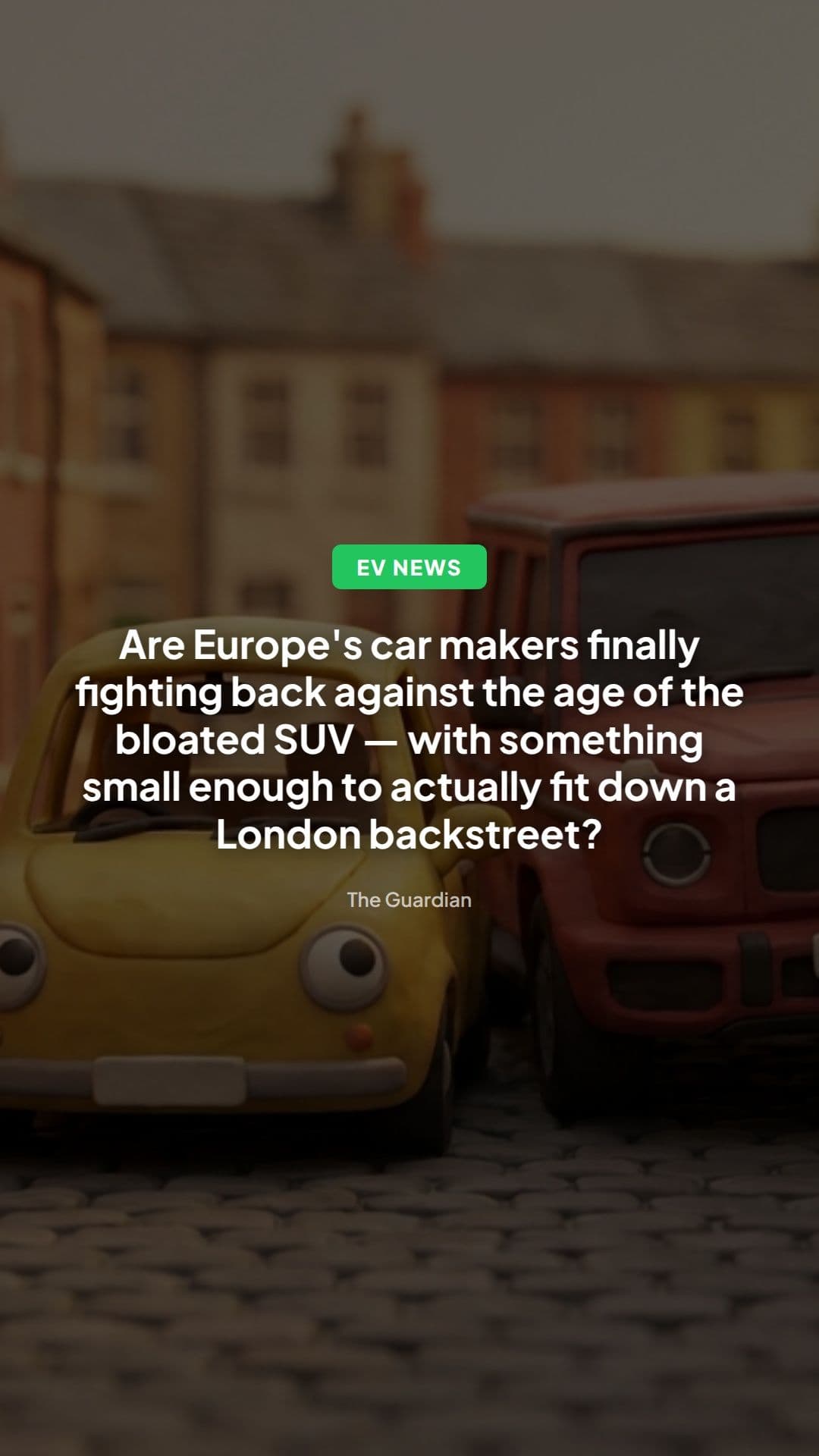
Picture this: you're squeezing your SUV into a Victorian terrace street in Bristol, wing mirrors folded, praying the neighbour's Volvo doesn't open its door. Meanwhile, a sleek little electric hatchback glides past and slots neatly into a space you'd dismissed as impossible. That's not a fantasy — it's the direction the European car industry is now sprinting towards, and the implications for UK drivers go far deeper than boot space.
The Guardian recently reported on a fascinating shift happening across European car manufacturing: rather than chasing the SUV arms race that has dominated the past decade, manufacturers are deliberately shrinking their electric vehicles. Not out of timidity, but out of strategic necessity. Narrow city streets, tightening emissions rules, and a cost-conscious public are forcing designers to rethink everything. The result is a new generation of compact EVs specifically engineered for the realities of British and European urban life — and it's worth examining what that actually means for drivers on the ground.
What's Actually Happening in the Market
For much of the 2010s, car makers chased one trend relentlessly: bigger, taller, heavier. SUVs and crossovers now account for roughly half of all new cars sold in the UK. Manufacturers loved them because the margins were fatter. Buyers loved them because they felt safer and more commanding. Nobody much worried about the consequences.
But the EV transition has exposed a fundamental problem with this logic. Large electric cars require enormous battery packs, which add weight, cost, and complexity. A full-size electric SUV can easily cost £50,000 or more before options. That's simply not a mass-market product.
European manufacturers — Renault, Stellantis (which owns Vauxhall, Peugeot, and Citroën), Volkswagen Group, and others — have realised that to compete with increasingly affordable Chinese EVs and to actually hit the UK Government's zero-emission vehicle (ZEV) mandate targets, they need smaller, cheaper, more efficient cars. The Renault 5 E-Tech, the Citroën ë-C3, the Volkswagen ID.2 (due imminently), and the upcoming Vauxhall Frontera Electric are all products of this thinking. They are deliberately designed to be narrower, lighter, and more affordable — starting prices pushing towards £20,000 — while still delivering genuine urban range.
The design trade-offs are real. Smaller cabins, reduced luggage space, and more modest motorway range are the price of admission. But for the majority of UK drivers — who, according to the Department for Transport, drive fewer than 20 miles on a typical day — these compromises are largely irrelevant.
Why This Matters: The UK Context
Britain's road network presents a particular argument for compact cars that is easy to overlook until you've spent twenty minutes trying to navigate a market town in a large SUV. Around 60% of UK roads are classified as local roads, many of which were built long before the motor car existed. Streets in cities like Edinburgh, York, Bath, and large swathes of inner London were designed for horses and pedestrians. The average lane width on a UK A-road is approximately 3.65 metres — considerably tighter than the American roads that inspired the SUV craze.
Compact EVs also interact directly with the UK's rapidly expanding network of Clean Air Zones (CAZs). Bristol, Birmingham, and Bath already operate charging schemes, and Manchester's CAZ is operational. Smaller EVs, by virtue of being zero-emission, pass through these zones freely. But there's a subtler benefit: their lighter weight causes less wear to road surfaces, which matters in a country facing a documented pothole crisis with a repair backlog running into the billions.
There is also a charging infrastructure dimension that rarely gets discussed. On-street charging — the kind installed in lamp posts and pavement gullies — is primarily designed for cars that park on residential streets overnight. Compact EVs with smaller batteries charge faster and require less energy per session, making them better suited to the slower 3.7kW or 7kW chargers that dominate residential installations. For the millions of UK drivers without off-street parking, this is not a trivial point.
The Legal and Regulatory Framework Driving the Shift
The commercial push towards compact EVs doesn't exist in a vacuum — it's being actively shaped by UK and European law.
The Zero Emission Vehicle Mandate requires that 80% of new cars sold in the UK must be zero-emission by 2030, rising to 100% by 2035. Manufacturers who fail to hit annual targets face fines of £15,000 per non-compliant vehicle sold over their quota. That's an extraordinary financial incentive to produce affordable EVs that ordinary buyers will actually purchase — not just premium models that skew the average price upward.
Vehicle Excise Duty (VED) changes that came into force in April 2026 now mean that EVs registered after that date are no longer exempt from road tax. However, the first-year rate remains lower than equivalent petrol or diesel vehicles, and smaller, lower-list-price EVs attract lower VED rates overall — another nudge towards compact models.
The UK EV Grant, administered through Plug-in Car Grant schemes, has historically favoured lower-priced vehicles. The current framework provides grants on vehicles priced below specific thresholds, meaning that manufacturers building cheaper compact EVs can offer grant-eligible pricing that larger premium models cannot access. The Fiat 600e recently became grant-eligible following a price adjustment — a telling sign of how the market is moving.
There is also the question of parking regulations and bay dimensions. Standard UK parking bay dimensions under the Traffic Signs Regulations and General Directions 2016 specify a minimum bay width of 2.4 metres. A growing number of compact EVs are being designed with overall widths of under 1.75 metres — meaning they fit comfortably in standard bays without risk of door-ding disputes or the dreaded PCN for parking outside bay markings (PCN Code 24). As cars got wider through the SUV era, this became a genuine enforcement risk in older, narrower car parks.
What Drivers Should Know: Practical Takeaways
If you're in the market for a new car — or advising someone who is — the compact EV trend has some genuinely useful practical implications:
- Check the physical dimensions before you buy. Many UK drivers underestimate how much easier daily life becomes with a car under 4.2 metres in length. Parallel parking, multi-storey car parks, and residential streets all become significantly less stressful.
- Understand the charging reality for your area. If you live in a Victorian terrace without a driveway, a smaller battery (say, 40–50kWh) that charges quickly on a 7kW lamp-post charger may be more practical than a 77kWh pack that takes all night on the same connection.
- Factor in Clean Air Zone costs. Any zero-emission vehicle — including all of these compact EVs — passes through UK CAZs without charge. If you regularly drive into Bristol, Bath, or Birmingham, that's a tangible annual saving that should be part of your total cost of ownership calculation.
- Check grant eligibility carefully. The Plug-in Car Grant rules change periodically. Always verify the current price cap threshold directly with the OZEV (Office for Zero Emission Vehicles) before committing to a purchase, as manufacturers sometimes adjust prices specifically to qualify.
- Don't assume small means underpowered. Modern compact EVs benefit from the inherent torque advantage of electric motors. The Renault 5 E-Tech, for example, offers brisk performance that would embarrass many larger petrol hatchbacks.
Looking Ahead: A Quieter, Smaller Future?
The irony of the compact EV movement is that it represents a kind of return. Before the SUV boom, the UK car market was dominated by superminis and small family hatchbacks — the Ford Fiesta, the Vauxhall Corsa, the Peugeot 206. These were cars built for British roads, British budgets, and British parking spaces. The EV transition, rather than delivering a fleet of silent Goliaths, may ultimately restore something closer to that sensible norm.
The competitive pressure from Chinese manufacturers — who have built affordable, well-specified small EVs while European brands were distracted by premium SUVs — has accelerated this reckoning. European makers are now playing catch-up on cost, and the compact segment is where that battle will be won or lost.
For UK drivers, the practical outcome is genuinely positive: more choice at lower price points, better suitability for real British roads, and vehicles that interact more sensibly with the parking, charging, and regulatory infrastructure that surrounds them. The bloated SUV era may not be over, but its dominance is being seriously challenged — one narrow street at a time.
Based on reporting by The Guardian (June 2026). Analysis and UK-specific context by Parking Ticket Pal editorial team.
Written by
Hannah MacLeod
Traffic Law Specialist
Ready to Challenge Your Ticket?
Let our AI analyse your PCN and generate a professional appeal letter in minutes.
Start Free Appeal