Scotland Speed Cameras Switched Off: Driver Impact
Police Scotland has switched off speed cameras despite warnings that speeding may rise. Learn what the change means for drivers, enforcement and road safety.

The Parking Ticket Pal Editorial Team
6 September 2026
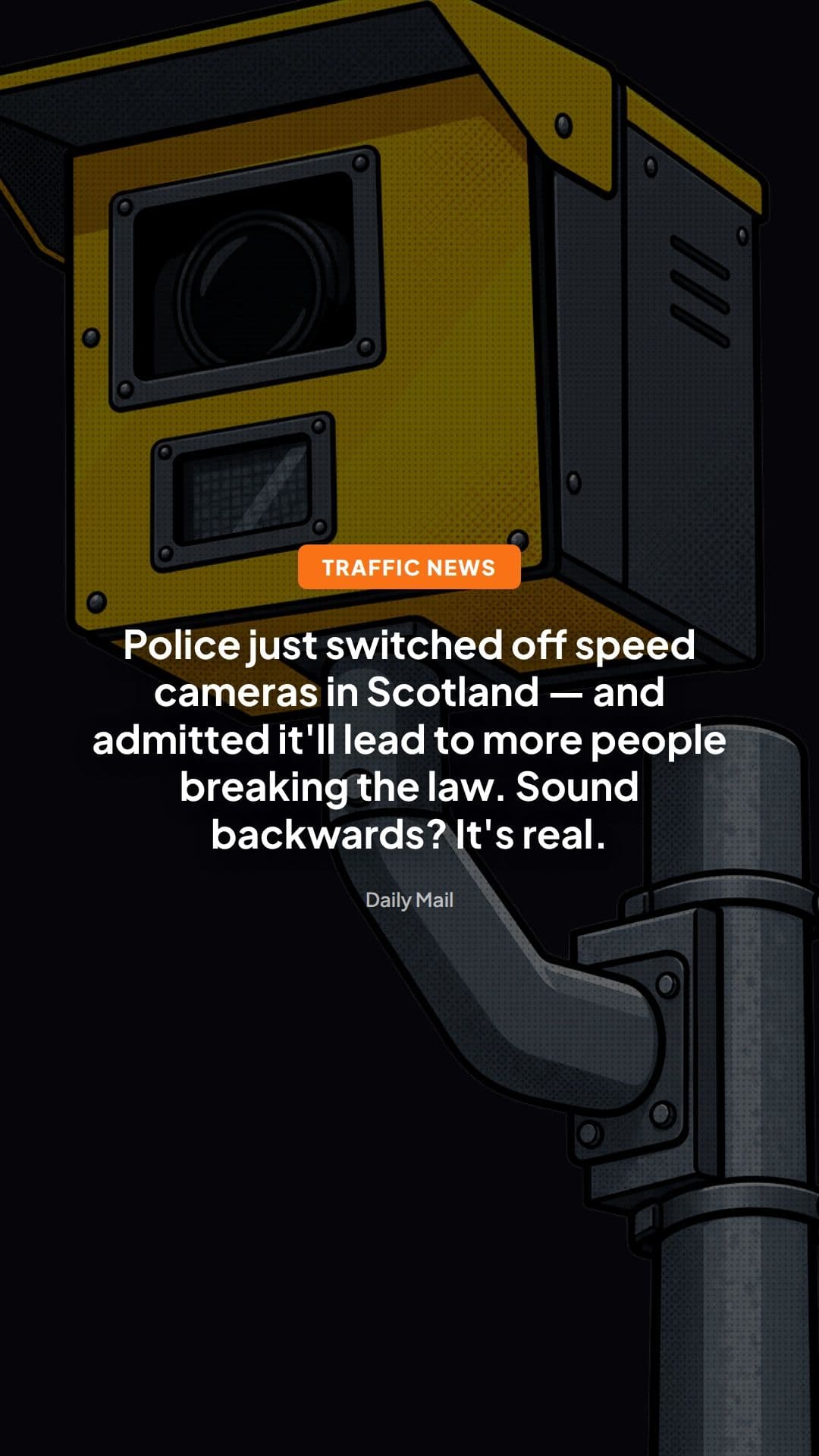
Police Switch Off Speed Cameras and Admit It Will Lead to More Law-Breaking
When the Watching Eye Closes
Imagine driving a stretch of road you know is monitored, easing off the accelerator out of habit rather than fear, and then discovering the camera watching you has been switched off. Now imagine the police force responsible for that camera admitting, openly, that turning it off will probably mean more drivers break the speed limit.
That is essentially what has happened in Scotland. According to reporting by the Daily Mail, speed cameras have been switched off north of the border, and police have acknowledged that doing so could lead to an increase in speeding offences. It is a rare moment of candour from an enforcement body, and it raises a much bigger question that goes well beyond one country's camera network: what happens to driver behaviour when the deterrent disappears, and what are the legal consequences for anyone caught out by the gap?
What Happened
The core of the story is straightforward but significant. Speed cameras that would normally be operational in Scotland have been turned off, and the police have not tried to pretend this is consequence-free. Rather than insisting the switch-off would have no impact on compliance, the force has effectively conceded the opposite: that removing active camera enforcement is likely to embolden some drivers to exceed the limit.
This matters because speed cameras in the UK, whether the classic yellow Gatso boxes, the newer digital Truvelo units, or average speed systems such as SPECS that clock a vehicle's pace over several miles rather than at a single point, have always relied on a combination of two things to work: the technology itself, and the psychological effect of drivers believing they might be caught. When cameras go dark, the technology stops functioning, but crucially, so does the perception of risk that keeps many drivers in check, at least until word gets around that the camera is inactive.
Scotland's roads are policed by Police Scotland, the single national force formed in 2013 from the merger of eight regional forces. Camera enforcement north of the border is coordinated through partnership arrangements involving Police Scotland, Transport Scotland and local authorities, similar in principle to the safety camera partnerships that operate in England and Wales. Any decision to power down part of that network, whether driven by funding, staffing, maintenance or technical issues, has knock-on effects for the whole system of deterrence built around it.
Why It Matters
Speed cameras have always been a slightly uncomfortable subject in British motoring debate. Some drivers view them as legitimate, life-saving tools placed at genuine collision blackspots. Others see them as revenue generators dressed up as safety measures. What is less commonly debated is what happens when they are removed, because it rarely happens in such a public, acknowledged way.
The admission itself is the real story here. For decades, police forces and camera partnerships have defended speed enforcement on the basis that it changes driver behaviour and reduces casualties. If switching cameras off is expected to increase rule-breaking, that is effectively an admission that the cameras were working as a deterrent in the first place. It is one thing for road safety campaigners to argue this, and quite another for the police themselves to say it.
There is also a practical, human dimension. Roads fitted with speed cameras are often chosen because they have a history of collisions, excessive speed, or vulnerable road users nearby, such as schools, pedestrian crossings or sharp bends. If enforcement lapses on those specific stretches, even temporarily, the risk is not evenly distributed. It falls hardest on the communities the cameras were originally installed to protect.
For drivers, there is also a fairness question. Many motorists genuinely believe that "no working camera" means "no consequences." That assumption can be a costly mistake.
The Legal Angle
It is worth being clear about what the law actually says, because a camera being switched off does not change it one bit.
Speeding remains an offence under section 89 of the Road Traffic Regulation Act 1984, regardless of whether it is detected by a fixed camera, a mobile unit, an unmarked police car, or an officer with a handheld device. The presence or absence of a camera has no bearing on the legal speed limit itself.
Enforcement, however, does depend on detection and process. For camera-based enforcement to result in a valid penalty, strict procedural rules apply. Under section 1 of the Road Traffic Offenders Act 1988, a Notice of Intended Prosecution generally has to be issued within 14 days of the alleged offence, either verbally at the roadside or by post to the registered keeper. If that notice does not arrive in time, in most circumstances the case cannot proceed, which is one reason camera systems need to be reliably operational and properly maintained.
Where a driver is caught speeding, the usual outcomes are a fixed penalty of three penalty points and a fine, or attendance on a speed awareness course for lower-level, first-time offences at the discretion of the police. More serious or repeated speeding can result in a court summons, higher fines calculated against income, and disqualification. Under the totting-up provisions in section 35 of the Road Traffic Offenders Act 1988, accumulating 12 or more penalty points within three years normally leads to disqualification, unless a driver can successfully argue exceptional hardship before a court.
None of this changes because a camera has been switched off. What changes is the likelihood of detection at that particular location during that particular period, not the underlying legal risk of speeding at all.
What Drivers Should Know
The practical takeaway for anyone reading this is simple: do not treat a switched-off camera, or reports of cameras being turned off generally, as a green light.
A few sensible points to bear in mind:
- The speed limit still applies. Camera downtime has no legal bearing on what the posted limit is or your obligation to comply with it.
- Other enforcement methods remain in play. Police forces routinely use mobile speed guns, unmarked patrol vehicles, and ANPR-equipped cars that are entirely independent of fixed or average speed camera networks.
- Camera outages can be temporary. Maintenance, technical faults, funding reviews or staffing issues can all lead to short-term switch-offs. A camera that is inactive today may well be back in operation next week or next month.
- Word of mouth is unreliable. Social media chatter or word-of-mouth claims that a particular camera "doesn't work" are often outdated, wrong, or simply misinformation. Relying on this is a gamble, not a fact.
- The roads targeted by cameras are usually targeted for a reason. Locations are typically chosen because of a genuine history of collisions or risk to vulnerable road users, meaning the danger does not disappear just because the enforcement does.
If you are ever issued with a Notice of Intended Prosecution or a fixed penalty and believe there has been an error, whether in timing, location, or the vehicle identified, it is worth seeking proper guidance on the formal appeals process rather than assuming the case will simply be dropped because of wider stories about camera downtime.
Looking Ahead
This story is unlikely to be the last of its kind. Road policing budgets across the UK remain under pressure, and camera networks are expensive to run, maintain and upgrade. Where a police force is willing to publicly acknowledge that switching off enforcement could lead to more law-breaking, it exposes a genuine tension at the heart of road safety policy: enforcement costs money, but the absence of enforcement carries its own cost, measured in collisions, injuries and, in the worst cases, lives.
For drivers, the sensible response is not to search for gaps in the system but to treat every road as though it is monitored, because in an era of expanding camera networks, average speed zones, and increasingly capable ANPR technology, it very often still is. The safest, and legally soundest, approach remains the simplest one: stick to the limit, camera or no camera.
Written by
The Parking Ticket Pal Editorial Team
Source-checked parking guidance
Ready to Challenge Your Ticket?
Let our AI analyse your PCN and generate a professional appeal letter in minutes.
Start Free Appeal