Scotland councils raise EV parking fees: what it means
Scottish councils are introducing higher parking charges for electric cars. See what’s changing, why it’s happening and what EV drivers can do next.

David Chen
27 March 2026
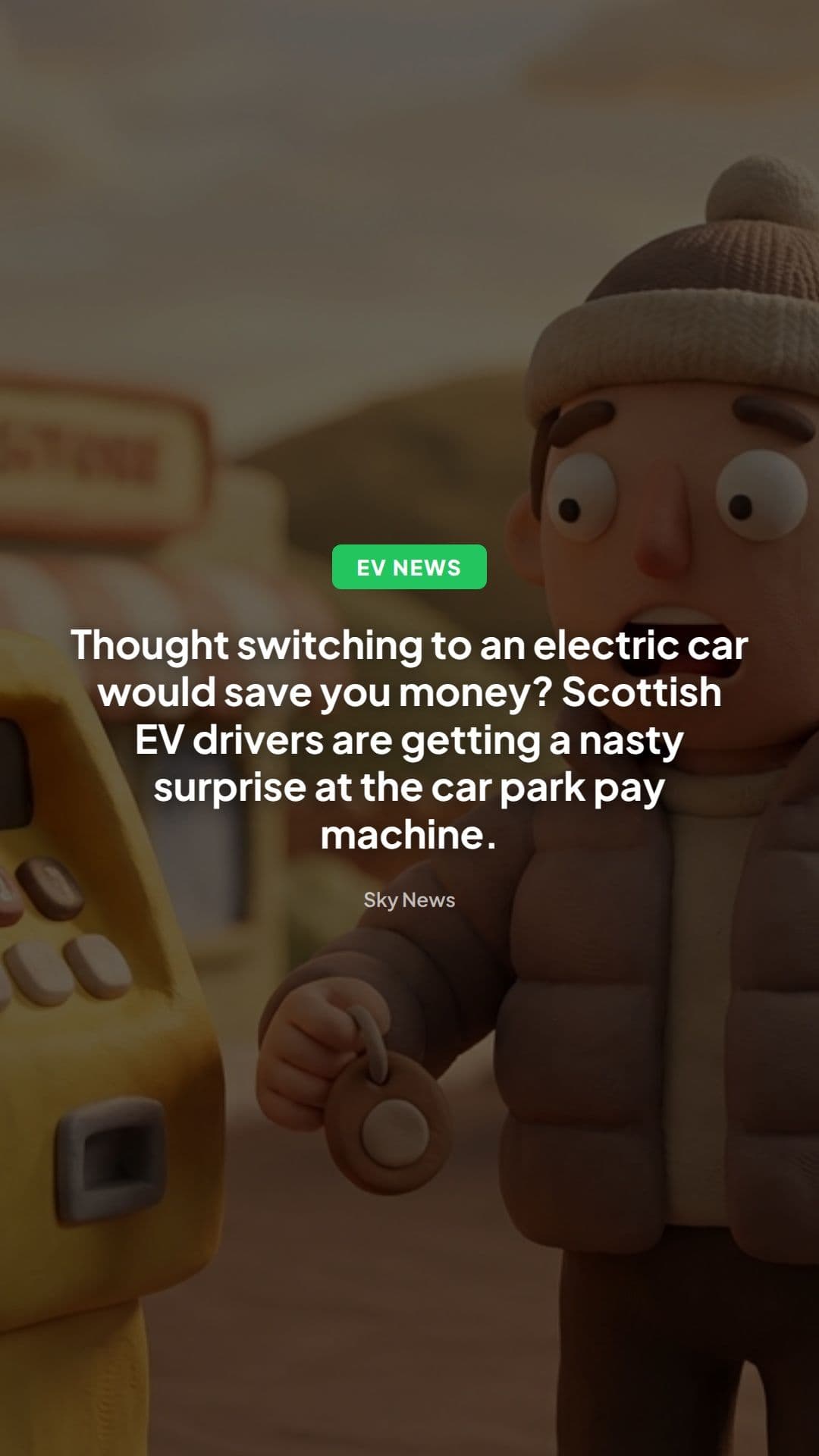
SNP Councils Are Charging EV Drivers More to Park — And It Could Set a Dangerous Precedent
Imagine buying an electric car in good faith — doing your bit for the environment, responding to government incentives, future-proofing your household against rising fuel costs — only to find that your local council has quietly decided to charge you more to park than the driver in the diesel next to you. That's not a hypothetical. It's happening right now in Scotland, and the implications stretch far beyond Holyrood.
What's Actually Happening
As reported by Sky News, several Scottish councils — predominantly those under SNP control — have begun introducing higher parking charges specifically for electric vehicles. The rationale? To recover revenue lost as more drivers switch away from petrol and diesel, reducing the council's income from parking fees that have historically been calibrated around conventional vehicles.
The specifics vary by council, but the pattern is consistent: EV drivers are being asked to pay a premium — in some cases meaningfully higher than the standard rate — simply because they're plugging in rather than filling up. In some car parks, this manifests as a higher flat rate for EV bays. In others, councils are exploring differential tariff structures that effectively penalise zero-emission vehicles.
This isn't a rogue decision by one cash-strapped authority. It represents a deliberate policy direction, with councils pointing to the fiscal pressure created by the UK Government's decision to freeze fuel duty — and the longer-term reality that as EV adoption grows, traditional revenue streams will shrink.
Why This Matters: The Bigger Picture
To understand why this is so contentious, you need to understand the financial architecture of road use in Britain.
Fuel duty has historically been one of the Treasury's most reliable revenue streams, generating around £25 billion per year. As the UK's EV fleet grows — the Government has mandated that all new car sales must be zero-emission by 2035 under the Zero Emission Vehicle (ZEV) Mandate — that revenue will evaporate. Local authorities, already squeezed by years of central government funding cuts, are acutely aware that their own parking income faces a similar cliff edge.
From a purely financial standpoint, the councils' position isn't entirely unreasonable. Car parks cost money to maintain. EV charging infrastructure costs even more. Someone has to pay.
But here's where it gets politically awkward: these are the same councils that have championed green transport policies, promoted EV uptake, applied for clean air zone funding, and encouraged residents to ditch fossil fuels. Charging EV drivers a premium for parking isn't just a revenue decision — it's a signal that contradicts years of messaging. It tells drivers that making the "right" environmental choice will cost them more.
The timing is particularly sensitive. The UK's EV transition is at a critical juncture. Uptake has been strong in wealthier demographics but remains stubbornly low among lower and middle-income households, partly because of the higher upfront cost of electric vehicles. Introducing punitive parking charges — however modest — risks reinforcing the perception that EVs are a luxury product with hidden costs, undermining the very behavioural shift that both local and national government claim to want.
The Legal Angle: Can Councils Actually Do This?
This is where things get genuinely interesting for drivers and legal observers alike.
Local authorities in Scotland derive their parking enforcement powers primarily from the Road Traffic Regulation Act 1984 and the Transport (Scotland) Act 2001, which devolved parking enforcement to Scottish councils. These frameworks give councils broad discretion to set tariffs in off-street car parks and, in many cases, on-street charging zones.
Critically, there is no legal requirement for parking charges to be uniform across vehicle types. Councils already differentiate — disabled badge holders often pay nothing, motorcycles frequently get reduced rates, and permit holders pay less than casual parkers. Charging EVs differently is, legally speaking, within the same framework of discretionary tariff-setting.
However, there are potential grounds for challenge, particularly around the Equality Act 2010 — not in the traditional protected characteristics sense, but in the broader principle that public bodies must act proportionately and not arbitrarily. If a council's stated purpose is environmental improvement, a policy that financially penalises zero-emission vehicles could be argued to be irrational in the public law sense — a policy that contradicts its own stated objectives.
There's also an interesting angle under consumer protection principles. Where EV bays include charging infrastructure and drivers are paying both for parking and electricity, the basis for any premium charge becomes more defensible. But where the premium applies simply because the vehicle is electric — with no additional service being provided — the justification is considerably weaker, and Trading Standards could potentially take an interest if charges are presented in a misleading way.
In England, the Traffic Management Act 2004 governs parking enforcement, and similar discretionary powers exist. Should English councils follow Scotland's lead — and there are early signs some are considering it — the same legal questions will apply.
What Drivers Should Know Right Now
If you drive an EV and park in Scottish council-run car parks, here's what you need to be aware of:
- Check tariff boards carefully. Councils are not always transparent about differential pricing. Look specifically for whether EV bays carry a separate rate to standard bays, and whether that rate is clearly displayed before you commit to parking.
- Document discrepancies. If you believe you've been charged a higher rate without adequate signage or prior notice, photograph the signs, keep your receipts, and raise a formal complaint with the council. Inadequate signage has historically been a strong ground for challenging parking charges.
- Know your appeal rights. In Scotland, parking enforcement appeals go to the Parking and Bus Lane Tribunal for Scotland. If you receive a Penalty Charge Notice that you believe was issued on the basis of unclear or unlawful charging, you have the right to make a formal representation and, if unsuccessful, appeal to the independent tribunal.
- Check whether your charging session is included. Some councils bundle charging costs into the parking fee. Others charge separately. Understanding what you're actually paying for matters — both for budgeting and for any potential challenge.
- Contact your local councillor. These decisions are made at council level, and elected members are accountable to residents. If you're an EV driver being penalised, make your voice heard through the democratic process as well as the legal one.
Looking Ahead: A Policy Collision in Slow Motion
What's unfolding in Scotland is, in many ways, a preview of a national conversation that is coming whether we're ready for it or not.
The UK Government has already introduced Vehicle Excise Duty for EVs from April 2025, ending the long-standing exemption that made electric cars cheaper to run annually. That decision was framed as a fairness measure — ensuring EV drivers contribute to road maintenance alongside everyone else. The Scottish council parking premium follows the same logic, even if the execution is clumsier.
The underlying tension is real: the public finances were partly built around fossil fuel consumption, and the transition to cleaner transport blows a hole in that model. Road pricing — a per-mile charge replacing fuel duty — is widely seen as the long-term solution, and the Government's Transport Decarbonisation Plan acknowledged as much. But road pricing is politically toxic, administratively complex, and years away from implementation.
In the meantime, local authorities are improvising. And drivers — particularly those who invested in EVs partly because of government encouragement — are finding themselves caught in the gap between policy aspiration and fiscal reality.
The danger isn't just financial. It's reputational. Every time a council introduces a charge that appears to punish green behaviour, it erodes public trust in the consistency of environmental policy. If drivers can't rely on the rules of the game staying stable, they'll be less willing to make long-term investments — like buying an electric car — based on those rules.
The SNP councils hiking EV parking charges may be solving a short-term revenue problem. But they risk creating a much longer-term credibility problem — not just for themselves, but for the entire project of getting Britain's drivers to go electric.
And that's a price worth thinking carefully about before it appears on the tariff board.
Written by
David Chen
Consumer Rights Expert
Ready to Challenge Your Ticket?
Let our AI analyse your PCN and generate a professional appeal letter in minutes.
Start Free Appeal