School speeding scheme: questions replace penalty points
Drivers caught speeding near a rural school face pupils’ road safety questions instead of penalty points. How the UK community scheme aims to change behaviour.

Lisa Rodriguez
30 March 2026
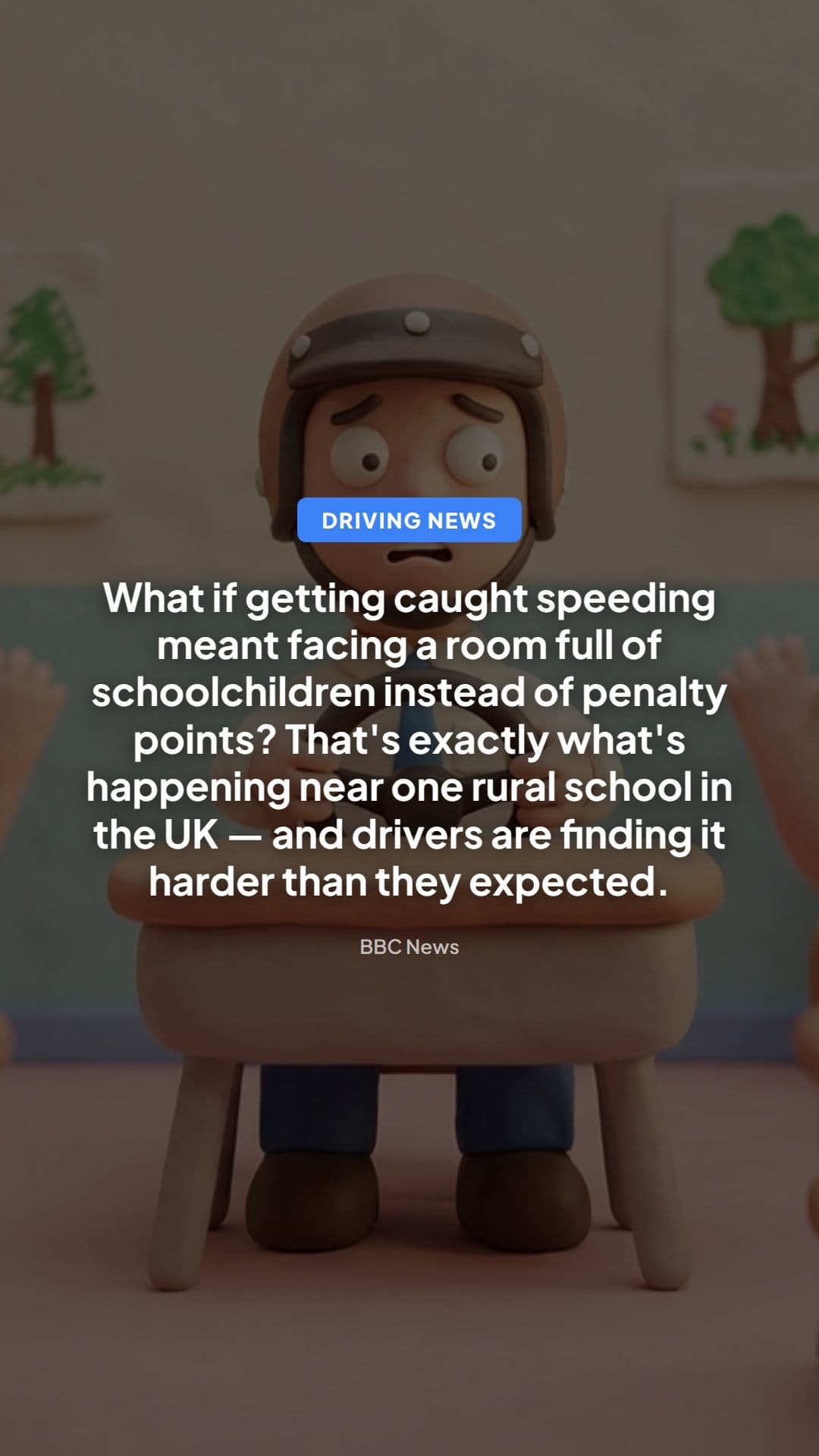
When Speeding Drivers Face the Toughest Audience of All: A Classroom Full of Children
Imagine being pulled over for speeding. You're bracing yourself for the familiar routine — the officer's approach, the quiet dread of penalty points, the insurance premium hike that will follow you for years. Now imagine instead being told you'll be answering questions from a group of primary school children who want to know why you were driving too fast past their school.
That's not a thought experiment. It's actually happening on British roads right now, and it raises some genuinely fascinating questions about how we tackle speeding, what actually changes driver behaviour, and what the law says about all of it.
What's Actually Happening
As reported by the BBC, a community speed awareness scheme operating near a rural school is offering drivers caught speeding a rather unconventional alternative to the standard penalty: sit down with the pupils and answer their questions about road safety.
Rather than receiving penalty points on their licence — the traditional stick used to deter speeding — motorists are brought before the children whose daily school run takes them past the very stretch of road where the offence occurred. The kids, armed with curiosity and the kind of bluntness only children can get away with, ask the drivers directly why they were going too fast, what they were thinking, and whether they understood the danger they posed.
It sounds almost whimsical. In practice, by most accounts, it's deeply uncomfortable — and that discomfort appears to be precisely the point.
Why This Matters More Than You Might Think
Speed-related collisions remain one of the most significant causes of death and serious injury on British roads. According to the Department for Transport, speed was a contributory factor in 13% of all reported road casualties in recent years, and the risk is acutely elevated in areas where children are present — school zones, residential streets, and rural roads with poor visibility.
The problem with conventional enforcement is well-documented. Penalty points and fines create a short-term deterrent, but behavioural research consistently shows that drivers — particularly those who speed habitually — quickly revert to old habits once the immediate threat of punishment recedes. Speed awareness courses, introduced as an alternative to points for lower-level offences, have shown more promise, but even these are increasingly viewed as a box-ticking exercise by some participants.
What makes the school-based scheme genuinely interesting is its use of restorative justice principles — a philosophy more commonly associated with the criminal justice system, where offenders are brought face-to-face with those affected by their actions. The evidence base for restorative approaches in reducing reoffending is reasonably strong, and the emotional impact of explaining your behaviour to a child who walks that road every day is arguably far more memorable than a fine.
There's also a community dimension here that conventional enforcement simply cannot replicate. Rural roads near schools are notoriously difficult to police consistently. Camera infrastructure is expensive, traffic officers are stretched thin, and many communities feel ignored when they raise concerns about local speeding. Schemes like this return a degree of agency to residents — and to the children themselves.
The Legal Angle: Can You Actually Avoid Penalty Points This Way?
This is where things get legally interesting, and it's worth being clear about how such schemes fit within the existing framework.
Under the Road Traffic Offenders Act 1988, speeding is a criminal offence. The standard penalty for exceeding the limit is a minimum £100 fixed penalty notice and three penalty points on your licence. For more serious cases — typically travelling at significantly above the limit — the matter goes to court, where fines can reach 150% of weekly income and bans can be imposed.
However, the law also gives police forces and prosecutors considerable discretion in how they deal with lower-level offences. The National Police Chiefs' Council (NPCC) speed enforcement guidelines provide a framework, but individual forces retain latitude in diverting drivers away from the formal fixed penalty route — provided the offence falls within certain thresholds.
Speed awareness courses, for instance, are typically offered to drivers caught between 10% + 2mph and 10% + 9mph above the limit (so, between 35mph and 42mph in a 30mph zone, roughly). They are not a legal right — they're offered at the discretion of the police force — and crucially, accepting a course means the offence is not formally recorded as a conviction, so no points are added and insurers are not legally required to be informed (though some policies do ask).
Community schemes like the one near this rural school likely operate within a similar discretionary space, potentially as an extension of or complement to existing diversion programmes. The key legal point for drivers is this: you cannot demand an alternative to points. These schemes are offered at the discretion of the relevant authority, and eligibility will depend on the speed recorded, your existing licence history, and the specific policies of the local force involved.
It's also worth noting that if you're offered such a scheme and decline, the standard penalty will almost certainly apply. These are not get-out-of-jail-free cards — they're structured interventions with their own requirements and expectations.
What Drivers Should Know: Practical Takeaways
Whether or not a community scheme like this exists near you, there are some genuinely useful things to take away from this story:
- Speed limits near schools are absolute. A 20mph limit is a 20mph limit, not a suggestion. Many local authorities have been actively rolling out 20mph zones around schools, and enforcement is increasing.
- Variable speed limits exist near some schools. In some areas, electronic signs display reduced limits during school arrival and departure times. These are legally enforceable in the same way as fixed signs — ignorance of the active limit is not a defence.
- Speed awareness courses are not automatic. If you're caught speeding and believe you may be eligible for a course rather than points, you cannot simply request one. The offer comes from the police force, and eligibility depends on multiple factors including whether you've attended a course within the past three years.
- Your insurance may still be affected. Even if you attend a speed awareness course and receive no points, some insurance providers ask whether you've been offered such a course. Check your policy wording carefully and answer honestly — misrepresentation can void your cover entirely.
- Community speed schemes may require your active participation. If you're offered an alternative like the school-based programme described here, understand that it will likely involve a genuine commitment of time and engagement — not a passive exercise.
- Dash cam footage and context rarely mitigate speed offences. Unlike some other driving offences, speeding is largely strict liability — the speed was either above the limit or it wasn't. Arguing that the road felt safe or that you were keeping up with traffic is unlikely to help your case.
Looking Ahead: Could This Become a Template?
The scheme near this rural school is small in scale, but it touches on something much larger: a growing recognition that enforcement alone cannot solve the speeding problem on British roads.
The government's Road Safety Action Plan has repeatedly emphasised the need for education alongside enforcement, and schemes that embed road safety into the school curriculum — making children active participants rather than passive victims of driver behaviour — align well with that philosophy. There's also a compelling argument that children who engage with these issues early carry those lessons into their own driving lives years later.
Whether this particular model can scale is another question. It depends heavily on willing schools, supportive local police, and communities prepared to invest time and goodwill into something that won't generate revenue in the way that a speed camera does. Funding and coordination are perennial obstacles.
But the emotional logic is hard to argue with. A fixed penalty notice disappears into a drawer. A conversation with a seven-year-old asking you, in all seriousness, whether you knew you could have hurt someone — that tends to stay with you.
If the goal is to genuinely change behaviour rather than simply punish it, perhaps we should be asking whether the children aren't, in fact, the most effective speed cameras we have.
Written by
Lisa Rodriguez
Automotive Journalist
Ready to Challenge Your Ticket?
Let our AI analyse your PCN and generate a professional appeal letter in minutes.
Start Free Appeal