School crossing patrol abuse rises amid UK road rage
School crossing patrols face rising abuse and threats as UK road rage worsens near schools. Why it’s happening, body cams, and the law for drivers.

Priya Sharma
13 May 2026
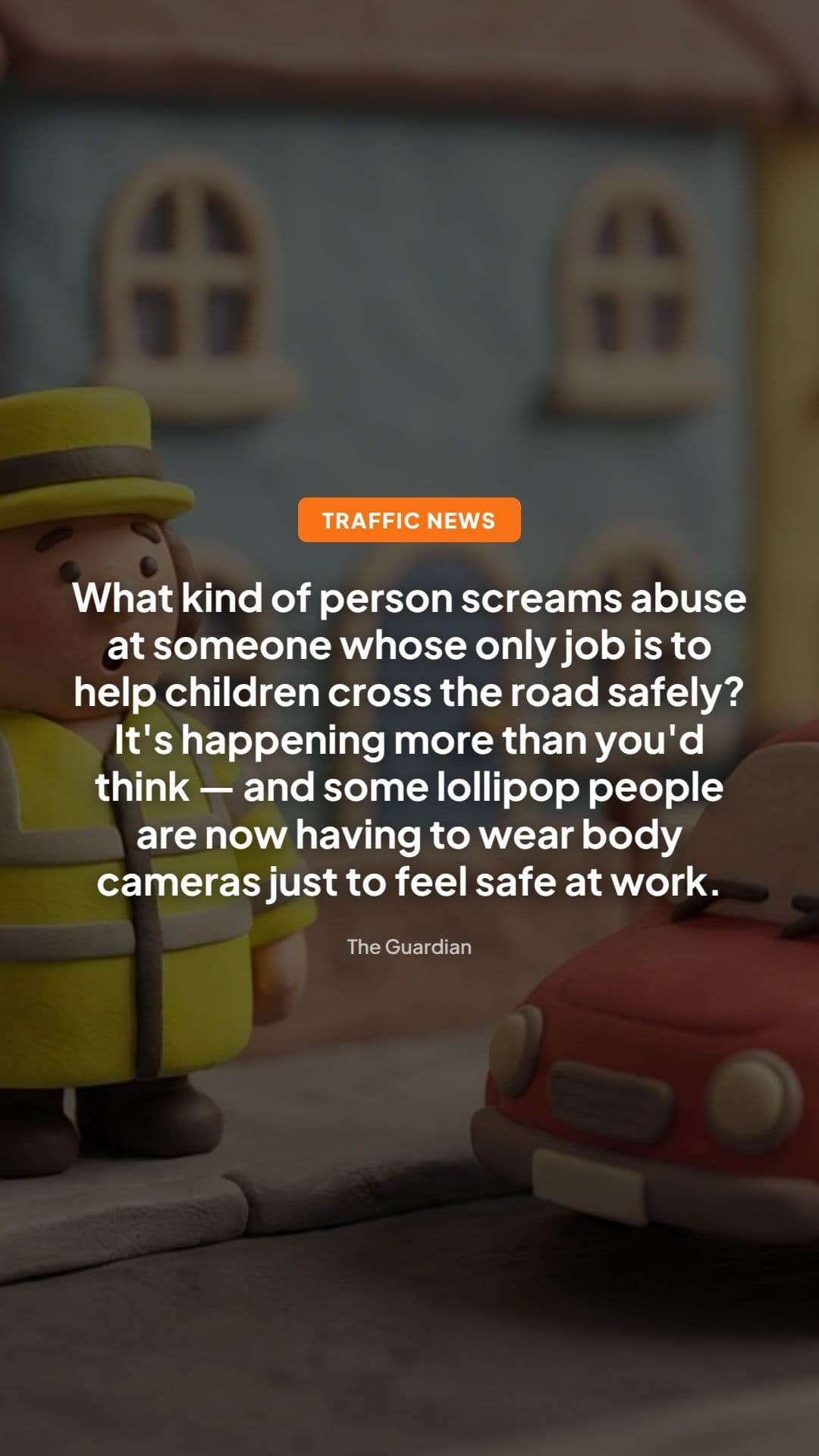
Road Rage Against Lollipop People: Why We're Failing the People Who Keep Our Children Safe
The abuse directed at school crossing patrols has reached a crisis point. Here's what's really going on — and what every driver needs to understand before they get behind the wheel near a school.
The Moment That Should Shock Us All
Picture this: it's 8:45 on a Tuesday morning. A woman in a hi-vis tabard steps into the road, raises her lollipop sign, and waits for a group of seven-year-olds to cross safely. A driver, already late and already frustrated, leans on the horn. Then comes the shouting. Then, in some cases, the car edges forward — close enough to make the crossing patrol officer flinch.
This isn't a rare occurrence. It's happening every single school day, in towns and cities across Britain, and it's getting worse.
A recent Guardian investigation shone a much-needed light on the escalating abuse faced by school crossing patrol officers — the people we affectionately call "lollipop people." Verbal aggression, threatening behaviour, and near-misses with vehicles have become so commonplace that many councils are now equipping their patrol officers with body cameras. That detail alone tells you something has gone badly wrong with how some British drivers behave the moment they're behind the wheel.
What's Actually Happening on Our Streets
The Guardian's feature revealed a pattern of behaviour that will be deeply uncomfortable reading for anyone who considers themselves a reasonable driver. Crossing patrol officers reported being screamed at, sworn at, and in some cases physically intimidated. One officer described a driver edging their car forward while children were still in the road. Another spoke of being followed after their shift by a driver who had taken exception to being asked to stop.
The introduction of body cameras by councils including those in Greater Manchester, Yorkshire, and parts of London reflects a recognition that verbal reports alone weren't enough to take action. Now, incidents are being recorded, evidence is being gathered, and some cases are being referred to the police.
But here's the thing: the cameras shouldn't be necessary. These are volunteers and low-paid local authority workers doing a job that exists purely to stop children being killed or seriously injured on their way to school. The fact that they now need recording equipment to protect themselves from drivers is a damning indictment of road culture in 2026.
Why This Matters Beyond the Immediate Outrage
The abuse directed at crossing patrols doesn't exist in a vacuum. It's part of a broader and deeply troubling pattern of aggression on British roads — one that has been building for years.
The numbers are stark. According to data from road safety charity Brake, the area immediately outside school gates is one of the most dangerous in the UK road network during school run hours. Pedestrian casualties involving children peak sharply between 8am–9am and 3pm–4pm on weekdays during term time.
Recruitment and retention are suffering. Several councils have already reported difficulty filling crossing patrol vacancies, and it's not hard to see why. When the job involves being screamed at by commuters while trying to help children cross the road, the appeal diminishes rapidly. Some areas have already lost their crossing patrols entirely, with no replacement in sight. When a lollipop person disappears from a junction, the danger doesn't disappear with them — it simply becomes invisible.
The school run itself has changed. More parents are driving children to school than ever before, partly due to concerns about road safety — a deeply ironic feedback loop. More cars near schools means more congestion, more frustration, and more opportunity for the kind of aggressive behaviour that is now being documented on body cameras.
The Legal Angle: What Drivers Must Understand
This is where many drivers are dangerously uninformed. Failing to comply with a school crossing patrol officer isn't just bad manners — it's a criminal offence.
Under Section 28 of the Road Traffic Regulation Act 1984, it is an offence to fail to stop when required to do so by a school crossing patrol officer. The offence carries:
- A fine of up to £1,000
- Three penalty points on your licence
- The possibility of a court appearance
Crucially, a school crossing patrol officer doesn't need to be a police officer to have this legal authority. They are granted specific statutory powers under the Act, and their lollipop sign — when raised — carries the same legal force as a stop sign or traffic signal. Driving past a raised lollipop is, in law, no different from running a red light.
Beyond the specific crossing patrol legislation, drivers who behave aggressively near schools also risk prosecution under:
- Section 4A of the Public Order Act 1986 — intentional harassment, alarm, or distress (which can result in imprisonment)
- Section 3 of the Road Traffic Act 1988 — careless or inconsiderate driving
- Section 2 of the Road Traffic Act 1988 — dangerous driving, if the vehicle is used in a threatening manner
If a driver makes physical contact with a crossing patrol officer, or uses their vehicle as a weapon of intimidation, they are potentially looking at charges of assault or worse. The body camera footage now being gathered by councils is entirely admissible as evidence in criminal proceedings.
What Every Driver Needs to Know Before the School Run
Whether you drive past a school daily or only occasionally, these are the things you genuinely need to have clear in your mind:
Slow down before you see the sign. In England, Scotland, and Wales, 20 mph limits now apply outside the vast majority of schools during school hours. Many of these are enforced by cameras. Even where they aren't, driving at 30 mph past a school gate is not only dangerous — it's almost certainly illegal.
The lollipop sign means stop — full stop. There is no legal grey area here. When a crossing patrol officer raises their sign and steps into the road, you must stop. Not slow down. Not edge forward. Stop. Completely. And wait until they have returned to the pavement and indicated it is safe to proceed.
Give yourself more time. The vast majority of aggressive incidents near schools happen because a driver is running late and treats the school crossing as an obstacle rather than a safety measure. Leave earlier. The two minutes you lose waiting for a crossing are not worth a criminal record, three penalty points, or — unthinkably — a child's life.
Don't park on the zigzag lines. Those yellow zigzag markings outside school gates are not suggestions. Parking on them is a specific offence under the Highway Code Rule 238 and Road Traffic Regulation Act, enforced by both police and local authority civil enforcement officers. They exist to ensure children can be seen — and can see — when crossing.
If you witness abuse, report it. If you see a driver behaving aggressively towards a crossing patrol officer, note the registration plate and report it to the local police. With body camera evidence increasingly available, there is a real chance that persistent offenders will face prosecution.
Looking Ahead: Can We Actually Fix This?
The body cameras are a pragmatic short-term response, but they are not a solution. A society in which people doing a vital public safety role need surveillance equipment to protect themselves from the people they're trying to help has a much deeper problem to address.
Several councils are now pushing for extended 20 mph zones around schools, combined with physical road design changes — raised tables, chicanes, and narrowed carriageways — that make it physically harder to drive aggressively. The evidence from places like Wales, which adopted a default 20 mph limit on restricted roads in 2023, suggests that lower speeds do reduce casualties, even when compliance is imperfect.
There is also a growing argument for graduated consequences for drivers who fail to comply with crossing patrols — not just a fixed penalty, but mandatory road safety education as part of any sentence. The idea is not punitive for its own sake; it's about changing the mindset that treats a school crossing as an inconvenience rather than a lifeline.
Perhaps most importantly, we need to have an honest national conversation about what our roads are actually for. School crossing patrols exist because we decided, as a society, that children's safety matters more than the uninterrupted flow of traffic. Every time a driver screams at a lollipop person, they are — consciously or not — rejecting that decision.
The lollipop sign is not an obstacle. It is a statement of values. How we respond to it says everything about the kind of drivers — and the kind of society — we choose to be.
Sources: The Guardian (May 2026); Road Traffic Regulation Act 1984; Road Traffic Act 1988; Public Order Act 1986; Brake road safety charity; Highway Code Rule 238.
Written by
Priya Sharma
Legal Aid Coordinator
Ready to Challenge Your Ticket?
Let our AI analyse your PCN and generate a professional appeal letter in minutes.
Start Free Appeal