Sadiq Khan’s Untaxed Car Fine: Registration Fraud Explained
Sadiq Khan was fined after a car allegedly registered in his name was left untaxed. What the case reveals about DVLA records, scams and your rights.

The Parking Ticket Pal Editorial Team
10 September 2026
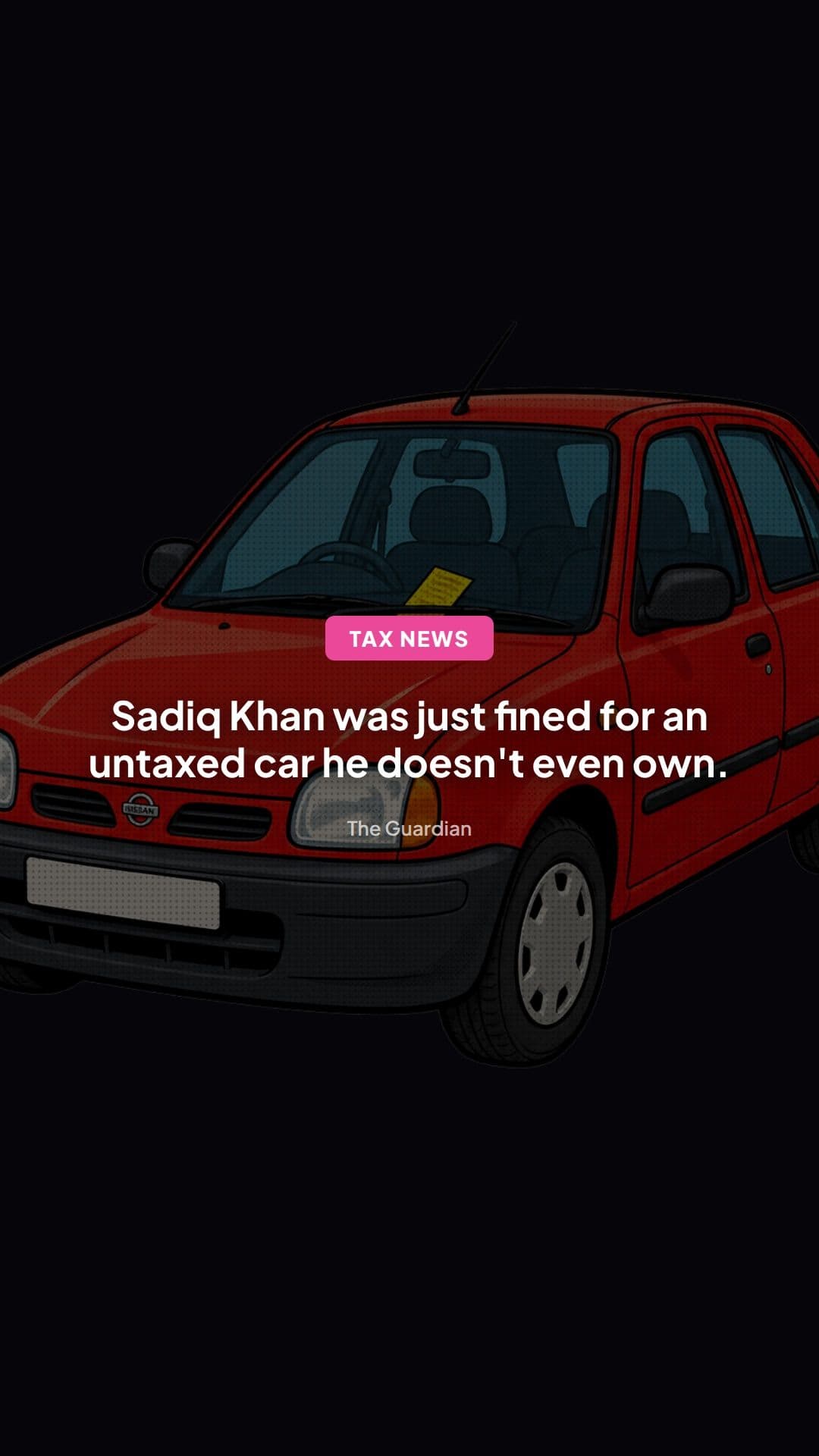
Sadiq Khan Fined Over Untaxed Car: What the Mayor's Ordeal Reveals About a Growing DVLA Scam
Imagine opening your post to find a court summons for a car you've never seen, never driven, and certainly never owned. That's roughly the situation London's mayor, Sadiq Khan, found himself in after a vehicle was fraudulently registered in his name and left untaxed. His office insists he's the victim of a scam, not a scofflaw who forgot to tax a runabout. Yet the fine landed anyway, processed through England's fast track court system before anyone had the chance to properly untangle the mess.
It's a story that sounds almost too neat to be true: the man in charge of London's transport network, hit with a penalty over a vehicle he says he's never had anything to do with. But strip away the political irony and you're left with something far more unsettling for ordinary drivers: a glimpse into how easily your identity can be attached to a car you know nothing about, and how unforgiving the system can be when it happens.
What Happened
According to reporting from the Guardian, a vehicle was registered against Sadiq Khan's name without his knowledge or consent. That vehicle then racked up an unpaid vehicle tax liability. Because DVLA enforcement for unpaid vehicle excise duty (commonly known as car tax) is largely automated and designed for speed, the case was funnelled through the fast track court process, essentially a streamlined system for dealing with high volumes of minor motoring and regulatory offences without the need for a traditional in-person hearing.
The result was a fine issued in Khan's name before his team had the opportunity to intervene. City Hall's response was clear: the mayor doesn't own the car, has never owned the car, and was the target of a scam that saw his identity used to register the vehicle fraudulently.
Whatever your politics, the process here is the interesting bit. This isn't a case of someone forgetting to renew their tax disc. It's a case of a name, seemingly plucked and attached to a vehicle without the knowledge of the person it belongs to, and a legal system that ground forward regardless.
Why It Matters
It's tempting to read this as a quirky story about a famous person's paperwork problem. It isn't. It's a warning shot for anyone who assumes that having a clean driving record and never having bought a dodgy car means they're safe from vehicle-related penalties.
Vehicle registration fraud, where someone else's name and address are used to register a car on the DVLA database, is not new, but it has become easier to pull off and harder to spot. The DVLA's registration system relies heavily on self-reported information. When someone buys a car, whether privately or from a trader, the seller or buyer notifies the DVLA of the change of keeper, usually via the V5C logbook or online. There isn't necessarily a robust identity check at that point comparable to, say, opening a bank account. If someone else's name and address are entered fraudulently as the new keeper, the DVLA has limited means of catching it at the point of registration.
The consequence is that the "registered keeper" of a vehicle, the person the DVLA has on file, isn't always the actual owner or user of the car. And because most enforcement, including automatic number plate recognition (ANPR) camera checks for unpaid vehicle tax, is triggered off that registered keeper record, penalties get issued to whoever's name is on file, regardless of whether they've ever sat in the driver's seat.
This matters enormously because unpaid vehicle tax enforcement doesn't wait around for a full investigation. It's designed to move fast, precisely because the vast majority of cases are genuine oversights rather than identity fraud. That efficiency is normally a good thing. It becomes a serious problem the moment the wrong person is caught up in it, as this case demonstrates all too clearly.
The Legal Angle
Vehicle Excise Duty (VED), the tax that pays for road use, is governed by the Vehicle Excise and Registration Act 1994. Under this legislation, liability for unpaid tax generally falls on the registered keeper of the vehicle as recorded by the DVLA, not necessarily whoever happens to be driving it at any given moment. This is a deliberate design choice: it gives the DVLA a single, traceable point of contact for enforcement rather than having to establish who was behind the wheel on a particular day.
Failing to tax a vehicle is a strict liability offence in most circumstances, meaning intent doesn't have to be proven for a penalty to apply. Cases are typically dealt with through the Single Justice Procedure or a fast track magistrates' process, where a magistrate reviews paperwork alone, without a hearing, and issues a decision. This system exists because the volume of minor traffic and regulatory cases would overwhelm the courts if every one required a full hearing. The trade-off is that there's limited scope, in the moment, for someone to say "wait, this isn't my car" before a penalty is issued.
That's precisely the gap that appears to have caught Sadiq Khan out. If you're fraudulently registered as a vehicle's keeper, you may not even know it's happened until a fine, court letter, or bailiff notice arrives. By that point, the case may already have moved through the fast track system.
There is a route to challenge this. Anyone who receives a penalty for a vehicle they don't own or didn't own at the relevant time can dispute the registered keeper record with the DVLA and, where a court penalty has already been issued, apply to have the case reopened, often via a statutory declaration process. This is similar in principle to the mechanisms used when someone is wrongly pursued for a parking charge on a vehicle they'd already sold, and it's worth understanding how those declarations work if you're ever caught in this position. Our guide to statutory declarations and TE7/TE9 forms covers the equivalent process for parking penalties, and the underlying logic, formally telling the authority the record is wrong and providing evidence, applies here too.
What Drivers Should Know
The uncomfortable truth is that this could happen to anyone, and there are practical steps worth taking to reduce the risk or catch it early.
Check your name isn't attached to a vehicle you don't recognise. You can use the free government vehicle enquiry service to check the tax and MOT status of any registration plate. If you suspect fraud, you're entitled to ask the DVLA to confirm what vehicles are registered against your name and address.
Keep your V5C paperwork current and don't delay notifying a sale. If you sell a car and don't formally notify the DVLA of the change of keeper, you remain the registered keeper on paper, exposing you to exactly this kind of liability if the buyer doesn't tax it or if fraud follows. If you've ever been fined for a vehicle you thought you'd sold, it's worth reading up on what to do when a fine follows a sale, since the fix often comes down to paperwork and timing.
Respond immediately to any DVLA correspondence, even if it seems irrelevant. Fast track and Single Justice Procedure cases move quickly precisely because they assume no dispute. Silence is read as agreement. If a notice arrives referencing a vehicle you don't recognise, contact the DVLA and, if necessary, the court straight away rather than assuming it will sort itself out.
Understand that identity fraud involving vehicles is a real and growing risk. Cloned number plates and fraudulently registered vehicles are both forms of the same underlying problem: your identity or your plate being used without consent. If you've ever dealt with a cloned plate generating unexpected penalty notices, the evidence-gathering process, insurance records, timestamped photos, alibi evidence, is broadly similar to what's needed to fight a fraudulent registration.
Don't assume a "fine" from a fast track court is the final word. These systems are built for speed and volume, not nuance. Genuine errors and fraud cases do get corrected, but usually only once the person affected pushes back formally.
Looking Ahead
Sadiq Khan's team has the resources, and presumably the legal support, to challenge this quickly and visibly. Most drivers caught in a similar scam won't have that advantage, and won't have a national newspaper covering their case either. That's the real lesson here: this can happen quietly, to anyone, and the system's default setting is to assume the paperwork is right until someone proves otherwise.
Expect renewed scrutiny of how the DVLA verifies keeper changes, and possibly calls for tighter identity checks when a vehicle's registered keeper is updated. Until any reform arrives, the best protection remains vigilance: check your own records occasionally, keep your paperwork tidy, and act fast the moment something doesn't add up. In a system built for speed, the burden of proof, in practice, often falls on the person wrongly accused to sort it out themselves.
Written by
The Parking Ticket Pal Editorial Team
Source-checked parking guidance
Ready to Challenge Your Ticket?
Let our AI analyse your PCN and generate a professional appeal letter in minutes.
Start Free Appeal