Red route parking rules UK: stops, loading & PCNs
Learn UK red route parking rules: when you can stop, load or drop off, what the markings mean, and how to avoid (or appeal) TfL PCNs.

David Chen
20 June 2026
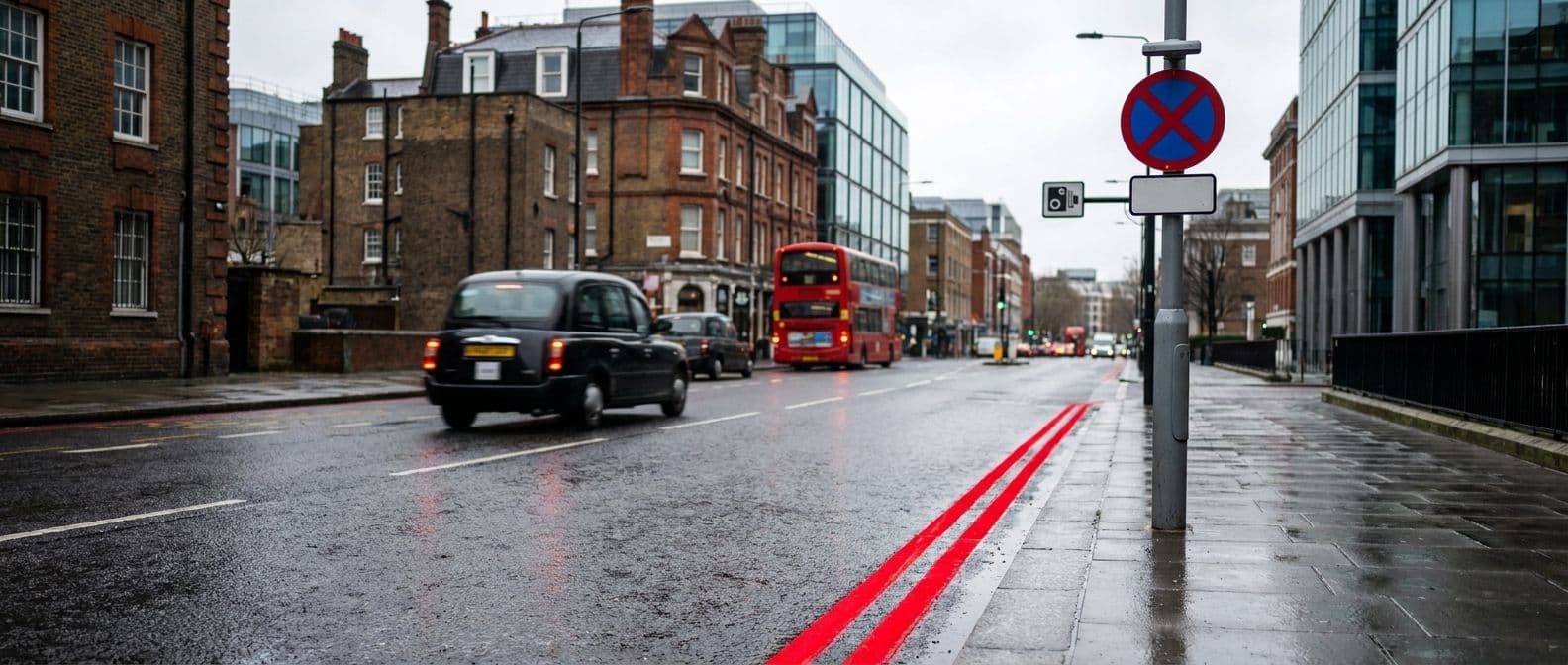
Red Route Parking Rules UK: What You Can (and Can't) Do — And How to Fight a PCN
You're running five minutes late, the traffic's brutal, and you spot a gap on the left just long enough to nip in and drop your passenger off. You pull over, they jump out, you're back in traffic within 60 seconds. Job done — or so you think.
Three weeks later, a £130 Penalty Charge Notice lands on your doormat. Welcome to the world of red route parking rules.
Red routes catch out thousands of drivers every year, not because people are reckless, but because the rules are genuinely confusing. What does a single red line mean versus a double? Can you ever stop? What about loading? And if you do get a PCN, is there any point appealing?
Let's break it all down.
What Is a Red Route?
A red route is a designated road — marked with red lines painted along the kerb — where stopping restrictions apply. The system was introduced in London by Transport for London (TfL) and is designed to keep traffic moving on the capital's busiest roads.
London has around 580 kilometres of red routes, covering roughly 5% of the road network but carrying about 30% of the city's traffic. Outside London, some local authorities have adopted similar schemes, but red routes are predominantly a London thing.
The key distinction from yellow lines? Yellow lines control parking. Red lines control stopping entirely — including loading and dropping off, unless signs or markings say otherwise.
Understanding Red Route Markings
Double Red Lines
Two red lines running parallel along the kerb mean no stopping at any time, for any reason. You cannot park, load, unload, or drop someone off. Not for 30 seconds. Not with your hazards on. Not while you "just run in."
This is the strictest category, and it applies 24 hours a day, seven days a week — unless a sign on a nearby plate says otherwise.
Single Red Line
A single red line means stopping restrictions apply during certain hours only — typically peak hours like 7–10am and 4–7pm on weekdays. Outside those times, you may be able to stop briefly to load or drop off.
Pro tip: Always check the time plate on a nearby sign post. The red line alone doesn't tell you the hours — you need the sign to confirm when restrictions apply.
Can You Ever Stop on a Red Route?
Yes — but only in specific circumstances.
Red Route Loading Bays
Look out for red-edged bays marked along the kerb with a sign indicating permitted use. These may allow:
- Loading and unloading for a set time window
- Parking during off-peak hours
- Taxi and bus use only (in which case, private vehicles must stay clear)
The markings will show a kerb-side box outlined in red, and a nearby sign will specify who can use it, and when.
Dropping Off and Picking Up
This is where many drivers get caught out. On a double red line, there is no exemption for dropping off or picking up passengers — not even briefly. On a single red line outside restricted hours, a very brief stop may be permissible, but you're still taking a risk if you leave the vehicle.
The safest approach: if you need to drop someone off on or near a red route, find a side street, a marked bay, or a designated drop-off area.
Exemptions
A small number of vehicles may be exempt from red route restrictions in certain circumstances:
- Emergency vehicles responding to an emergency
- Vehicles displaying a Blue Badge, in some (not all) red route scenarios — but this varies by location and sign, so never assume
- Licensed taxis picking up or setting down passengers, where signs permit
How TfL Enforces Red Routes
TfL uses a combination of Civil Enforcement Officers (CEOs) on foot and CCTV cameras — including fixed cameras and mobile units — to monitor red routes. The camera enforcement is particularly unforgiving because it captures footage from the moment you stop, making it very difficult to dispute the basic facts.
PCNs issued on red routes in London are typically:
- £160 for a higher-level contravention (reduced to £80 if paid within 14 days)
- Issued under the Traffic Management Act 2004
The relevant PCN codes for red route contraventions include code 01 (parked in a restricted street during prescribed hours) and code 14 (stopped on a red route), among others.
Common Scenarios — and What the Rules Actually Say
Scenario 1: You stop to let someone out of the car On a double red line, this is a contravention. Full stop. The fact that you were "only there for a moment" is not a defence.
Scenario 2: You pull over to check Google Maps Still a contravention on a double red line. Stopping is stopping.
Scenario 3: You park in a red bay outside the permitted hours You're likely fine — but check the sign carefully. Some bays have multiple restriction windows, and getting the hours wrong is a very common (and very expensive) mistake.
Scenario 4: You're a delivery driver unloading on a single red line Outside restricted hours, brief loading may be permitted. During restricted hours, it is not — regardless of whether you have a delivery to make.
How to Appeal a Red Route PCN
Getting a PCN doesn't mean you have to pay it. If you have genuine grounds, it's absolutely worth challenging.
Valid Grounds for Appeal
- The signs or markings were unclear, missing, or obscured — if the time plate was hidden by an overgrown tree or a poorly positioned sign, you have a case
- You were in a permitted bay but the PCN was issued incorrectly
- The vehicle was broken down and you had no choice but to stop
- The PCN contains factual errors — wrong vehicle registration, incorrect location, wrong contravention code
- You were not the registered keeper at the time (for example, the car had recently been sold)
The Appeals Process
- Informal challenge — Within 14 days of the PCN being issued, write to TfL explaining your grounds. If successful, the PCN is cancelled. If you pay the reduced rate during this period, you lose the right to challenge further.
- Formal representation — If your informal challenge is rejected, you'll receive a Notice to Owner. You then have 28 days to make a formal representation.
- Independent adjudication — If TfL rejects your formal representation, you can appeal to the Traffic Penalty Tribunal (for London, this is London Tribunals), which is free and independent.
Pro tip: Always include evidence. CCTV screenshots, photographs of unclear signage, breakdown recovery receipts — anything that supports your account. A well-evidenced appeal is significantly more likely to succeed than a written explanation alone.
How to Avoid Red Route PCNs in the First Place
- Never stop on a double red line — not even briefly, not even with hazards on
- Look for time plates before stopping on a single red line — the line alone tells you nothing about current restrictions
- Use side streets or designated bays for drop-offs near busy roads
- Plan ahead on delivery routes — identify permitted loading windows in advance
- Don't assume a Blue Badge covers everything — on red routes, it often doesn't
Your Next Steps
If you've received a red route PCN, act quickly:
- Don't ignore it — unpaid PCNs escalate to a Charge Certificate (adding 50% to the fine) and eventually to a debt recovery order
- Check the contravention code and location against what you remember
- Gather evidence — photos, receipts, witness accounts
- Submit an informal challenge within 14 days if you have grounds, keeping the reduced payment option open while you wait
- Escalate to London Tribunals if TfL rejects your appeal — adjudicators are independent, and many appeals succeed at this stage
Red routes exist for a good reason — keeping London moving — but the rules are strict and the enforcement is relentless. Know the markings, read the signs, and if you do get caught out unfairly, don't be afraid to fight it.
Written by
David Chen
Consumer Rights Expert
Ready to Challenge Your Ticket?
Let our AI analyse your PCN and generate a professional appeal letter in minutes.
Start Free Appeal