Record wholesale gas spike could push up UK fuel prices
Wholesale gas prices saw a record two-day jump amid Middle East tensions. Here’s what it could mean for UK petrol prices, forecourts and bills.

Hannah MacLeod
5 March 2026
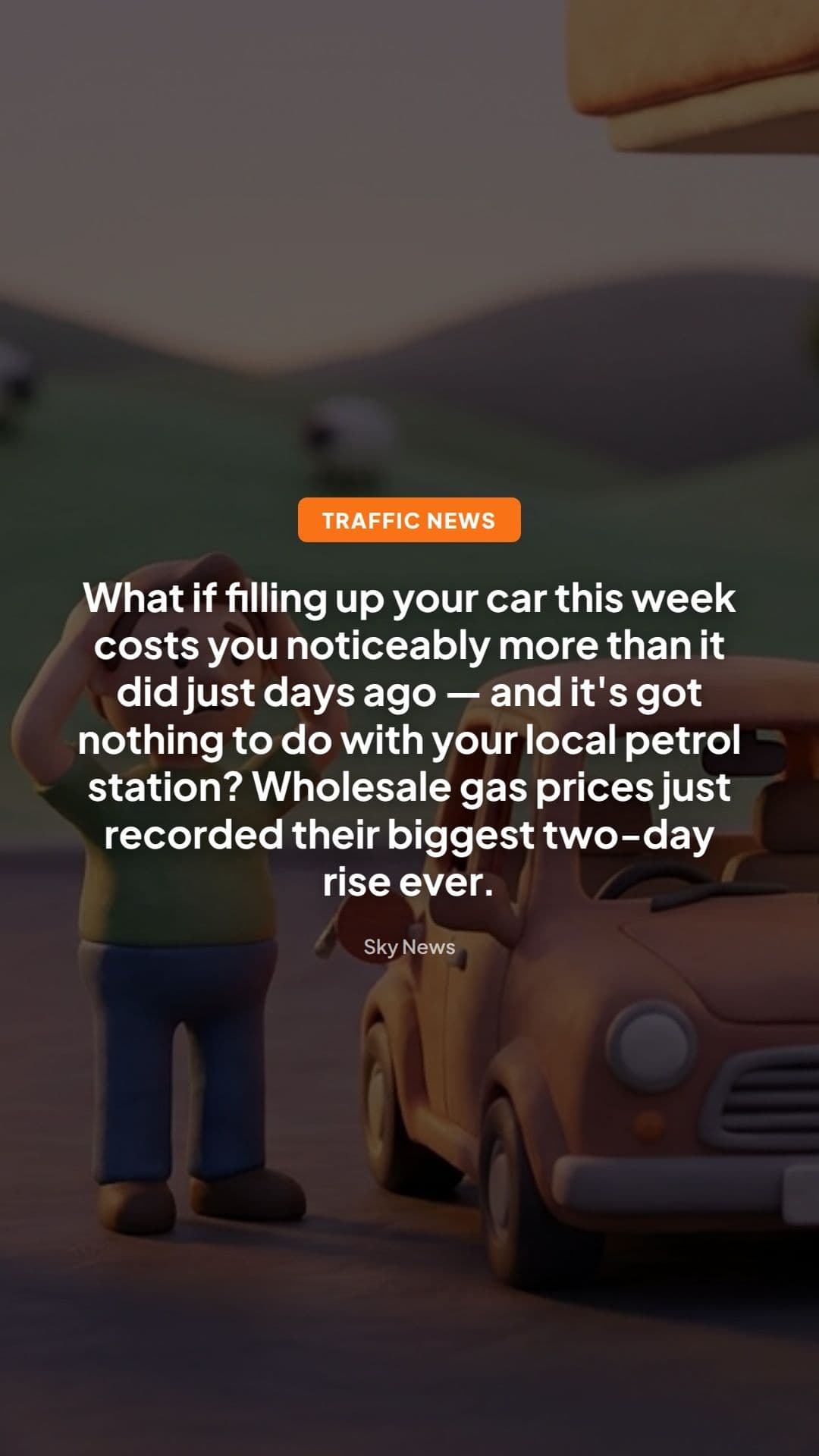
Fuel Prices Are Rising Again — And This Time, the Middle East Is Pulling the Strings
There's a particular kind of dread that settles over British drivers when they pull into a forecourt and squint at the price board. That creeping realisation that it's gone up again — not by a penny or two, but by a noticeable chunk — is becoming uncomfortably familiar. And if recent events in global energy markets are anything to go by, we may be about to relive one of the most painful chapters in recent motoring history.
Sky News has reported what analysts are calling the biggest two-day rise in wholesale gas prices on record, driven by escalating tensions in the Middle East. The ripple effects are already being felt across energy markets, and UK drivers — already squeezed by the cost of living — are firmly in the crosshairs.
What Actually Happened in the Energy Markets
To understand why your next fill-up might cost noticeably more, it helps to understand what's moved in the markets.
Wholesale gas prices surged over a 48-hour period at a pace not previously recorded. The trigger was a sharp escalation in Middle East tensions — the kind of geopolitical instability that energy traders react to almost instantaneously. When conflict or the credible threat of conflict emerges in or near oil and gas-producing regions, commodity markets don't wait for the dust to settle. They price in risk immediately, and that risk premium gets baked into every barrel of crude and every unit of gas traded globally.
Sky News's on-the-ground coverage captured the mood at UK forecourts — a sense of weary resignation from drivers who have been here before. The 2022 energy crisis, which saw petrol prices smash through the 190p-per-litre barrier, is still fresh in the collective memory. The question now is whether we're looking at a temporary spike or the beginning of a sustained new pressure on pump prices.
Why This Matters Beyond the Forecourt
It would be easy to frame this purely as a petrol price story, but the implications run considerably deeper for UK drivers and the broader motoring landscape.
The oil-gas connection is tighter than many people realise. While petrol and diesel are refined from crude oil rather than natural gas directly, the two markets are closely correlated. When gas prices spike, energy-intensive industries — including oil refining — face higher operating costs. Those costs get passed downstream. Hauliers, logistics companies, and fleet operators absorb them first, then pass them on through higher delivery charges and, ultimately, higher prices for goods.
Fuel duty and VAT mean that British drivers are particularly exposed to price volatility. Unlike some European counterparts, UK pump prices carry a fixed fuel duty of 52.95p per litre (as of the current rate, unchanged since the March 2022 freeze), plus 20% VAT on the total price including duty. This tax structure means that even a modest rise in the underlying wholesale cost produces a disproportionate jump at the pump. The government collects more in VAT as prices rise — a fact that has repeatedly prompted calls from motoring groups for duty cuts during price spikes.
Rural drivers bear the heaviest burden. The RAC and AA have consistently highlighted that drivers in rural areas — where public transport is sparse or non-existent — have no realistic alternative to their car. For them, fuel price rises aren't an inconvenience; they're a direct hit to household budgets with no easy workaround.
The Legal and Regulatory Landscape Around Fuel Pricing
Here's where things get interesting from a driver's rights perspective — because the fuel retail market in the UK is subject to a surprisingly complex web of regulation, and recent legislative changes have shifted the balance somewhat in consumers' favour.
The Pumpwatch Scheme
In 2023, the Competition and Markets Authority (CMA) published a landmark review of the UK road fuel market, concluding that weakened competition was costing drivers hundreds of millions of pounds per year. The government responded by legislating for a mandatory fuel price transparency scheme, colloquially known as Pumpwatch, under the Fuel (Spring) Act 2024 — though its full implementation has been phased.
Under Pumpwatch, major fuel retailers are legally required to report their pump prices in real time to a central database, which is then made publicly accessible. The intention is to give drivers the information they need to shop around and to put competitive pressure on retailers not to hold prices artificially high when wholesale costs fall.
This matters enormously in the current climate. One of the CMA's key findings was that while retailers were quick to raise prices when wholesale costs went up, they were far slower to pass on savings when costs fell — a phenomenon sometimes called "rockets and feathers" pricing. Pumpwatch is designed to make this behaviour visible and, ultimately, less sustainable.
Your Rights at the Pump
It's worth being clear about what the law does and doesn't protect. Fuel retailers in the UK are not legally obliged to sell fuel at a particular price — pricing remains a commercial decision. However, under the Consumer Rights Act 2015, any price displayed must be accurate and not misleading. If a forecourt advertises one price on its board and charges another at the till, that is a potential trading standards matter.
The Weights and Measures Act 1985 and associated regulations govern the accuracy of fuel dispensing equipment. If you have reason to believe a pump is dispensing less fuel than it's charging for, you can report this to your local Trading Standards office — though in practice, pump calibration is subject to regular inspection by Ofwat-accredited testing authorities.
What Drivers Should Know Right Now
The practical reality is that most drivers can't wait for regulatory frameworks to protect their wallets — they need strategies that work today. Here's what the evidence actually supports:
- Use the Pumpwatch data. The government's fuel finder tool and third-party apps such as Petrol Prices and Waze aggregate real-time pump price data. In many areas, there can be a difference of 5-8p per litre between the cheapest and most expensive forecourt within a few miles. On a 50-litre fill, that's a £4 saving for minimal effort.
- Supermarket forecourts remain the benchmark. Tesco, Asda, Sainsbury's, and Morrisons have consistently priced fuel below the national average. During periods of wholesale price volatility, the gap between supermarket and motorway service station forecourts can widen to 15-20p per litre. Motorway fuel, in particular, commands a significant premium and should be avoided unless genuinely necessary.
- Loyalty schemes have real value during price spikes. Tesco Clubcard, for instance, has periodically offered double points on fuel. During a sustained price rise, stacking these benefits becomes meaningfully worthwhile.
- Adjust your driving style. This sounds obvious, but the fuel efficiency gains from smooth acceleration, maintaining steady speeds, and keeping tyres properly inflated are well-documented. The Energy Saving Trust estimates that aggressive driving can increase fuel consumption by up to 30%. At current prices, that's not trivial.
- Consider whether your insurer covers fuel card fraud. A less-discussed risk during periods of economic stress is fuel theft and card skimming at forecourts. Check your bank's fraud protection policies and consider using contactless payment where available to reduce skimming risk.
Looking Ahead: The Bigger Picture for UK Drivers
The trajectory of fuel prices over the next six to twelve months will depend on factors largely outside any individual driver's control — the evolution of Middle East tensions, OPEC+ production decisions, the strength of sterling against the dollar (crude oil is priced in USD, so a weaker pound amplifies price rises), and the pace of domestic energy policy decisions.
What is within drivers' control is staying informed and organised. The Pumpwatch scheme represents a genuine structural improvement in market transparency, and if it functions as intended, it should at least prevent the worst excesses of "rockets and feathers" pricing during the current spike.
There is also a longer-term conversation to be had about the transition to electric vehicles and what sustained fuel price volatility means for that journey. For drivers already considering switching, a sustained period of high pump prices historically accelerates EV adoption — though the upfront cost barrier and charging infrastructure gaps remain real constraints for many.
For now, the immediate message is straightforward: stay informed, shop around, and don't assume the price at your nearest forecourt is the best available. In a volatile market, a little homework at the pump can make a meaningful difference to your monthly outgoings — and that's a form of driver empowerment that requires no legislation at all.
Source: Sky News — "Biggest two-day rise in gas prices on record"
Written by
Hannah MacLeod
Traffic Law Specialist
Ready to Challenge Your Ticket?
Let our AI analyse your PCN and generate a professional appeal letter in minutes.
Start Free Appeal