Rail-Ready Land Rovers: Driving 4x4s Built for Tracks
Test-driving Land Rovers converted for railway maintenance: rail gear mods, handling on track, off-road ability and what makes them ideal for UK rail work.

Emma Thompson
25 April 2026
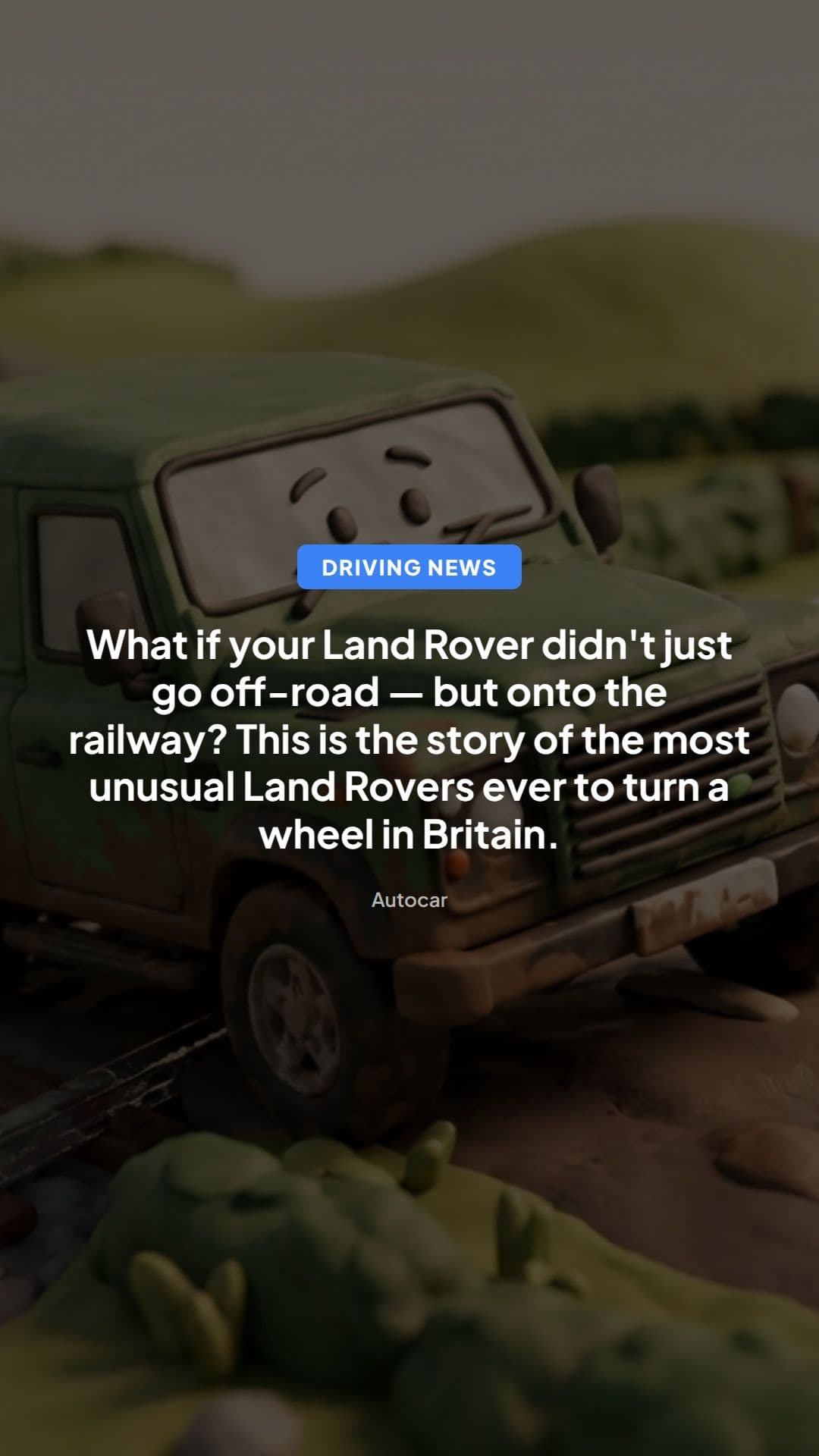
On the Rails and Off the Road: The Fascinating World of Railway Land Rovers — and What They Teach Us About Specialist Vehicle Law
There's something gloriously British about solving a complex engineering problem by bolting extra wheels onto a Land Rover. But these extraordinary machines raise some genuinely important questions about how specialist vehicles operate within — and sometimes outside — the rules that govern the rest of us.
The Story That Caught Our Eye
Autocar recently published a brilliant feature on one of motoring's more obscure corners: Land Rover Defenders and Series models that have been converted to run on railway tracks. The headline — "Corners like it's on rails!" — is, of course, entirely literal. These vehicles have been modified with flanged steel wheels that sit alongside their regular rubber tyres, allowing them to travel on standard British rail gauge track whilst retaining full road capability.
The machines in question are used primarily for railway maintenance work — inspecting track, delivering equipment to remote sections of line, and supporting engineering crews in locations that are simply inaccessible by either conventional rail vehicles or standard road traffic. They're known in the industry as road-rail vehicles or hi-rail vehicles, and they represent a genuinely remarkable piece of British engineering pragmatism.
The Autocar piece describes the driving experience as unexpectedly composed — the rail guidance system effectively does the steering for you once you're on track, leaving the driver to manage throttle and brakes whilst the flanged wheels keep everything pointed in the right direction. Off track, the vehicle behaves much as any modified Land Rover would: capable, purposeful, and entirely at home in demanding terrain.
Why These Vehicles Matter Beyond the Novelty
It's tempting to treat road-rail Land Rovers as a charming curiosity — the sort of thing that makes a great magazine feature but has little bearing on everyday motoring. In fact, they sit at the intersection of several genuinely important areas of transport law, vehicle regulation, and driver responsibility.
Road-rail vehicles have been operating on British infrastructure for decades. Network Rail and its predecessors have relied on hi-rail machinery since at least the 1970s, and the fleet today includes everything from converted Land Rovers to purpose-built road-rail excavators worth hundreds of thousands of pounds. The Land Rover variants are particularly valued for their versatility — they can travel to a remote lineside location by road, transition onto the track, complete maintenance work, and return to the road without the logistical complexity of bringing in specialist rail-only equipment.
What makes them especially interesting from a regulatory perspective is that they exist in two entirely separate legal frameworks simultaneously — road traffic law when on the public highway, and railway operational law when on the network. Getting the transition between those two states wrong, even briefly, can have serious consequences.
The Legal Framework: Two Sets of Rules, One Vehicle
On the Road
When a road-rail Land Rover is travelling on public roads, it is subject to the full weight of UK road traffic legislation, including:
- The Road Traffic Act 1988, which governs driver licensing, vehicle insurance, and roadworthiness
- The Road Vehicles (Construction and Use) Regulations 1986, which set out detailed requirements for vehicle dimensions, weight, lighting, and equipment
- The Road Vehicles Lighting Regulations 1989, covering mandatory lighting requirements
The additional rail guidance equipment — the flanged wheels, hydraulic deployment systems, and associated steelwork — must comply with these regulations just as any other modification would. Critically, any modification that affects a vehicle's type approval can require Individual Vehicle Approval (IVA) from the Driver and Vehicle Standards Agency (DVSA). A poorly documented conversion could render the vehicle technically illegal on the public road, regardless of how well it performs on the track.
Insurance is another significant consideration. A standard commercial vehicle policy almost certainly won't cover a road-rail conversion. Operators need specialist engineering or plant insurance that explicitly acknowledges the vehicle's dual-purpose nature and the environments in which it operates.
On the Railway
Once the vehicle transitions onto Network Rail infrastructure, road traffic law largely ceases to apply and an entirely different regime takes over:
- The Railways Act 1993 and subsequent amendments govern access to and operation on the national rail network
- Network Rail's own Rule Book — formally the Rulebook for Train Movements — sets out detailed operational requirements for any vehicle or person on the managed infrastructure
- The Railways and Other Guided Transport Systems (Safety) Regulations 2006 (ROGS) impose duties on operators to manage safety risks, including the use of road-rail vehicles
Drivers of road-rail vehicles on Network Rail infrastructure must hold specific Personal Track Safety (PTS) certification, which involves training in track awareness, hazard recognition, and emergency procedures. This is entirely separate from any road driving licence and must be renewed regularly. The vehicle itself must be formally accepted by Network Rail before it can operate on the managed infrastructure — a process that involves engineering assessment, documentation, and ongoing maintenance requirements.
What Drivers and Fleet Operators Should Know
If you're involved in fleet management, specialist vehicle operations, or simply find yourself curious about where the boundaries of road vehicle law actually lie, these practical points are worth keeping in mind:
1. Modifications require proper documentation Any significant modification to a road vehicle — particularly one that affects its structure, weight distribution, or safety systems — needs to be properly documented and may require IVA certification. Don't assume that because a modification is technically impressive, it's automatically legal for road use.
2. Dual-use vehicles need dual-use insurance If a vehicle operates in more than one environment — road and rail, road and off-highway, or road and site — the insurance policy must reflect that. A gap in cover at the point of transition between environments is a serious liability risk.
3. Driver qualification isn't just about the licence Operating specialist vehicles often requires qualifications beyond the standard driving licence categories. PTS certification for railway work, CPCS cards for plant machinery, and similar credentials exist precisely because standard road training doesn't prepare drivers for specialist environments. Employers have a duty under the Health and Safety at Work etc. Act 1974 to ensure workers are competent for the tasks they undertake.
4. Vehicle acceptance processes exist for good reasons Network Rail's acceptance process for road-rail vehicles is rigorous because the consequences of a failure on the railway are potentially catastrophic. The same principle applies in other contexts — whether it's a vehicle operating in a port, on an airfield, or on private industrial land, the absence of formal road traffic enforcement doesn't mean the absence of legal obligation.
5. MOT exemptions don't mean maintenance exemptions Some specialist vehicles benefit from MOT exemptions — historic vehicles over 40 years old being the most familiar example. But exemption from the MOT test does not exempt a vehicle from the requirement to be roadworthy. Operators of specialist fleets need robust internal inspection and maintenance regimes to fill the gap.
Looking Ahead: Specialist Vehicles in a Changing Landscape
The road-rail Land Rover is, in many ways, a product of a particular era of British engineering — practical, adaptable, and built around a platform that was designed from the outset to handle difficult terrain. As Land Rover has moved away from the utilitarian Defender towards a more premium positioning, the supply of suitable base vehicles for these conversions has become more complicated. The reintroduction of the new-generation Defender has been welcomed by some conversion specialists, though its more complex electronics and modern construction present different challenges to the older Series and classic Defender platforms.
More broadly, the question of how specialist vehicles integrate with road traffic law is becoming increasingly relevant as the range of vehicle types on UK roads expands. Electric road-rail vehicles are already in development, raising new questions about battery safety in the railway environment and charging infrastructure for vehicles that spend significant time away from conventional facilities.
There's also a wider point here about the relationship between innovation and regulation. The road-rail Land Rover works because the regulatory frameworks governing it — however complex — were developed thoughtfully, with input from engineers, operators, and safety specialists. As new categories of vehicle emerge, from autonomous delivery robots to electric vertical take-off aircraft with road capability, the challenge of building appropriate legal frameworks before the technology outpaces them becomes ever more pressing.
For now, though, it's hard not to feel a certain admiration for the engineers who looked at a Land Rover, looked at a railway track, and decided the obvious solution was to combine the two. Sometimes the most elegant answer really is the most straightforward one — even if the paperwork required to make it legal is anything but.
Source: Autocar, "Corners like it's on rails! Driving the Land Rovers built for the railway"
Written by
Emma Thompson
Traffic Law Specialist
Ready to Challenge Your Ticket?
Let our AI analyse your PCN and generate a professional appeal letter in minutes.
Start Free Appeal