Public Tackles Speeding as Councils Fail to Enforce
UK residents are stepping in to curb speeding with grassroots action. We examine what’s legal, risks of confrontation and why councils aren’t enforcing.

Raj Patel
3 April 2026
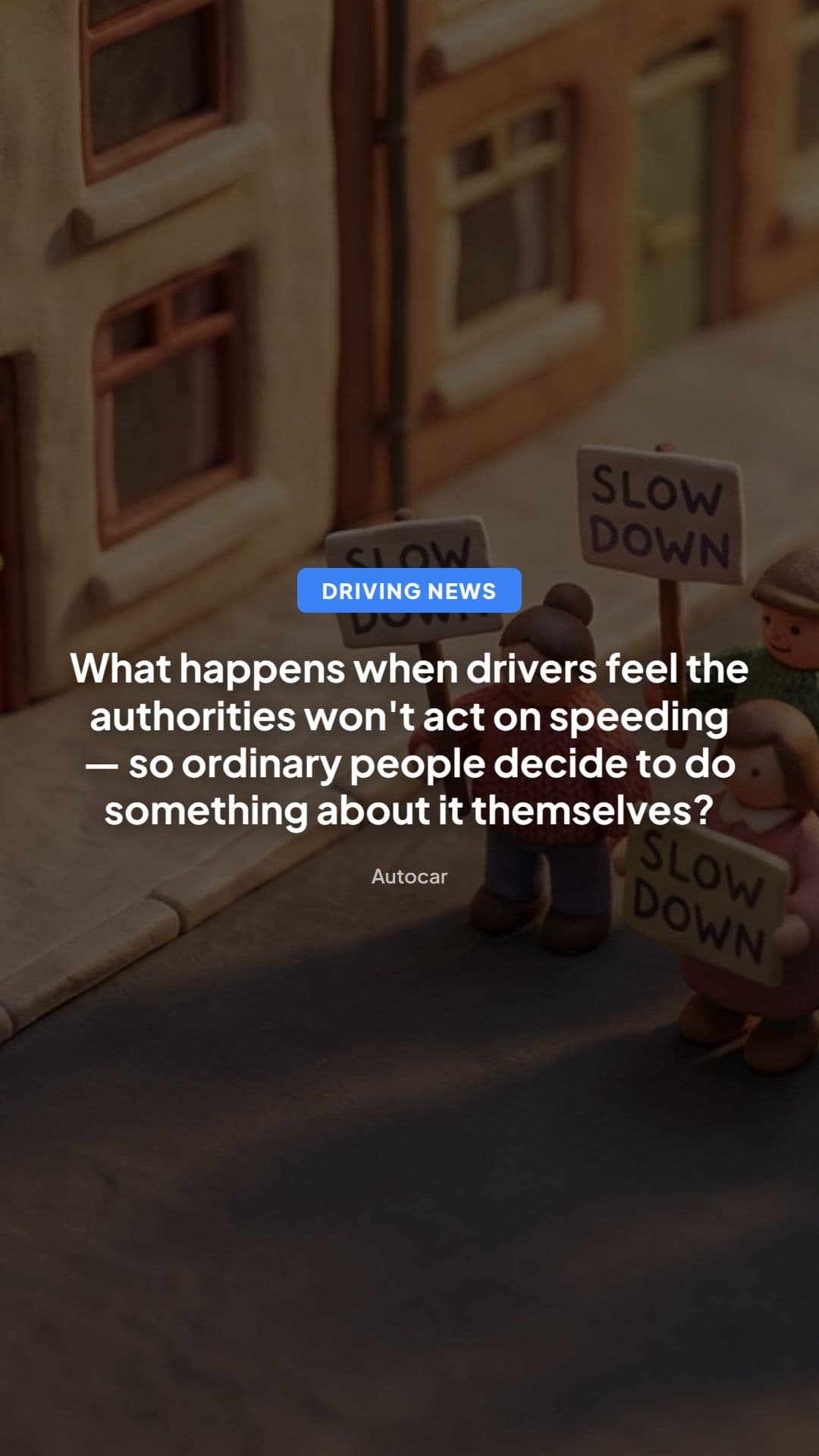
When Locals Take the Law Into Their Own Hands: The Rise of Grassroots Speed Enforcement in the UK
The roads outside your front door are getting faster and more dangerous — and if you're waiting for the authorities to do something about it, you might be waiting a very long time.
The Scene on Britain's Streets
Picture this: a quiet residential road in a market town somewhere in middle England. Children walk to school along the pavement. Elderly residents cross at the junction. And every morning, a stream of commuters uses the street as a rat run, regularly hitting 40 or 50 miles per hour in a 30 zone, seemingly without consequence.
The residents complain. They write to their council. They contact the police. And they are told, repeatedly, that resources are stretched, that other priorities exist, that data needs to be gathered before anything can be done.
So they do it themselves.
This is the reality playing out across Britain right now. As reported by Autocar, community groups and individual members of the public are increasingly stepping up to tackle speeding in their neighbourhoods — not because they want to, but because they feel they have no other choice. It is a story about frustration, civic action, and a growing disconnect between what local residents need and what official bodies are willing or able to deliver.
What's Actually Happening
The grassroots response to speeding has taken several forms. Community Speedwatch schemes — where trained volunteers use speed-detection equipment alongside police officers — have existed for years, but what's emerging now goes further. Residents are filming speeding vehicles, compiling evidence dossiers, and presenting them to police and councils. Some are erecting their own warning signs (of questionable legality). Others are lobbying for traffic-calming measures with a persistence that borders on the relentless.
In some areas, community groups have effectively shamed local authorities into action by going to local media or social media with footage of persistent offenders. In others, residents have clubbed together to fund independent traffic surveys — the kind of data councils claim they need before they'll act — and handed the results directly to highways departments.
The Autocar piece highlights the tension at the heart of this: communities are doing the legwork that authorities say is necessary to justify intervention, only to find that the goalposts keep moving. Data is gathered. Surveys are completed. And still, the speeding continues.
Why This Is Happening Now
To understand why this is boiling over in 2025, you need to understand what has happened to road policing in the UK over the past fifteen years.
The numbers are stark. According to figures from the Police Federation, the number of dedicated roads policing officers in England and Wales has fallen by around a third since 2010. The RAC Foundation has consistently highlighted the gap between the scale of speeding on UK roads and the enforcement capacity available to address it.
Meanwhile, fixed speed cameras — once the go-to deterrent — have been switched off in some areas due to funding disputes between central and local government. Average speed cameras are more effective but expensive to install. And mobile enforcement, which requires actual officers in actual vehicles, has become increasingly rare outside of motorways and major A-roads.
The result is a vacuum. Speeding in residential areas, on B-roads, and through village centres has become, in practical terms, largely unenforced. The 20mph zones that councils have rolled out across urban areas — controversial in their own right — are widely flouted precisely because there is no realistic prospect of being caught.
Add to this the post-pandemic shift in traffic patterns. More people working from home has redistributed traffic across the day, pushing more vehicles onto residential roads at times when enforcement was never designed to cover. And the growth in delivery vehicles, with drivers under time pressure, has added another layer of speed-related risk to streets that were never designed to handle it.
The Legal Landscape: What Can and Can't Be Done
This is where things get genuinely complicated — and where drivers need to pay close attention.
Community Speedwatch is the one formally sanctioned avenue for public involvement. Schemes operate under a framework agreed between the College of Policing and local constabularies. Volunteers are trained, they use calibrated equipment, and they operate strictly alongside police oversight. Crucially, they cannot issue fines or penalties themselves. What they can do is record vehicle registration numbers, which are then passed to police for a warning letter to be sent to the registered keeper. Repeat offenders can be referred for further action.
The legal basis here is important: Community Speedwatch volunteers have no powers of enforcement. They are, in effect, data gatherers. The decision to act on that data rests entirely with the police.
Filming from public spaces is generally lawful. Members of the public can film on public roads without requiring consent, and this footage can be submitted to police via the National Dash Cam Safety Portal — a scheme that allows drivers and pedestrians to upload video evidence of driving offences for police review. Several forces have used this evidence to pursue prosecutions.
However, erecting unofficial signage is a different matter entirely. Under the Traffic Management Act 2004 and the Road Traffic Regulation Act 1984, only authorised bodies — councils, Highways England, and similar — can legally place signs on the public highway. Residents who put up their own speed warning signs, however well-intentioned, are technically in breach of these regulations and could face removal notices or fines.
Blocking roads or physically attempting to slow traffic moves into even more legally precarious territory, potentially engaging offences under the Highways Act 1980 (obstruction of the highway) or, in more extreme cases, public order legislation.
The bottom line: public frustration is entirely understandable, but the legal tools available to ordinary citizens are narrower than many assume.
What Drivers Should Know
Whether you're a resident frustrated by speeding near your home, or a driver who wants to stay on the right side of the law, here's what matters:
If you're a resident wanting to take action:
- Join or set up a Community Speedwatch scheme — contact your local police force's roads safety team. This is the most effective and legally sound route available.
- Use the National Dash Cam Safety Portal to submit footage of dangerous driving. Forces vary in how actively they pursue submissions, but it creates a record.
- Commission an independent traffic survey if your council claims it lacks data. Several specialist firms offer this at reasonable cost, and presenting hard evidence is often more effective than anecdotal complaints.
- Engage your local councillor and MP — road safety falls under local authority and central government remit, and political pressure can unlock action that officer-level requests cannot.
- Avoid DIY signage or road modifications — the legal risk isn't worth it, and councils can use it as a reason to dismiss your wider concerns.
If you're a driver passing through residential areas:
- Be aware that Community Speedwatch activity is more widespread than many drivers realise. Warning letters from police — even without a fine — can be used as evidence of a pattern of behaviour in subsequent proceedings.
- Dash cam footage submitted by residents is increasingly being used by police. Driving at speed through a residential area is no longer as invisible as it once was.
- 20mph limits are enforceable, even if enforcement is currently rare. The legal limit is the legal limit, and that won't change because cameras are scarce.
Looking Ahead: A System Under Pressure
The grassroots enforcement trend raises a question that should make policymakers deeply uncomfortable: what happens when the public loses faith in official enforcement?
There are positive signs. The Vision Zero approach — targeting zero road deaths — has gained traction in several UK cities, and investment in average speed camera networks has continued in some areas. The government's road safety strategy, long overdue for an update, is expected to address some of these gaps.
But the structural problem — too few roads officers, too many competing demands on police resources, and a funding model for cameras that pits councils against central government — is not going to resolve itself quickly.
What the grassroots movement has demonstrated, perhaps unexpectedly, is that there is enormous public appetite for safer roads. Communities are not asking for the impossible. They are asking for basic enforcement of existing law on their own streets. The fact that they feel compelled to do it themselves is not a testament to civic spirit — it is an indictment of a system that has quietly withdrawn from one of its most fundamental responsibilities.
For drivers, the message is simple: the cameras may be switched off, the patrol cars may be absent, but the neighbours are watching. And increasingly, they know exactly what to do with what they see.
Source: Autocar — ["Public tackles speeding as authorities refuse to act"](https://www.autocar.co.uk/car-news/consumer/public-tackles-speeding-authorities-refuse-act)
Written by
Raj Patel
Transport Policy Analyst
Ready to Challenge Your Ticket?
Let our AI analyse your PCN and generate a professional appeal letter in minutes.
Start Free Appeal