Private Parking PCNs to Hit 14.5m: What Drivers Can Do
RAC says private parking firms may issue 14.5m PCNs this year. See who’s issuing most tickets, common pitfalls (apps, signs) and how to appeal.

Carlos Mendoza
14 July 2026
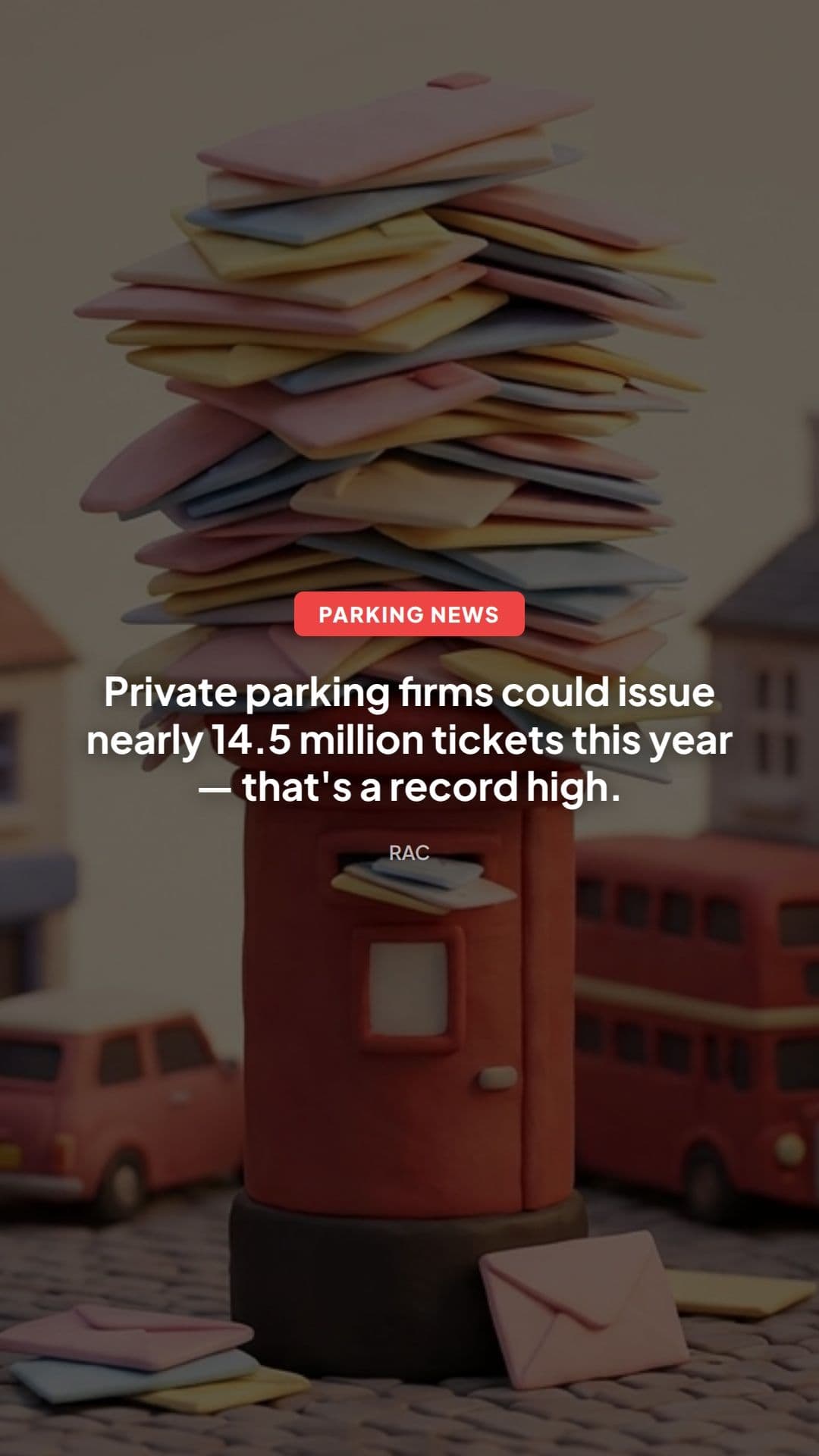
14.5 Million Private Parking Tickets: Why Britain's Enforcement Boom Should Worry Every Driver
Picture this: somewhere in Britain, a private parking ticket is being issued roughly every two seconds. Not by a council warden, not by the police, but by a private company with a camera, a database, and a financial incentive to catch you out. According to RAC analysis of government data, private parking firms are on course to issue close to 14.5 million penalty charge notices in a single year, a figure that would represent a record high and a staggering increase on the volumes seen just a few years ago.
That is not a typo. Nearly 14.5 million tickets, from private land alone, in twelve months.
So what is driving this surge, who is issuing these tickets, and what does it mean for the millions of drivers who park on private land every single day? Let us dig into the detail.
The Scale of the Problem
The RAC's analysis, drawing on government data, paints a picture of an industry that has grown enormously in both reach and appetite. Private parking enforcement has expanded rapidly alongside the rollout of automatic number plate recognition (ANPR) cameras, which allow firms to monitor car parks, retail forecourts, hospital grounds, and housing estates with minimal human intervention. A camera films your plate as you enter, again as you leave, and the system does the maths. If you overstay, pay incorrectly, or fall foul of any condition, a notice lands on your doorstep days later.
What makes this particularly striking is that enforcement is heavily concentrated. A handful of major operators account for a disproportionate share of the total ticket volume. This concentration matters because it means a small number of companies wield enormous power over millions of drivers, and their practices, including the reliability of their apps, the clarity of their signage, and the fairness of their appeal processes, directly affect whether those millions of tickets are legitimate or not.
Why This Matters Beyond the Numbers
At first glance, 14.5 million tickets might sound like 14.5 million people who simply broke the rules. But the reality is considerably more complicated.
Private parking tickets are not the same as council-issued penalty charge notices. They are, in legal terms, a contractual claim. The theory is that by entering a private car park, you enter into a contract with the landowner or their agent. If you breach the terms, whether by overstaying or failing to pay, the company claims you owe them a sum of money.
This distinction matters enormously. Because these are civil debts rather than statutory penalties, the burden of proof and the rules around enforcement are different. A company must be able to demonstrate that the contract was clearly communicated, usually through signage, and that you are the person liable. Errors in this process are common, and they form the basis of many successful appeals.
The growing scrutiny mentioned in the RAC's analysis centres on three areas in particular: app reliability, signage quality, and appeal mechanisms. Each of these deserves serious attention.
App reliability has become a genuine flashpoint. Many car parks now rely entirely on cashless payment through smartphone apps. When those apps fail, time out, or fail to register a session correctly, drivers can receive a ticket through no fault of their own. If you have ever paid for parking only to receive a notice weeks later claiming you did not, you are far from alone. Our guide on what to do when parking apps fail and how to appeal the resulting PCN covers this in detail.
Signage is the other major battleground. Under the British Parking Association (BPA) and International Parking Community (IPC) codes of practice, which govern their respective member firms, signage must be clear, legible, and positioned so that drivers can read the terms before committing to park. In practice, signs are frequently obscured, faded, poorly positioned, or written in language so dense that a reasonable person could not be expected to absorb the key conditions. Courts and independent appeal adjudicators have repeatedly found in drivers' favour on signage grounds.
Appeal mechanisms remain a source of frustration. While both trade bodies operate independent appeal services, the process can feel deliberately opaque to drivers who are unfamiliar with it. The IPC operates the Independent Appeals Service (IAS), while BPA members are subject to oversight from POPLA (Parking on Private Land Appeals). Both provide a route to challenge a ticket without going to court, but awareness of these routes remains low.
The Legal Framework: Where Things Stand
The legal landscape governing private parking has shifted significantly in recent years. The Protection of Freedoms Act 2012 was a landmark piece of legislation that ended the practice of clamping on private land in England and Wales, and crucially, it introduced the concept of "keeper liability." This means that if a driver cannot be identified, a parking company can pursue the registered keeper of the vehicle instead, provided they follow a strict set of procedural rules.
Those rules include issuing a Notice to Keeper within specific timeframes and following the correct format. If a company gets these steps wrong, keeper liability does not apply, and the notice may be unenforceable. This is one reason why procedural errors in private parking enforcement are not merely technical quibbles: they can be decisive.
More recently, the Parking (Code of Practice) Act 2019 paved the way for a single, government-backed code of practice for private parking. That code, developed by the British Standards Institution, introduced a mandatory ten-minute grace period before a ticket can be issued after a permitted parking time expires, and it capped charges at £100 in most cases outside London. These were meaningful protections, though campaigners argue they do not go far enough.
It is also worth noting that the Competition and Markets Authority (CMA) has taken an increasingly active interest in private parking practices, having investigated and fined operators for failures around information provision. This signals a regulatory environment that is, slowly, becoming less tolerant of sharp practice.
What Drivers Should Know
If you receive a private parking ticket, here is what is worth understanding, bearing in mind that this is general information rather than advice about your specific situation, and that if the sums involved are significant, you may want to seek professional guidance.
Do not ignore it. Unlike a council PCN, a private parking ticket does not automatically escalate to a bailiff. However, if a company obtains a county court judgment against you and you ignore that, enforcement can follow. The safest approach is always to engage with the process.
Check the basics first. Is the vehicle registration correct? Were the signs clearly visible and legible when you arrived? Did you pay correctly and do you have evidence of that payment? Was the notice issued within the correct timeframe? Any of these could form the basis of a challenge.
Appeal if you have grounds. Start with an informal representation to the company. If that fails, escalate to POPLA or the IAS depending on which trade body the operator belongs to. These are free services for the driver.
Keep your evidence. Photographs of signage, payment receipts, app confirmation screenshots, and any correspondence should all be retained. Evidence is everything in a successful appeal.
Know the grace period rules. Since the code of practice came into force, operators must allow at least ten minutes after a paid or permitted period expires before issuing a ticket. If a ticket was issued before that window closed, that is a strong ground for appeal.
Looking Ahead: Reform, Resistance, and the Road Forward
The trajectory here is uncomfortable. If private parking firms are approaching 14.5 million tickets annually, and if enforcement technology continues to improve, that number will not fall on its own. The question is whether the regulatory environment will keep pace.
There is genuine political pressure for further reform. Campaigners and motoring organisations have called for stricter controls on signage standards, mandatory plain-English terms, stronger appeal rights, and greater transparency about how companies calculate their charges. The argument is straightforward: a system that generates this volume of tickets, concentrated among a small number of operators, with known problems around app reliability and signage, is not functioning fairly.
At the same time, the industry argues that enforcement serves a legitimate purpose. Without it, car parks intended for customers would be abused, disabled bays would be blocked, and residential areas would be overwhelmed. That case has merit. The issue is not enforcement itself but the standards to which it is held.
For drivers, the practical reality is this: private parking enforcement is here to stay, and the volumes involved mean that almost every driver will encounter it at some point. Understanding your rights, knowing the appeal process, and keeping evidence of your parking arrangements are no longer optional extras. They are essential knowledge for anyone who drives in modern Britain.
The scale of what the RAC's analysis reveals should serve as a prompt, not just for policymakers, but for every driver who has ever assumed that a private parking ticket is simply a bill to be paid. Sometimes it is. But very often, it is not.
Written by
Carlos Mendoza
Parking Technology Analyst
Ready to Challenge Your Ticket?
Let our AI analyse your PCN and generate a professional appeal letter in minutes.
Start Free Appeal