Private Land Parking Rights: Trespass, Permits & Towing
Learn your private land parking rights in the UK: when parking becomes trespass, who can ticket you, what signs must say, and when towing is unlawful.

Emma Thompson
4 April 2026
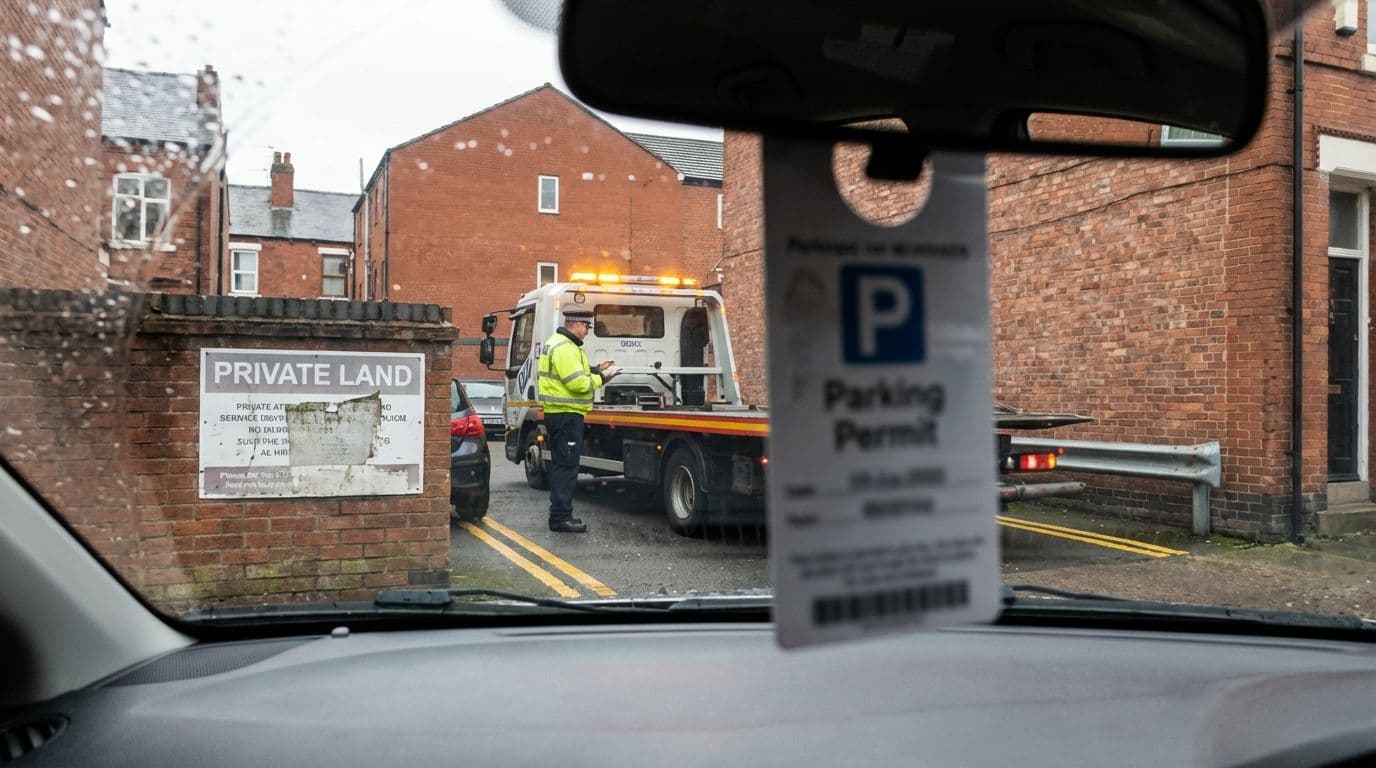
Private Land Parking Rights: What Every UK Driver Needs to Know
You've just returned to your car to find a bright yellow notice tucked under your windscreen wiper. But here's the thing — you weren't parked on a council-controlled street. You were in a supermarket car park, a private estate, or perhaps outside a friend's house on privately owned land. So what exactly are your rights? Who has the authority to issue that ticket? And when does the landowner cross a line themselves?
Private land parking in the UK is a legal minefield that catches thousands of drivers off guard every single year. The rules are fundamentally different from council-issued penalties, and understanding those differences could save you a significant amount of money — and stress.
What Actually Makes Land "Private"?
Private land is any land that isn't publicly maintained highway. That includes:
- Supermarket and retail car parks
- Hospital car parks
- Private residential estates and driveways
- Industrial estate access roads
- Hotel and leisure facility car parks
- Land adjacent to shops, restaurants, or gyms
Just because the public can access it doesn't mean it's public land. A supermarket car park, for instance, is privately owned even though hundreds of people use it daily. This distinction matters enormously when it comes to enforcement.
Parking on Private Land: Is It Trespass?
Here's something that surprises many drivers: parking on private land without permission is civil trespass, not a criminal offence. You cannot be arrested for it. In most cases, a landowner's remedy is through civil court — not calling the police to haul you away.
That said, trespass does give the landowner certain rights, including the right to request you remove your vehicle. If you refuse, they may seek a court order. The key point is that trespass alone does not automatically entitle anyone to clamp or tow your vehicle — we'll come back to that shortly.
If you park on genuinely private land — say, a private driveway without any signage or permission — the landowner can ask you to leave. If you don't, they can pursue a civil claim for damages, but these situations rarely escalate that far.
How Private Parking Charges Actually Work: It's Contract Law
Unlike a Penalty Charge Notice (PCN) issued by a council, a Parking Charge Notice from a private operator is not a fine. It is a contractual charge. The legal basis is this: when you drive onto private land displaying appropriate signage, you are entering into an implied contract. The signs set out the terms — pay for parking, display a valid permit, don't overstay — and by parking there, you're deemed to have accepted those terms.
This is why the signage matters so much. If the signs are inadequate, unclear, or absent, the contract argument falls apart entirely.
For a private parking charge to be legally enforceable, the signage must:
- Be clearly visible at the entrance to the land
- State the terms in plain, legible language
- Specify what the charge will be for a breach
- Be adequately lit if enforcement takes place at night
Pro tip: If you receive a Parking Charge Notice and the signs at the location were obscured, damaged, or missing, photograph them immediately. This is one of the strongest grounds for a successful appeal.
What Private Operators Can and Cannot Do
Private parking companies — often members of the British Parking Association (BPA) or the International Parking Community (IPC) — operate under codes of practice that carry real weight. Since the government-backed Private Parking Code of Practice came into force, operators face stricter rules around grace periods, signage, and charge caps.
What they CAN do:
- Issue a Parking Charge Notice (PCN) for a breach of the terms on their land
- Pursue the registered keeper of a vehicle through the civil courts
- Use DVLA-approved ANPR cameras to capture entry and exit times
- Pass debt to a collections agency if a charge remains unpaid
What they CANNOT do:
- Issue a legally enforceable "fine" (only councils and police can issue statutory fines)
- Clamp your vehicle on most private land (more on this below)
- Charge more than the capped maximum under the current code of practice
- Pursue a driver for a charge where the signage was inadequate
The Permit Parking Problem
Many private residential estates and managed developments operate permit schemes. If you park in a permit-only bay without a valid permit displayed, the operator may issue a charge — but only if the signage and scheme are properly administered.
Common scenarios where drivers get caught out:
- Visitor permits not displayed correctly — even if you have one, it must be visible
- Permit expired — some schemes require annual renewal and send no reminder
- Wrong zone — permits are often zone-specific on larger estates
- Temporary suspension of bays — sometimes bays are suspended for works, but residents aren't notified in time
If you live on a managed estate and receive a charge despite holding a valid permit, your first port of call should be the managing agent or residents' management company, not the parking operator directly.
Pro tip: Always keep a photograph of your permit as displayed in your vehicle. If a charge is issued claiming no permit was visible, that timestamped photo could be decisive in an appeal.
When Is Towing Unlawful?
This is where things get serious. Clamping on private land in England and Wales has been illegal since 2012, under the Protection of Freedoms Act 2012. Anyone who clamps your vehicle on private land without lawful authority commits a criminal offence. The same Act also made it illegal to tow a vehicle from private land without lawful authority.
There are narrow exceptions — local authorities, the police, and DVLA enforcement agents retain powers to clamp and tow in specific circumstances. But a private parking company? They have no such power.
If your vehicle is towed from a private car park by a company acting on behalf of the landowner, this is potentially unlawful. You may be entitled to recover your vehicle without paying, and the company could face criminal liability. The practical steps in this situation:
- Do not pay a release fee under duress without first establishing the legal basis for the tow
- Report the incident to the police — this may constitute theft or an offence under the Protection of Freedoms Act
- Document everything — photographs, the company's details, any signage present
- Seek legal advice if the company refuses to return your vehicle without payment
Appealing a Private Parking Charge
If you receive a Parking Charge Notice from a private operator and believe it's unjust, you have a clear appeals process available to you.
Stage 1: Appeal to the operator directly
Do this in writing, setting out your grounds clearly. Common successful grounds include:
- Inadequate or unclear signage
- Valid permit was displayed
- Vehicle was exempt (e.g., a Blue Badge holder, a carer, an emergency)
- The charge exceeds the permitted cap
- You were the registered keeper but not the driver
Stage 2: Independent Appeals Service
If the operator rejects your appeal, they must offer you access to an independent adjudicator. Depending on which trade association the operator belongs to, this will be either POPLA (Parking on Private Land Appeals) for BPA members, or the IAS (Independent Appeals Service) for IPC members. These services are free to use and genuinely independent.
Pro tip: Operators lose a significant proportion of cases at independent appeal stage. Don't assume a rejection at Stage 1 is the end of the road.
Your Practical Action Plan
Whether you've just received a charge or want to protect yourself in future, here's what to do:
- Before you park: Read the signs carefully. Note the terms, any time limits, and whether a permit or payment is required.
- When you park: Photograph the signage at the entrance and any permit you display. Note the time.
- If you receive a charge: Don't ignore it. Respond within the appeal window (usually 28 days).
- Build your case: Gather evidence — photos, receipts, witness statements, anything relevant.
- Know your escalation route: Operator appeal first, then POPLA or IAS if rejected.
- If your vehicle is towed: Contact police immediately and do not assume you must pay to retrieve it.
Private land parking law in the UK is firmly on the driver's side in more situations than most people realise. The key is knowing your rights, keeping your evidence, and not letting an official-looking notice intimidate you into paying something you don't legitimately owe.
Written by
Emma Thompson
Traffic Law Specialist
Ready to Challenge Your Ticket?
Let our AI analyse your PCN and generate a professional appeal letter in minutes.
Start Free Appeal