PCN Code 82: Parked After Paid Time Expired (UK)
Got a PCN Code 82 for overstaying in an off-street car park? Learn what it means, key UK rules, evidence to gather, and appeal tips.

James Wilson
21 February 2026
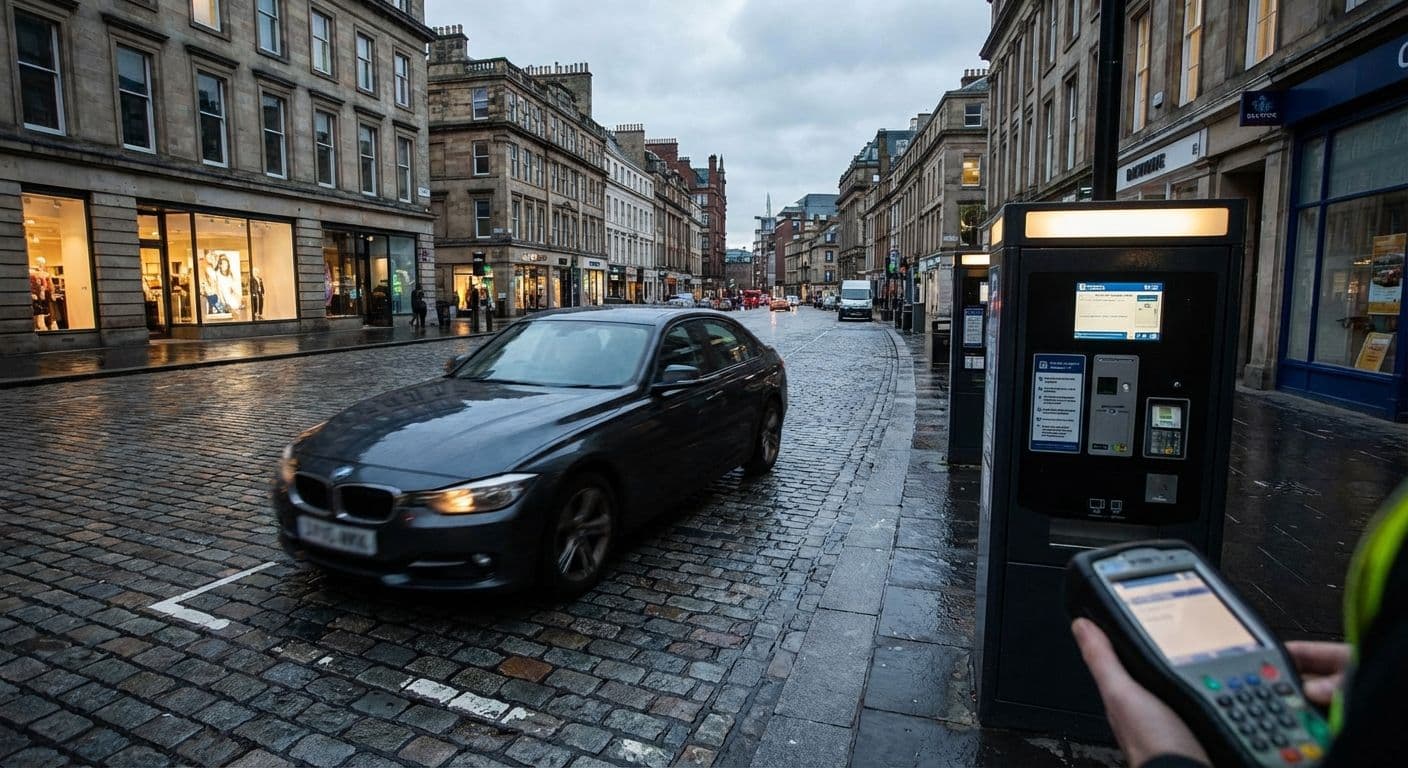
PCN Code 82: Parked After Paid Time Expired (UK)
You know the feeling: you paid, you displayed (or you paid on the app), you popped into town “for ten minutes”… and somehow ten minutes became forty-five. You get back to the car park and there it is — that bright yellow packet, or an email later if the council uses ANPR.
If your ticket says **PCN Code 82 – “Parked after the expiry of paid for time”**, this guide will walk you through what it means in a **UK council off-street car park**, what rules matter, what evidence actually helps, and how to put together a solid appeal.
---
What does PCN Code 82 mean?
**PCN Code 82** is used by councils for **off-street parking places** (council-run car parks) when they believe your vehicle stayed **beyond the time you paid for**.
Typical setups include:
- **Pay & display** (paper ticket on the dashboard)
- **Pay by phone** (RingGo, PayByPhone, etc.)
- **Barrier or pay-on-exit** (less common for Code 82, but not impossible)
- **ANPR-monitored car parks** (entry/exit cameras)
In plain terms, the allegation is:
You paid for parking until X time, but your vehicle was still parked after X time.
This is different from on-street “meter expired” situations (that’s a different contravention). Code 82 is the council’s go-to for **overstays in a council car park**.
---
The legal backbone (without the jargon)
Most council PCNs in England (and many in Wales) are enforced under the **Traffic Management Act 2004** and the **Civil Enforcement of Parking Contraventions** regulations.
What that means for you in practice:
- The council must follow a set **statutory process** (PCN → informal challenge → Notice to Owner → formal reps → tribunal).
- The contravention must be backed by a valid **Traffic Regulation Order (TRO)** (the legal document that sets the car park terms).
- Evidence and procedure matter. Councils don’t always get either right.
(Scotland and Northern Ireland have different systems and terminology, but Code 82 is typically seen in the civil enforcement context used by councils.)
---
A quick story: the “I paid, honestly” overstay
Let’s say Aisha parks in a council car park at 14:05 and pays for two hours on RingGo. Her receipt shows expiry at 16:05. She gets delayed at the pharmacy and returns at 16:12.
A Civil Enforcement Officer (CEO) logs the car at 16:10 and issues a PCN at 16:11. Aisha thinks, “It’s seven minutes… surely that’s allowed?”
Maybe. But the outcome depends on **grace periods**, **local policy**, and the evidence.
---
Grace periods in off-street car parks: what you should know
You’ll often hear “you get 10 minutes.” The reality is: **it’s not always straightforward**, especially off-street.
In many places, councils apply a **10-minute grace period** after paid time ends, but:
- It can depend on how the car park order is drafted and how the council applies the guidance.
- A grace period can be treated as **policy** (discretion) in some off-street contexts rather than an absolute guarantee.
- ANPR timing can be especially messy because it may measure **entry/exit**, not **when you actually parked**.
**Actionable tip:** If you overstayed by a small margin (say **1–10 minutes**), check your council’s website for:
- “grace period” policy
- “observation period” wording
- CEO handbook notes (some councils publish them)
Even where it’s not crystal clear, a short overstay is often a strong **mitigation + proportionality** argument.
---
How councils prove a Code 82 contravention
A council will usually rely on one of these:
1) CEO evidence (pay & display / app-checked)
- Photos of your vehicle in the bay
- Photos of your pay & display ticket (if visible)
- Notes showing the **observed time**, **PCN time**, and any checks made
2) ANPR evidence (entry/exit cameras)
- Time-stamped images of entry and exit
- A “parking duration” calculation
**Pro tip:** ANPR doesn’t prove “parked” time perfectly — it often proves **time on site**. If you had to queue to enter, find a bay, or queue to exit, that can matter (especially in busy town-centre car parks).
---
The most common reasons Code 82 PCNs are successfully challenged
Here are the strongest, most realistic angles — with the type of evidence that makes them work.
1) You did pay — the council hasn’t matched it correctly
This happens a lot with cashless parking:
- Wrong VRM entered (one digit/letter off)
- Paid for the wrong car park (app defaulted to a nearby location)
- Payment started later than arrival due to poor signal / app delay
- Multiple vehicles on the account and the wrong one was selected
**Evidence to gather:**
- **RingGo transaction** screenshot/email
- **PayByPhone receipt**
- Bank statement line showing the charge
- App history showing location code / session details
**Pro tip:** If the VRM is slightly wrong but clearly connected to you and the correct time/location, many councils will cancel or reduce as a discretionary fix — especially if it’s a first-time issue.
---
2) The signage or payment instructions weren’t clear
In off-street car parks, the council must communicate the terms. If key information is missing or confusing (especially around **ANPR**, **how time is calculated**, or **how to extend a session**), that’s appeal fuel.
**What to photograph:**
- Entrance sign (especially if it’s ANPR)
- Tariff board near the machine
- Any sign about “time starts on entry” vs “time starts on payment”
- Any sign about app use / location code
- The machine screen prompts (if still there)
**Example scenario:** The entrance says nothing about ANPR, but the PCN relies on ANPR entry/exit time. If the only sign is deep inside the car park, you can argue the terms weren’t adequately brought to the driver’s attention at the point of deciding to park.
---
3) The PCN timing / observation looks shaky
A Code 82 PCN may be vulnerable if:
- The CEO issued immediately at expiry with no meaningful observation
- The times recorded don’t match the evidence
- The photos don’t show the ticket clearly (if pay & display)
**Evidence to request/check:**
- CEO notes (many councils provide on request or via the portal)
- Full photo set
- Pay & display machine audit log (if relevant)
- ANPR log (if ANPR used)
---
4) You tried to leave but couldn’t (queues, blocked exits, events)
This is especially relevant for ANPR sites.
**Useful proof:**
- Photos/video of queue at exit (if you have it)
- Witness statement (short, factual)
- Evidence of an event, roadworks, or temporary closure affecting exits
- Timestamps from messages/calls showing you were delayed while attempting to leave
**Pro tip:** Keep this grounded: “I attempted to exit at X; traffic was stationary; I exited at Y.” Councils respond better to a tight timeline than a long story.
---
5) Mitigating circumstances (the human stuff)
Councils can cancel PCNs using discretion. Strong examples include:
- Medical emergency (you or passenger)
- Breakdown
- Blue Badge-related issues in an off-street context (depends on car park rules)
- Machine not working + you attempted to pay another way
**Best evidence:**
- Breakdown report
- Appointment slip (if relevant)
- Photo of faulty machine + error message
- Record of calling the helpline (if a number is displayed)
---
Don’t sleep on the discount period
Most councils offer a **discount period** (often 14 days) where the penalty is reduced (e.g., 50%).
If you’re going to challenge, check the council’s wording. Many councils will **re-offer the discount** if you make an informal challenge within the discount window — but not all.
**Practical approach:**
- Challenge early, clearly, with evidence attached.
- If the council rejects but re-offers the discount, you can decide whether to pay or continue.
---
Step-by-step: how to appeal a PCN Code 82
Step 1: Check what you received
- A PCN on the windscreen? You can usually make an **informal challenge** first.
- A postal PCN (often ANPR)? You still challenge, but the timelines differ.
Step 2: Get your evidence together (before you write anything)
Create a small folder with:
- Payment proof (ticket photo, RingGo/PayByPhone receipt, bank line)
- Photos of signs/machines (if relevant)
- Any timeline notes (arrived, paid, returned, attempted exit)
Step 3: Submit an informal challenge (keep it structured)
Aim for:
- What happened (short timeline)
- What you paid / why the contravention didn’t occur (or why it should be cancelled)
- What evidence you attach
- What you want (cancellation, or discretion)
Step 4: If rejected, wait for the Notice to Owner (NTO) if you want to go formal
If the PCN was on the car and you don’t pay, the council will send a **Notice to Owner** to the registered keeper. That’s when you make **formal representations**.
Step 5: Tribunal stage (if needed)
If formal representations are rejected, you can appeal to an independent tribunal:
- **London Tribunals** (if the council is in London)
- **Traffic Penalty Tribunal** (most councils outside London)
At tribunal, clear evidence and clear chronology win more often than passionate arguments.
---
A practical informal challenge template (copy/paste)
Use this as a starting point and tailor it to your facts:
Subject: Informal Challenge – PCN [number] – Vehicle [VRM] – Contravention Code 82

I am challenging PCN [number] issued on [date] at [car park name/location].

I paid to park and did not park beyond the expiry of paid time / OR I request cancellation due to the circumstances below.

Timeline:
- Arrived: [time]
- Payment made: [time] via [RingGo/PayByPhone/pay & display]
- Paid until: [expiry time shown]
- Returned / attempted to leave: [time]
- Left site (if ANPR): [time]

Evidence attached:
1) Proof of payment: [receipt/transaction ID/screenshot]
2) [Photo of pay & display ticket / bank transaction / app history]
3) [Any relevant photos of signage/machine/exit queue]

If the council alleges an overstay, please provide the full CEO notes and all photographs, or the ANPR entry and exit images and the calculation used.

In view of the evidence, I request the PCN is cancelled. If you do not agree, please treat this as a request for discretion and provide a full explanation with the evidence relied upon.

Yours faithfully,
[Name]
[Address or postcode]
---
Common mistakes that weaken Code 82 appeals
- **Not including proof of payment** (even a bank line helps)
- Writing “I only overstayed a little” but giving **no times**
- Ignoring ANPR logic (argue the *timing method*, not just the result)
- Waiting too long and missing the chance to challenge at the discount stage
---
Next steps (do this today)
- **Read the PCN carefully**: location, contravention time, observation time, evidence type.
- **Download your payment proof**: RingGo/PayByPhone receipt, ticket photo, or bank record.
- **Check the council portal** for photos/ANPR images and save them.
- **Draft your informal challenge** using the template and submit within the discount window if possible.
- If rejected and you’re confident, **prepare for the Notice to Owner** and formal representations — and keep every message and screenshot.
If you want, paste the PCN wording (front/back) and tell me whether it was **pay & display, RingGo/PayByPhone, or ANPR**, and I’ll help you shape the strongest appeal points for your exact situation.
Written by
James Wilson
Legal Counsel
Ready to Challenge Your Ticket?
Let our AI analyse your PCN and generate a professional appeal letter in minutes.
Start Free Appeal