PCN Code 81: Restricted Area in Car Parks—Appeal Tips
Got a PCN code 81 for parking in a restricted area in a car park? Learn what it means, key evidence to gather, and appeal arguments for UK councils.

Emma Thompson
11 June 2026
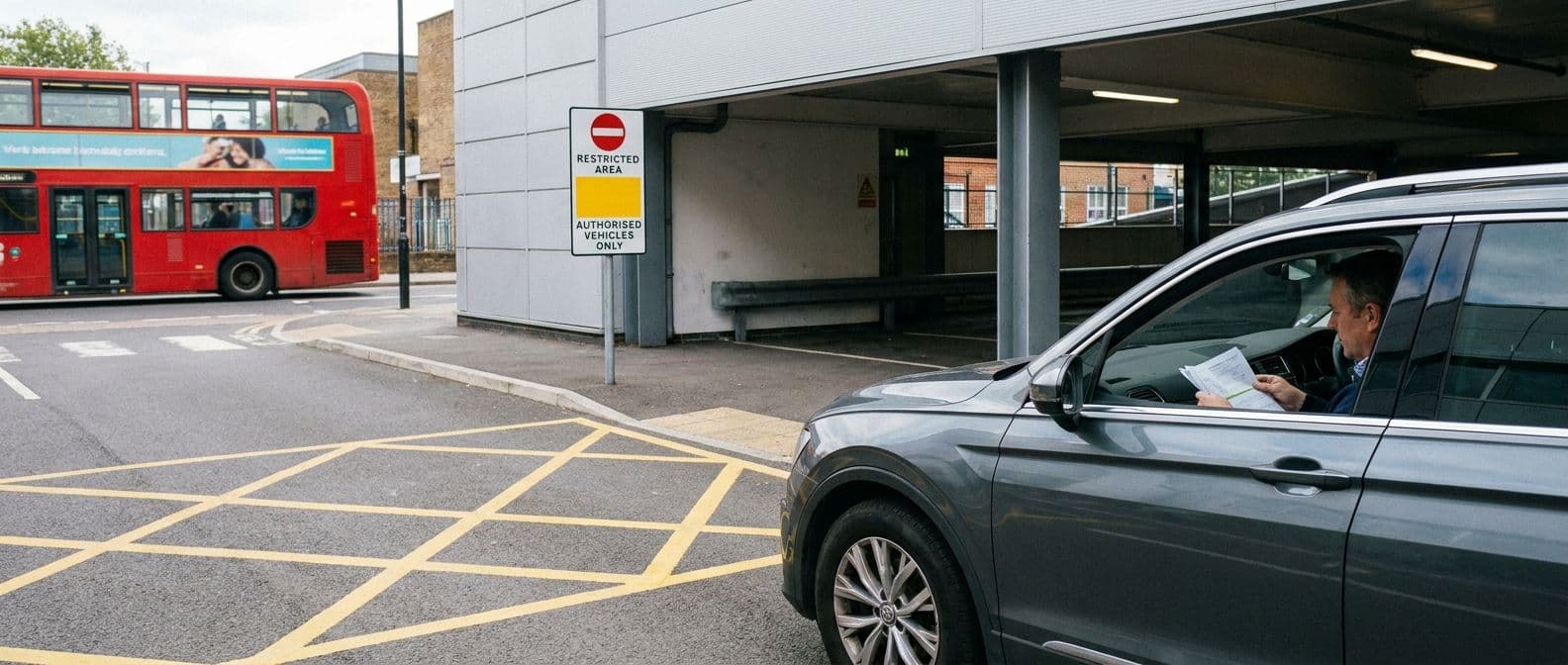
PCN Code 81: Parked in a Restricted Area in a Car Park — Your Complete Appeal Guide
You've returned to your car to find a Penalty Charge Notice tucked under the wiper. The code reads 81. You're in a council car park, you weren't blocking anyone, and you genuinely thought you were parked perfectly legally. So what went wrong — and more importantly, what can you do about it?
PCN code 81 is one of those contraventions that catches drivers off guard precisely because it's not always obvious where the "restricted area" begins and ends. Unlike a double yellow line on the street, car park restrictions can be subtle — a faded hatch marking here, an easy-to-miss sign there. The good news? That subtlety is often exactly what makes these PCNs worth challenging.
What Does PCN Code 81 Actually Mean?
PCN code 81 is issued for "parked in a restricted area in a car park." It falls under off-street parking enforcement, meaning it applies to council-operated car parks rather than on-street locations.
The contravention covers a range of situations, including:
- Parking on hatched or yellow box areas within a car park
- Stopping in a no-stopping zone marked within the car park
- Parking in an area designated for specific use only (e.g., loading bays, staff areas, or service vehicle zones)
- Parking in a prohibited zone that isn't a standard numbered bay
The key legislation underpinning this is the Traffic Management Act 2004, which gives local authorities the power to enforce off-street parking contraventions through Civil Enforcement Officers (CEOs). When a council issues a PCN under code 81, they're asserting that your vehicle was positioned in an area where parking is expressly prohibited by the car park's Traffic Regulation Order (TRO) or management scheme.
Why These PCNs Are Often Weak — and Worth Challenging
Here's something councils don't always advertise: many code 81 PCNs are successfully appealed, often because the signage or markings fail to meet the required legal standard.
For a restriction to be enforceable, it must be adequately signed and marked. That means:
- Signs must be visible, legible, and positioned so that a reasonable driver could be expected to see them on entry or approach
- Bay markings and hatched areas must be clearly painted and not significantly faded
- The restriction must be authorised by a valid TRO — if the council can't produce one, the PCN falls apart
If any of these elements are missing or deficient, you have a genuine basis for appeal.
Gathering Your Evidence: Do This Before You Do Anything Else
The moment you receive a code 81 PCN, your priority is evidence gathering. Don't delay — car parks can be repainted, signs replaced, and conditions change.
Go back to the location as soon as possible and photograph:
- The exact spot where you parked — show the markings (or lack of them) clearly
- Any signs at the car park entrance and within the car park — capture the full sign, including height, position, and legibility
- The hatched or restricted area from multiple angles — show whether it was faded, partially obscured, or ambiguous
- Any obstructions — overgrown hedges, parked vehicles, or structures that blocked your view of signs
- The surrounding bays — to show context; was your car actually in a marked bay?
Pro tip: Take timestamped photos and note the weather and lighting conditions. If the sign was partially obscured by a lorry or a tree branch, photograph that too. Councils must prove the restriction was visible and enforceable at the time of the contravention.
Common Scenarios — and How to Argue Them
Scenario 1: The Hatched Area Was Faded
You parked at the edge of a bay and didn't notice faded yellow hatching beneath your wheels. The CEO issued a code 81.
Your argument: The road markings were not sufficiently clear to alert a reasonable driver to the restriction. Faded or worn markings that fail to clearly delineate the restricted zone undermine the enforceability of the contravention. Include close-up photographs showing the deterioration.
Scenario 2: No Clear Signage at the Car Park Entrance
You entered the car park and saw no sign indicating that certain areas were restricted. You parked in what appeared to be an unused space.
Your argument: Under the Traffic Management Act 2004 and associated regulations, restrictions in off-street car parks must be communicated through adequate signage. If there was no sign at the entrance or within the car park identifying the restricted area, the restriction may not be enforceable. Request that the council provide evidence of compliant signage.
Scenario 3: You Were Parked Partially in a Bay
Your vehicle was mostly within a marked bay but slightly overlapping a hatched area. The CEO issued a code 81.
Your argument: If the majority of your vehicle was within a lawful bay and any overlap was minimal and unintentional, this may constitute a disproportionate enforcement action. Also check whether the bay markings themselves were clearly defined — if the bay line and hatch boundary were unclear, that ambiguity should work in your favour.
Scenario 4: The Restriction Wasn't Authorised by a TRO
This is less common but powerful. If the restricted area exists informally — painted by the car park operator without a proper Traffic Regulation Order — it may have no legal force at all.
Your argument: Request a copy of the Traffic Regulation Order authorising the restriction. If the council cannot produce one, or if the TRO doesn't cover the specific area where you parked, the PCN should be cancelled.
The Appeal Process: Step by Step
Step 1 — Informal Challenge (Within 14 Days)
When you receive the PCN, you have 14 days to pay at the discounted rate (usually 50% of the full penalty) or to submit an informal challenge to the issuing council. If you challenge informally and the council rejects it, you still get the opportunity to pay at the discounted rate — but only if the council's rejection notice offers this.
Write your informal challenge clearly. State your grounds, reference your photographic evidence, and keep the tone factual and calm.
Step 2 — Formal Representations (After the Notice to Owner)
If your informal challenge is rejected, the council will issue a Notice to Owner (NTO). This is your opportunity to make formal representations — a more structured legal challenge. You have 28 days from the NTO to respond.
At this stage, your representations are taken more seriously. The council must consider them properly and issue a formal Notice of Rejection if they disagree.
Step 3 — Traffic Penalty Tribunal
If your formal representations are rejected, you can appeal to the Traffic Penalty Tribunal (TPT) — the independent adjudicator for parking disputes outside London. In London, this is handled by London Tribunals.
This is a free process for the appellant. Adjudicators are independent of the council and will assess the evidence impartially. A significant proportion of cases that reach this stage are decided in the driver's favour, particularly where signage or markings are deficient.
Pro tip: Don't be put off by a council rejection at the informal stage. Councils often reject challenges as a matter of routine. The TPT is where genuinely weak PCNs get cancelled — and adjudicators have repeatedly found against councils where car park signage was inadequate.
Key Arguments to Include in Your Appeal
When writing your challenge, consider including these points where relevant:
- Signage was absent, obscured, or illegible at the time of the contravention
- Road markings were faded or unclear, failing to adequately define the restricted area
- The council has failed to produce a valid TRO authorising the restriction
- The area was ambiguous — a reasonable driver could not have known it was restricted
- Your vehicle was predominantly within a lawful bay, and any encroachment was minimal
- The CEO's observation photographs do not clearly show a contravention
Actionable Next Steps
- Don't pay immediately — paying accepts the contravention and ends your right to appeal
- Return to the car park and photograph everything — signs, markings, your exact parking spot
- Submit an informal challenge within 14 days — include your photos and a clear written argument
- Request the Traffic Regulation Order — ask the council to confirm the restriction is properly authorised
- If rejected, wait for the Notice to Owner and submit formal representations within 28 days
- If still rejected, appeal to the Traffic Penalty Tribunal — it's free, independent, and worth using
PCN code 81 might feel like an open-and-shut case from the council's perspective, but the reality is that off-street restrictions are frequently poorly signed, inadequately marked, or improperly authorised. Take the time to build your case properly, and you may well find that fine doesn't stick.
Written by
Emma Thompson
Traffic Law Specialist
Ready to Challenge Your Ticket?
Let our AI analyse your PCN and generate a professional appeal letter in minutes.
Start Free Appeal