PCN Code 35 & No Entry Signs: How to Challenge It
Got a PCN code 35 for ‘no entry’? Learn the key legal checks on signage, camera evidence and TROs, plus practical appeal points to get it cancelled.

Tariq Khan
7 July 2026
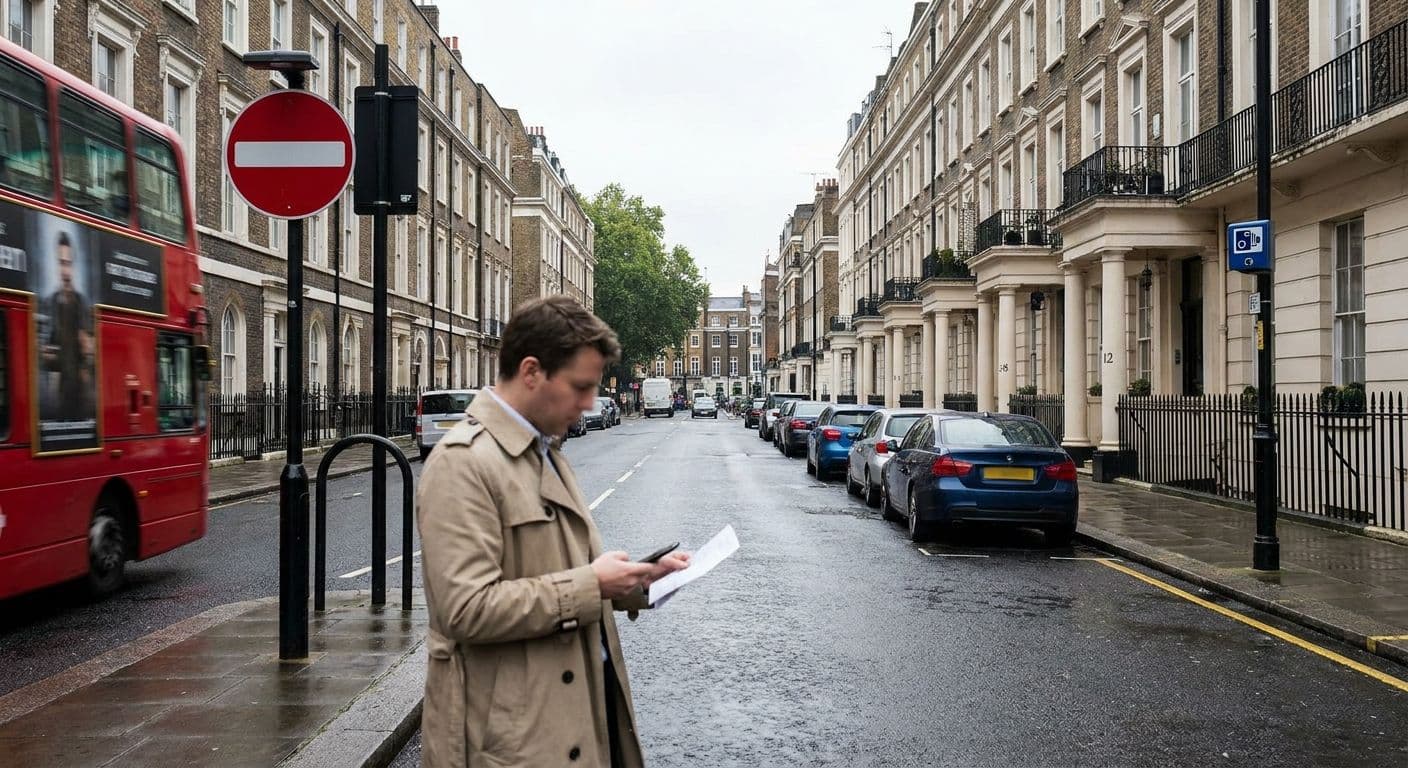
PCN Code 35: How to Challenge a No Entry Sign Penalty
You're driving through an unfamiliar area, following your sat nav, and you slip down a road that turns out to have a no entry sign. Maybe you didn't see it. Maybe it was obscured by a van. Maybe you genuinely couldn't tell the restriction applied to your vehicle. A few weeks later, a Penalty Charge Notice drops through your letterbox — PCN code 35: failing to comply with a no entry sign.
It feels deeply unfair, especially when you weren't trying to break the rules. The good news? These PCNs are far from bulletproof. Councils make mistakes with signage, camera evidence, and traffic orders — and those mistakes can get your fine cancelled entirely. Here's exactly what to check and how to fight back.
What Is PCN Code 35?
PCN code 35 is a moving traffic contravention issued when a driver is recorded entering a road or junction in the prohibited direction past a no entry sign. Unlike parking PCNs, these are almost always captured by CCTV or ANPR cameras rather than a physical warden.
In London, moving traffic enforcement is handled by the council under powers granted by the Traffic Management Act 2004. Outside London, most no entry contraventions are still dealt with by the police — though more councils are gaining moving traffic enforcement powers under the Traffic Management Act rollout across England.
The standard penalty is £130 in London (reduced to £65 if paid within 14 days), with similar amounts elsewhere depending on the issuing authority.
The Legal Framework: What the Council Must Prove
For a PCN code 35 to be valid, the council must demonstrate three things:
- A lawful Traffic Regulation Order (TRO) is in place prohibiting entry
- Signage complies with the Traffic Signs Regulations and General Directions 2016 (TSRGD)
- Camera evidence clearly shows your vehicle entering in contravention
If any of these pillars crumble, your appeal has a strong foundation.
Checking the Signs: Your First Line of Defence
The TSRGD 2016 sets out precise requirements for no entry signs — and councils don't always get it right. The standard no entry sign (diagram 616 in TSRGD) must be:
- The correct size — minimum dimensions apply depending on road speed limit and type
- Properly illuminated or reflective where required
- Clearly visible and not obscured by vegetation, parked vehicles, or other street furniture
- Positioned correctly — at or near the point of entry to the restricted road
Pro tip: Use Google Street View to check what the signage looked like at the time of the alleged contravention. Councils must keep signs maintained, but Street View often captures historic images that reveal faded, damaged, or partially hidden signs.
If a sign is obscured, damaged, or non-compliant with TSRGD dimensions, that's a legitimate ground for appeal. Adjudicators at the Traffic Penalty Tribunal (outside London) and London Tribunals have consistently upheld appeals where signage was ambiguous or non-compliant.
Checking the Traffic Regulation Order
Every no entry restriction must be backed by a valid Traffic Regulation Order (TRO). A TRO is the legal instrument that creates the restriction — without it, the sign has no legal force.
Here's how to check:
- Submit a Subject Access Request (SAR) or Freedom of Information (FOI) request to the council asking for a copy of the TRO covering the road in question
- Check whether the TRO is current and unrevoked — councils sometimes forget to update orders when road layouts change
- Verify the TRO's geographical description matches the exact location where you were caught — a surprisingly common discrepancy
If the TRO is missing, expired, or doesn't cover the specific point of entry, the PCN cannot stand. This is one of the most powerful grounds available and is well worth investigating.
Scrutinising the Camera Evidence
When you receive a PCN, you have the right to request the full CCTV footage as part of your challenge. Don't just accept the still images included with the notice — ask for the video clip. When reviewing it, look for:
- Is your vehicle clearly identifiable? Partial number plate reads or poor image quality are legitimate challenges
- Is the no entry sign visible in the footage? If the camera angle doesn't capture the sign, it's harder for the council to prove you could see it
- Are road markings visible? The no entry bar markings on the road surface should be present and legible
- Is there any indication the sign was temporarily removed or covered? Roadworks, maintenance, or events sometimes lead to signs being bagged or repositioned without proper authority
Pro tip: Councils are required to retain footage for a reasonable period. If they can't produce clear, continuous footage showing the contravention, that weakens their case considerably.
Common Scenarios Where PCN Code 35 Gets Cancelled
Scenario 1: The sat nav trap You're following sat nav directions and turn into a road that used to be two-way. The no entry restriction is relatively new, and the sign is small and positioned behind a parked lorry. This is a strong appeal — particularly if you can show the sign was obscured or the restriction was recently introduced without adequate advance warning signs.
Scenario 2: Delivery or loading exemptions Some no entry restrictions include exemptions for loading, deliveries, or certain vehicle types. If your TRO includes such an exemption and you were genuinely loading or delivering, you may have a complete defence. Check the supplementary plates beneath the sign carefully.
Scenario 3: Emergency or unavoidable entry If you entered the restricted road to avoid an immediate hazard — a pedestrian stepping out, a vehicle reversing unexpectedly — document this and include it in your representations. Adjudicators have discretion in genuine emergency cases.
Scenario 4: Wrong vehicle recorded ANPR misreads happen. If the number plate on the PCN doesn't precisely match your vehicle's registration, or if the vehicle description doesn't match yours, challenge it immediately with photographic evidence of your vehicle.
How to Appeal: The Step-by-Step Process
Step 1: Informal representations (within 14 days for the discount) Write to the council setting out your grounds clearly. Keep it factual and evidence-based. Attach photographs of the signage, Street View screenshots, and any supporting documentation. Reference the TSRGD where relevant.
Step 2: Formal representations (within 28 days of the Notice to Owner) If informal representations are rejected, you'll receive a Notice to Owner. You then have 28 days to make formal representations. This is a statutory process — the council must consider your grounds properly and issue a formal response (a Notice of Rejection or cancellation).
Step 3: Independent adjudication If formal representations are rejected, you can appeal to an independent adjudicator — the Traffic Penalty Tribunal (outside London) or London Tribunals (within Greater London). These are free to use, genuinely independent, and overturn a significant proportion of appeals that reach them. You can submit evidence online and request a hearing if needed.
Your Actionable Next Steps
If you've received a PCN code 35, do this right now:
- Note the 14-day deadline — paying at the reduced rate is an option, but don't let it stop you investigating first
- Request the full CCTV footage from the council in writing
- Check the signage on Google Street View and photograph it in person if possible
- Submit an FOI request for the TRO covering that road
- Draft your informal representations citing specific TSRGD requirements and any signage defects
- Keep copies of everything — correspondence, photographs, and footage
PCN code 35 might feel like an open-and-shut case for the council, but the legal requirements around signage, TROs, and camera evidence are strict for good reason. Get the details right, and you have a genuine chance of getting it cancelled without paying a penny.
Written by
Tariq Khan
Bailiff Procedures Expert
Ready to Challenge Your Ticket?
Let our AI analyse your PCN and generate a professional appeal letter in minutes.
Start Free Appeal