PCN Code 27: Parked Adjacent to a Dropped Footway
Got a PCN code 27 for parking by a dropped kerb? Learn what it means, UK rules, common exemptions, evidence to gather, and how to appeal.

James Wilson
24 February 2026
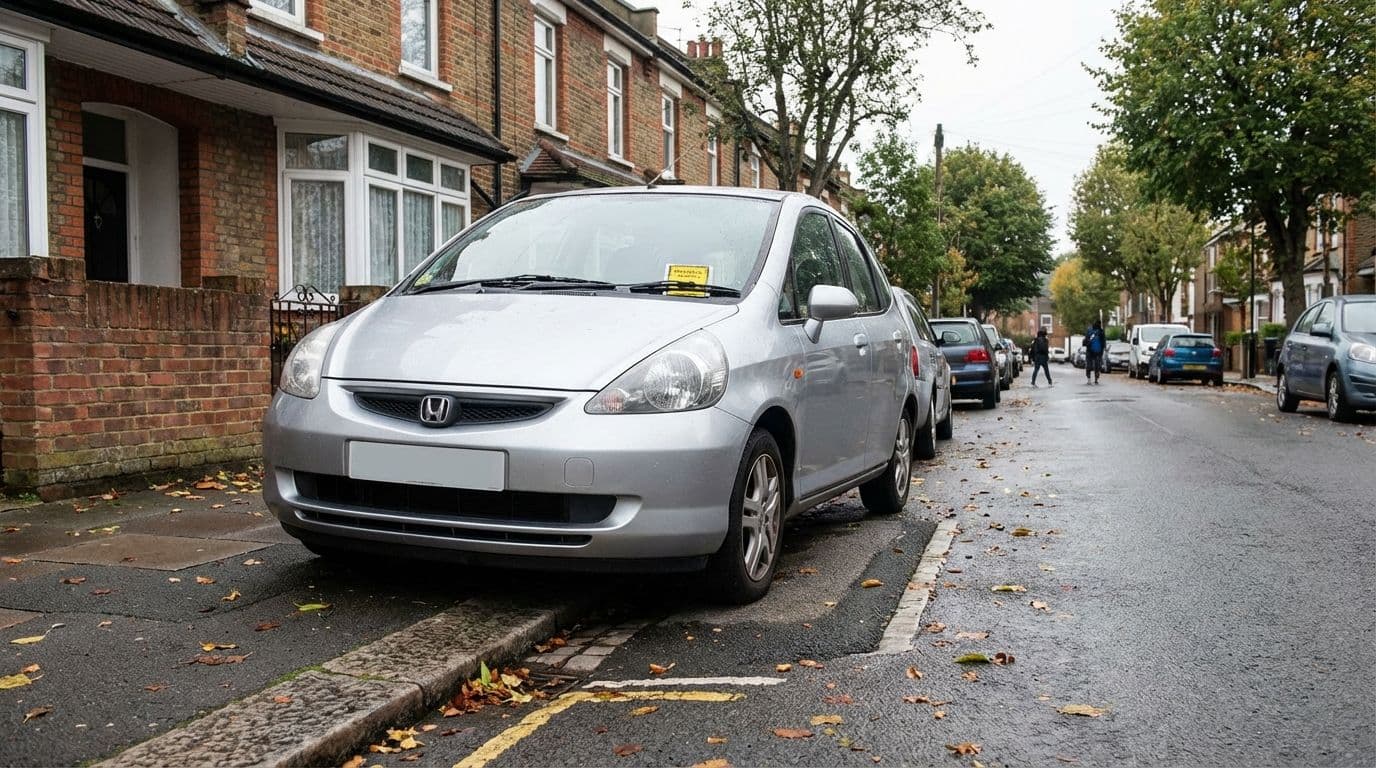
PCN Code 27: Parked Adjacent to a Dropped Footway
You nip into the house for “literally two minutes”. You leave the car where the kerb slopes down—half on the flat bit, half near the dip—and when you come back there’s a bright yellow packet under the wiper.
**PCN code 27** is one of those contraventions that catches genuinely careful drivers out, because it doesn’t always look like “a restriction”. Often there’s **no sign**, **no yellow line**, and sometimes it’s not even obvious the kerb is “dropped” for anything important.
This guide breaks down what code 27 means, the UK rules behind it, **common exemptions**, **the evidence that actually helps**, and **how to appeal** (informally, formally, and at tribunal if needed).
---
What does PCN Code 27 mean?
**PCN Code 27** is issued when a vehicle is:
**Parked adjacent to a dropped footway** (also called a **dropped kerb**).
In plain terms: your car is next to a section of kerb that has been lowered so that something can cross the pavement more easily.
Councils enforce this because dropped kerbs are there for access and safety—think **wheelchairs**, **pushchairs**, **cyclists**, and **vehicles entering driveways**.
You’ll see this contravention across the UK, and in London it’s commonly described as **London parking contravention 27**.
---
The legal basis (and why there’s often no sign)
This contravention is enforced under the **Traffic Management Act 2004**, which allows councils to enforce parking restrictions in **Special Enforcement Areas** (most of London and many other civil enforcement areas).
A key point that surprises people:
- **Dropped-kerb enforcement does not normally require signs or road markings.**
So the absence of a sign isn’t automatically a winning appeal point. Your best angle is usually about **whether the dropped footway meets the legal purpose**, whether you were **actually “adjacent”**, or whether an **exemption applies**.
---
What counts as a “dropped footway” for Code 27?
A dropped footway for code 27 is typically lowered to help one (or more) of the following:
- **Pedestrians crossing the road**
Often includes **tactile paving** (the bumpy slabs) for visually impaired pedestrians.
- **Cyclists entering/leaving a cycle track**
You may see a clearly formed cycle route or cycle crossing.
- **Vehicles entering/leaving a driveway or off-street premises**
A dropped kerb outside a private drive, garage, or car park entrance.
Common real-world examples
- Outside a house with a driveway: the kerb dips so cars can go in/out.
- On a corner near a junction: kerb dips with tactile paving for crossing.
- Outside a park entrance: a wide dropped area for shared pedestrian access.
---
“Adjacent to” — does it mean fully blocking?
This is where arguments often live.
**“Adjacent to” doesn’t mean you must be fully blocking it.** Councils can issue a PCN if your car is parked next to the dropped section in a way that interferes with its use.
That said, **precision matters**:
- If your wheels were **not alongside the lowered part** (e.g., you were beside the normal-height kerb), you may have a strong factual challenge.
- If only a tiny part of your car overlapped the dropped section, it becomes evidence-led: photos, angles, and the CEO notes matter.
**Pro tip:** Don’t rely on “I left enough space”. Focus on whether you were *actually adjacent to the lowered kerb* and whether the lowered kerb is *for one of the statutory purposes*.
---
The three dropped-kerb “types” (and how enforcement differs in practice)
1) Dropped kerb for a driveway
This is the classic: you park outside someone’s drive and get a code 27.
What people often don’t realise is that councils can enforce even if:
- the driveway looks unused, or
- the occupant isn’t home, or
- there’s no car trying to get in/out at that moment.
However, factual issues can still help:
- Is it **really** a vehicular access, or just a lowered kerb that leads to a wall/fence?
- Is it a **shared drive** and you have permission from the occupier?
- Is the dropped section **fully within** the property frontage you think it is?
2) Dropped kerb for pedestrians (often tactile paving)
You’ll typically see:
- tactile paving,
- a pair of drops on both sides of the road, and
- a natural “crossing line”.
If there’s tactile paving and you’re parked across it, councils tend to be firm.
3) Dropped kerb for cyclists
Less common, but enforced where a cycle track meets the carriageway.
If the “cycle track” is unclear or not a cycle facility at all, that can be worth exploring—but you’ll need photos showing the layout.
---
Common exemptions (when a Code 27 PCN may not be valid)
Exemptions are very fact-specific and vary slightly by council policy, but these are the ones that come up most often.
You were not actually adjacent to the dropped section
This is the simplest, most effective line when supported by photos.
What helps:
- a side-on photo showing where your wheels were,
- the limits of the dropped kerb, and
- the relation to your tyres (front and rear).
The kerb isn’t dropped for a relevant purpose
Sometimes kerbs are lowered for historic reasons, drainage, or a layout that no longer exists.
A good challenge might say:
- there is **no driveway or vehicle crossover**, and/or
- there is **no pedestrian crossing point** (no tactile paving, no matching drop opposite), and/or
- there is **no cycle track**.
Assisted boarding/alighting (where applicable)
Councils may allow short stops for boarding/alighting, especially for passengers needing assistance (think mobility issues, young children, heavy luggage). This is not a “park and leave it” free pass—timing and evidence matter.
Useful evidence:
- a short explanation of what happened and why assistance was needed,
- timestamps (phone location history can help),
- witness statement if available.
Loading/unloading (limited and not always accepted)
Many councils treat dropped kerbs more strictly than yellow lines. Loading is often a hard sell unless you can show:
- it was continuous,
- it was necessary,
- you were not away longer than needed.
If your council’s policy explicitly excludes loading at dropped kerbs, don’t hang your whole appeal on it—use factual points too.
The “occupier consent” situation (driveways)
In some areas (notably London practice), councils may be less likely to enforce **a private driveway drop** if:
- the occupier requests enforcement, or
- there’s a complaint history.
But it isn’t uniform, and **a CEO can issue without a complaint**.
If you have written confirmation from the occupier that they consented to your parking and there was no obstruction to access, include it—some councils will cancel, others won’t, but it’s still persuasive.
Blue Badge: a common misunderstanding
A **Blue Badge does not automatically allow parking adjacent to a dropped footway**.
Many drivers assume “I can park on yellow lines, so this is fine”—but dropped kerbs are treated differently because they protect access and crossings.
If a passenger is disabled and you stopped briefly for assisted boarding/alighting, that’s a different argument (and often stronger) than relying on the badge alone.
---
Evidence to gather (what actually moves the needle)
If you’re going to challenge a code 27 PCN, evidence is everything. Aim to collect:
Photos (your best friend)
Take wide and close shots:
- **Your car position** relative to the dropped kerb (front, rear, and side-on).
- The **full dropped section** (show start and end of the slope).
- The **opposite side of the road** (is there a matching drop/tactile paving?).
- Any **driveway entrance** (does it genuinely allow vehicle access?).
- Context shots showing **signage/markings** (even if none exist—showing absence can still support narrative).
**Pro tip:** Stand further back and take a photo that includes a fixed reference point (lamp post, drain, house number). It helps later if the council photos are zoomed in or oddly angled.
The council’s evidence pack
Once you make a formal representation (or if you go to tribunal), request or review:
- **CEO photos** (often more than those shown online),
- **CEO notes** (do they describe the dropped kerb properly?),
- **observation time** (some councils note it even if not required).
Street view / historic images
Google Street View can show:
- whether the kerb layout changed,
- whether a driveway was removed/blocked,
- whether tactile paving existed at the time.
---
How to appeal a Code 27 PCN (step-by-step)
Exact steps vary by council, but the typical path is:
1) Check the PCN and deadlines
- Most council PCNs offer a **14-day discount** window.
- You can usually make an **informal challenge** before a Notice to Owner is issued (if it was a windscreen PCN).
Decide early: pay at discount, or challenge with intent to fight.
2) Make an informal challenge (quick, factual, polite)
This is your first bite at the cherry. Keep it evidence-led.
Good informal challenges usually include:
- a clear sentence on why the contravention didn’t occur (or why an exemption applied),
- 2–6 labelled photos,
- a direct request to cancel.
3) If rejected, wait for the Notice to Owner (NTO)
The NTO goes to the registered keeper. Then you can submit a **formal representation**.
4) Appeal to the tribunal if needed
If the council rejects your formal representation, you’ll receive a code to appeal:
- **London Tribunals** (inside London)
- **Traffic Penalty Tribunal** (most of England and Wales outside London)
Tribunals are independent. If your argument is strong and your evidence is clear, it’s often worth pursuing.
---
Scenarios (so you can spot your strongest argument)
Scenario A: “I was only slightly over the edge”
If the kerb is clearly dropped and your vehicle overlaps it even a bit, your best approach is:
- prove you were **not adjacent** to the dropped part (if true), or
- rely on a valid exemption (assisted boarding/alighting), with timestamps/evidence.
Scenario B: “It doesn’t look like a driveway”
If there’s no usable access—e.g., there’s a wall immediately behind the footway—focus on:
- **not a vehicular access in reality**, backed by photos showing no entrance or that it’s blocked/raised.
Scenario C: “There’s tactile paving but I didn’t notice”
Tactile paving is a strong indicator the location is protected. Appeals here are harder unless:
- your car wasn’t actually adjacent, or
- council photos are unclear/incorrect location.
---
A simple informal challenge template (copy/paste)
Use this as a starting point and tailor it to your facts:
**Subject:** Informal challenge – PCN [PCN number], vehicle [VRM], contravention code 27
I’m challenging this PCN because the contravention did not occur. My vehicle was not parked adjacent to the lowered section of the kerb. The attached photos (labelled A–D) show the position of my wheels relative to the start/end of the dropped footway.
In addition, the location does not appear to be a dropped footway for pedestrian crossing/cycle track/vehicular access. There is no tactile paving or matching dropped kerb opposite, and there is no usable vehicular crossover/driveway entrance at this point (see photos E–F).
Please cancel the PCN. If you do not agree, please provide all CEO photographs and the CEO’s notes so I can consider the evidence in full.
Kind regards,
[Name]
[Address/postcode]
[Email/phone]
**Pro tip:** If you *were* adjacent but have an exemption (boarding/alighting, assisted passenger, etc.), rewrite the middle paragraph to explain that clearly with a timeline.
---
Next steps (do this today)
- **Read the PCN carefully**: contravention code, location, time, and whether it’s a CCTV or CEO-issued PCN.
- **Go back and photograph the kerb**: wide shots + close-ups + opposite side of the road.
- **Check what the drop is for**: driveway, tactile paving crossing, or cycle track.
- **Decide your strategy**: pay at discount vs challenge with evidence.
- **Submit an informal challenge promptly** (and keep proof of submission).
- If rejected and you’re confident: **prepare for formal representation**, and keep the option of **London Tribunals** or the **Traffic Penalty Tribunal** in mind.
If you want, tell me what the dropped kerb was for (driveway, tactile paving crossing, cycle track) and whether your wheels were actually alongside the slope, and I’ll suggest the strongest appeal angle and what photos to prioritise.
Written by
James Wilson
Legal Counsel
Ready to Challenge Your Ticket?
Let our AI analyse your PCN and generate a professional appeal letter in minutes.
Start Free Appeal