Pavement Parking Reform in England: What Changes Next?
England may let councils enforce pavement parking outside London. See what’s planned, how it affects School Streets and 20mph zones, and enforcement challenges.

James Wilson
6 April 2026
Pavement Parking Reform: What England's New Enforcement Powers Really Mean for Drivers
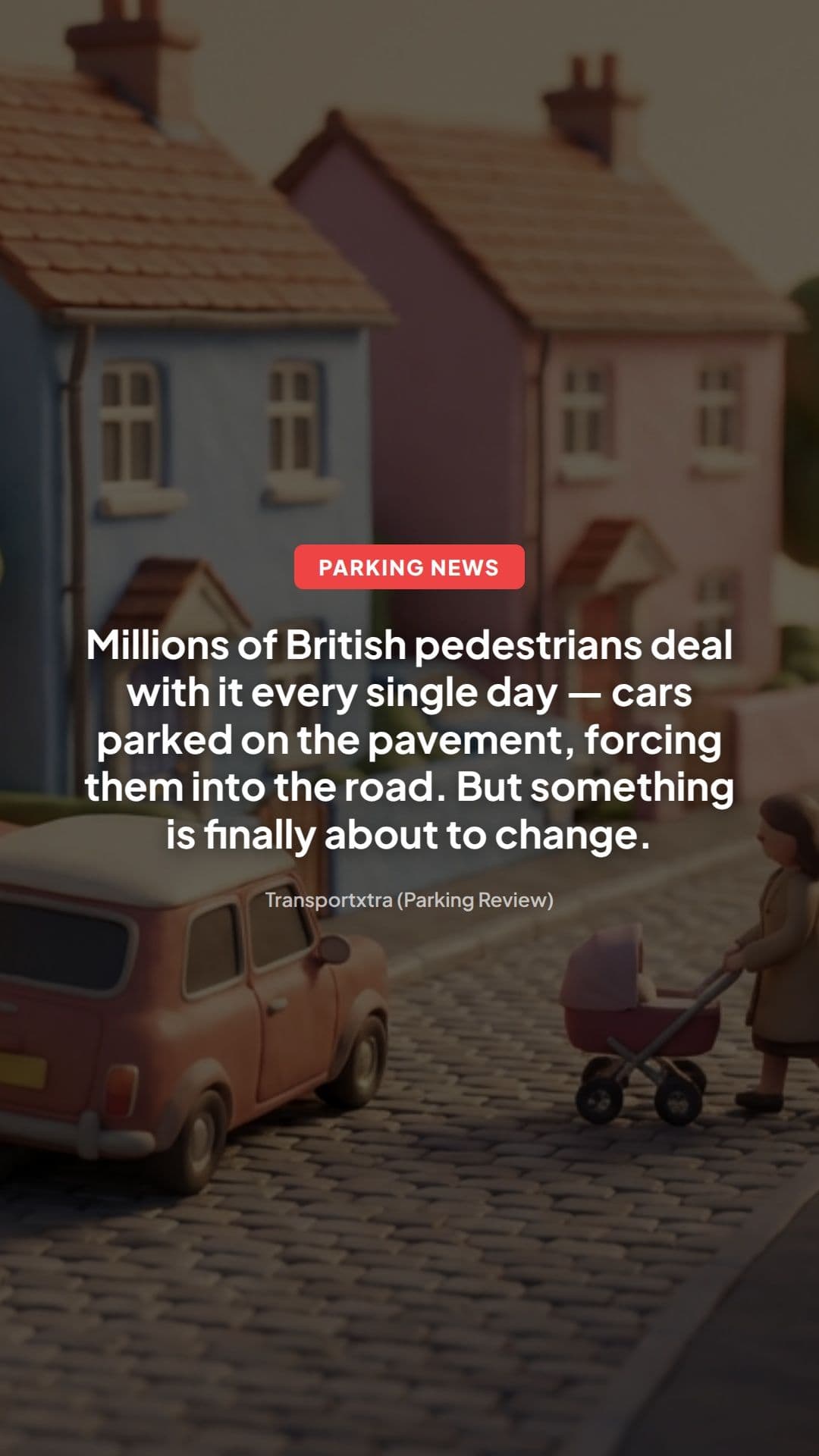
Picture this: you're pushing a pram along a residential street, or navigating a wheelchair down a narrow pavement, and there it is — a car mounted squarely on the kerb, forcing you into the road. It's a scene so commonplace in England that most of us barely register it anymore. But that could be about to change in a significant way, as the government moves to hand English councils the power to tackle pavement parking directly — a shift that has been decades in the making and carries far-reaching consequences for drivers, pedestrians, and local authorities alike.
What's Actually Happening
As reported by Parking Review (Transport Xtra), the government is advancing plans to give English councils outside London civil enforcement powers specifically targeting pavement parking. Until now, pavement parking enforcement in most of England has technically been a matter for the police — a system that, in practice, has meant almost no enforcement at all. Officers have rarely prioritised it, resources have been stretched, and the result has been a de facto free-for-all on pavements across the country.
London has long been the exception. The capital banned pavement parking back in 1974 under the Greater London Council (General Powers) Act, giving London boroughs the authority to issue Penalty Charge Notices (PCNs) to vehicles parked on the footway. Councils there have used this power extensively ever since. The rest of England, however, has been operating under a patchwork of inconsistent rules, with enforcement left to a police force that simply doesn't treat it as a priority.
The proposed reform would change this by creating a new civil enforcement framework — similar to the existing Decriminalised Parking Enforcement (DPE) regime — allowing councils to hire Civil Enforcement Officers (CEOs) to issue PCNs for pavement parking contraventions. The Parking Review piece also highlights how this reform intersects with other pedestrian safety initiatives, including 20mph zones and School Streets programmes, raising important questions about how councils will manage these overlapping responsibilities.
Why This Matters More Than You Might Think
The scale of the problem is genuinely significant. Research by the Living Streets charity has found that pavement parking affects millions of pedestrians daily, with blind and partially sighted people, wheelchair users, and parents with buggies disproportionately impacted. When a car parks on the pavement, it doesn't just inconvenience — it can force vulnerable people into live traffic.
But the reform isn't simply about issuing more fines. It represents a fundamental shift in who is responsible for managing public space at street level, and that shift has real implications for how our towns and cities function.
Consider the School Streets programme, which restricts motor traffic around school gates during drop-off and pick-up times. These schemes have proliferated across England in recent years, with councils using existing traffic regulation order (TRO) powers to create the restrictions. Pavement parking enforcement powers would sit alongside these schemes naturally — but also add complexity. Councils will need to ensure their CEOs are properly trained, that signage is consistent and legally robust, and that their enforcement policies don't inadvertently create new grounds for appeal.
The link to 20mph zones is equally important. As more residential streets adopt lower speed limits, the character of those streets changes. Pavement parking — often a symptom of streets designed primarily around motor vehicles — becomes more visible as a problem when pedestrian and cycling activity increases. Reform here isn't happening in isolation; it's part of a broader rebalancing of how street space is allocated.
The Legal Angle: Where Does the Law Currently Stand?
This is where things get genuinely complicated, and where many drivers are surprised to learn what the rules actually say.
Outside London, pavement parking is largely governed by Section 72 of the Highways Act 1980, which makes it an offence to "wilfully obstruct" the free passage of a highway — including a footway. However, this is a criminal offence requiring police action, and the evidential bar for "wilful obstruction" is relatively high. In practice, prosecutions are vanishingly rare.
There is also Rule 244 of the Highway Code, which states that drivers must not park partially or wholly on the pavement in London, and should not do so elsewhere unless signs permit it. The 2022 update to the Highway Code strengthened the language around pedestrian priority, but Rule 244 outside London remains advisory rather than legally enforceable through civil means — which is precisely the gap this reform seeks to close.
The proposed legislative vehicle for change has been long-awaited. The government committed to consulting on pavement parking reform following a 2020 consultation that attracted over 15,000 responses — an unusually high level of public interest. The Traffic Management Act 2004 already provides the framework for civil parking enforcement more broadly, and the expectation is that any new pavement parking powers would be built on or alongside this existing structure, requiring councils to designate themselves as civil enforcement authorities if they haven't already done so.
One practical legal consideration worth flagging: Traffic Regulation Orders. For councils to enforce pavement parking civilly, they will almost certainly need TROs in place on the relevant streets. Creating TROs is time-consuming, resource-intensive, and subject to statutory consultation requirements. This is one of the most significant practical barriers to the reform delivering results quickly.
What Drivers Should Know Right Now
Even before the new enforcement powers come into force, there are things every driver in England should understand:
- Pavement parking is already unlawful in many circumstances. Section 72 of the Highways Act 1980 means that if you obstruct the footway, you could theoretically face police action — even if enforcement is rare.
- London rules are different and strictly enforced. If you're driving in any London borough, pavement parking is prohibited and actively enforced. PCNs are issued routinely, and appeals on the basis of "everyone does it" will get you nowhere.
- Watch for local TROs. Some councils outside London have already used TROs to prohibit pavement parking on specific streets. If a sign indicates a prohibition, a CEO can already issue a PCN under existing powers. Don't assume that because pavement parking seems common, it's permitted.
- School Streets schemes carry real teeth. If you park on the pavement within a School Streets restricted zone during operational hours, you may already be subject to enforcement. Check local signage carefully.
- Photograph your parking position. If you believe you've been unfairly issued a PCN — for example, if signage was unclear or the vehicle was not obstructing the footway — photograph the scene immediately. This evidence is invaluable if you appeal.
- Start building good habits now. The direction of travel is clear. Councils will get these powers, and enforcement will increase. Drivers who habitually park on pavements — even partially — should start reconsidering that habit before fines start landing on their doormats.
Looking Ahead: A Slow but Significant Shift
The honest answer about timing is that this reform is unlikely to transform England's pavements overnight. Councils face real practical challenges: funding CEOs, creating the necessary TROs, investing in signage, and managing the inevitable appeals that will follow any new enforcement regime. Some local authorities, already under severe financial pressure, may be slow to take up the new powers even once they're available.
There's also a political dimension. In many areas, pavement parking is a deeply ingrained habit — particularly in older residential streets with no off-street parking provision. Residents who have parked on the pavement for thirty years are unlikely to welcome change warmly, and councillors know it. Expect a period of public information campaigns and warnings before enforcement ramps up significantly in most areas.
That said, the direction of travel is unmistakable. With the Highway Code already strengthened, School Streets expanding, and active travel firmly on the policy agenda, pavement parking is increasingly seen not as an acceptable compromise but as a genuine safety and accessibility failure. The question is no longer whether enforcement will come, but when — and how ready councils and drivers will be when it does.
For drivers, the message is straightforward: the pavement is not a parking space. It never really was — and soon, the law will make that much harder to ignore.
Source: Parking Review / Transport Xtra — "Where is pavement parking reform heading?"
Written by
James Wilson
Legal Counsel
Ready to Challenge Your Ticket?
Let our AI analyse your PCN and generate a professional appeal letter in minutes.
Start Free Appeal