Pavement parking bans start: avoid £100 fines today
New pavement parking bans are being enforced by councils such as Falkirk. Learn where you can’t park, typical £100 penalties, and what to do if fined.

Sophie Dubois
14 May 2026
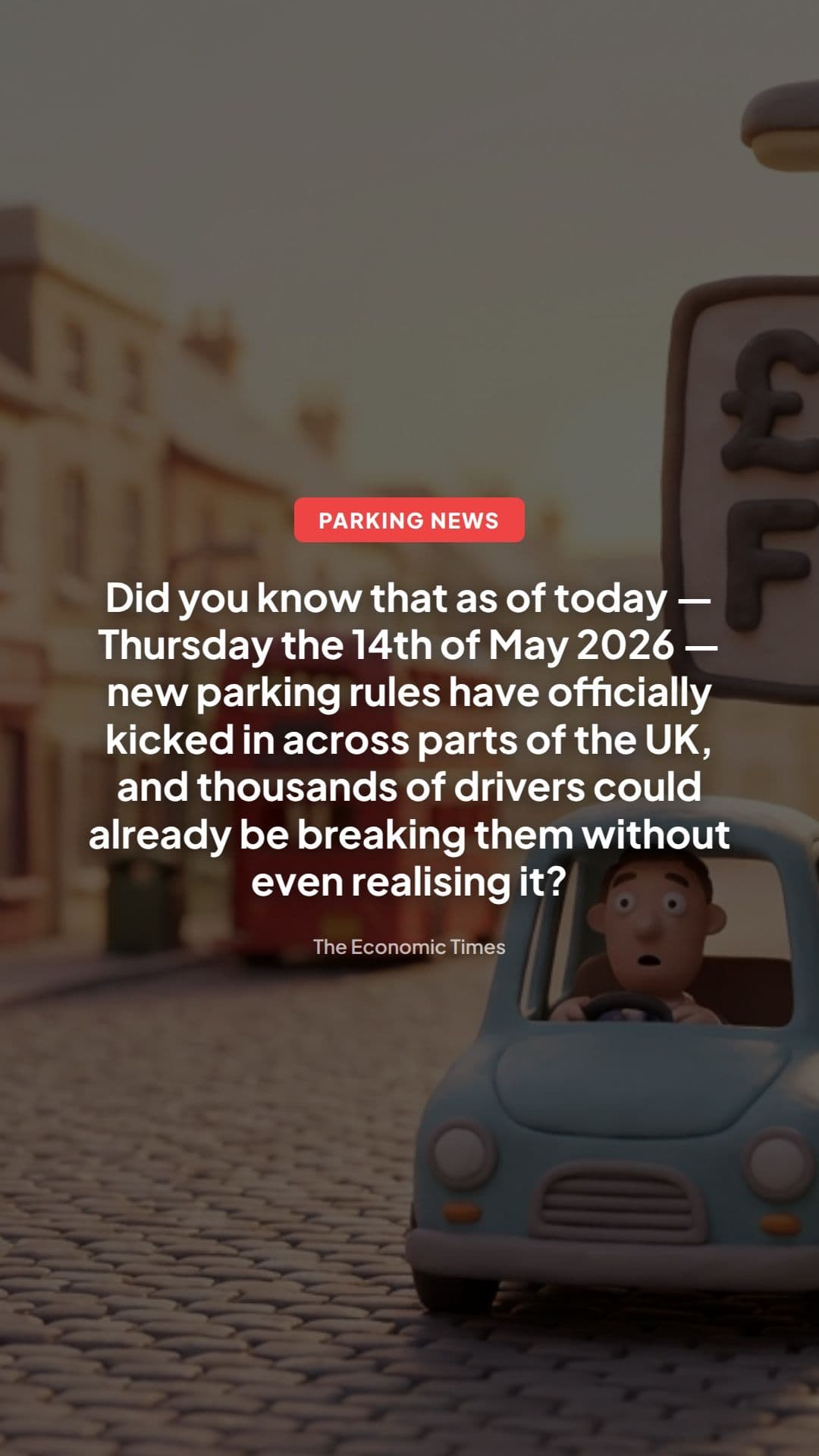
New UK Parking Rules: What Every Driver Needs to Know Right Now
If you've driven anywhere near a pavement recently and thought nothing of it, now might be the time to reconsider. A fresh wave of parking enforcement is sweeping across the UK, and councils are making it abundantly clear they mean business. Fines of up to £100 are already landing on windscreens — and in some cases, dropping straight into drivers' inboxes — as local authorities begin enforcing rules that many motorists didn't even know existed.
This isn't simply a matter of councils looking to boost their coffers. The changes reflect a genuine shift in how the UK views road space, pedestrian safety, and the responsibilities that come with being behind the wheel. Here's everything you need to know — and what you should do differently from today.
What's Actually Happening
Reports from across the UK confirm that councils are ramping up enforcement of pavement parking bans and a broader suite of road safety rules. Falkirk Council in Scotland has been among those making headlines, actively enforcing pavement parking restrictions with fines in the region of £100 for drivers caught with wheels on the footway.
But this isn't isolated to one council or one region. The enforcement push covers a wider set of behaviours, including:
- Pavement parking — parking wholly or partially on the pavement in restricted areas
- Distracted driving penalties — higher fixed penalties for mobile phone use at the wheel
- Driving without insurance — increased scrutiny and stiffer consequences for uninsured motorists
The Economic Times reported on these changes landing simultaneously, which has understandably caused some confusion among drivers trying to work out what's new, what's been tightened, and — crucially — what they're now at risk of being fined for.
Why This Matters More Than You Might Think
Pavement parking has long been one of those grey areas in British motoring culture. Unlike in Scotland, where a blanket ban on pavement parking has been in force since 2023 under the Transport (Scotland) Act 2019, England has historically relied on a patchwork of local Traffic Regulation Orders (TROs) to restrict it. London is the notable exception, where pavement parking has been prohibited since 1974 under the Greater London Council (General Powers) Act.
For drivers in England outside London, the situation has been frustratingly inconsistent. You might park on the pavement on one street without penalty and receive a £70 fine on the next, depending on whether a TRO exists. This inconsistency has bred a culture of casual pavement parking that councils are now actively working to dismantle.
The human cost of pavement parking is well documented. Pedestrians — particularly those with visual impairments, wheelchair users, parents with pushchairs, and older people — are frequently forced into the road when pavements are blocked by vehicles. Research by Living Streets found that over half of disabled people say pavement parking negatively affects their ability to get around. This is not a trivial inconvenience; for many people, it's a genuine barrier to independence.
The Legal Angle: What the Law Actually Says
Understanding the legal framework is essential if you want to avoid a fine — or successfully challenge one.
In Scotland, the position is clear. The Transport (Scotland) Act 2019 introduced one of the most comprehensive pavement parking bans in Europe. It is a criminal offence to park on a pavement, a dropped kerb, or a cycle track, with some limited exemptions for loading and unloading. Enforcement is carried out by council wardens, and fines are issued as Fixed Penalty Notices (FPNs) typically set at £100, reduced to £50 for prompt payment.
In England (outside London), the legal position is more complex. The Government has been consulting on a nationwide pavement parking ban for several years, with the Traffic Management Act 2004 providing the theoretical framework for councils to take on civil enforcement powers. However, a blanket ban equivalent to Scotland's has not yet been introduced in England. Instead, councils must rely on existing TROs, and enforcement officers can issue Penalty Charge Notices (PCNs) where those orders are in place.
In London, pavement parking is prohibited under longstanding legislation, and TfL and borough councils enforce it through PCNs. The standard penalty is £110 in London (reduced to £55 if paid within 14 days), making it one of the higher-cost offences on the books.
On the broader penalties mentioned in reports:
- Mobile phone use at the wheel carries a fixed penalty of £200 and six penalty points since 2017 reforms — and courts can impose higher penalties for repeat offenders or cases that reach prosecution.
- Driving without insurance is a £300 fixed penalty and six points, with courts able to impose unlimited fines and disqualification in serious cases. The Motor Insurers' Bureau estimates there are around 1 million uninsured drivers on UK roads at any given time, making enforcement a genuine priority.
What Drivers Should Know: Practical Advice
The rules may feel like they're multiplying, but the practical steps to stay on the right side of them are straightforward.
1. Check for pavement parking restrictions before you stop Look for yellow lines on the kerb, signage indicating a TRO, or dropped kerbs. If you're in Scotland, the default position is that pavement parking is banned unless you see signage indicating an exemption. Don't assume it's fine just because you've done it before.
2. Keep all four wheels on the carriageway where possible Even where a TRO doesn't explicitly exist, parking with wheels on the pavement can still attract enforcement in some circumstances — particularly if it causes an obstruction. The safest approach is to keep your vehicle entirely on the road.
3. Never assume a quiet street means no enforcement Councils are increasingly deploying CCTV, mobile cameras, and warden patrols in residential areas. The absence of a warden doesn't mean the absence of evidence.
4. Check your insurance documentation carefully With enforcement of uninsured driving increasing, make sure your policy is current, that the vehicle details are accurate, and that any named drivers are correctly listed. A simple administrative error — a wrong registration number or an out-of-date address — can create serious problems.
5. Put your phone away completely Not on the seat. Not on the dashboard. Not in your lap. The £200 fine and six points for handheld phone use is career-ending for new drivers (who lose their licence at six points in the first two years), and damaging for anyone. Hands-free is legal, but even that carries risks if it leads to distraction.
6. If you receive a PCN, act quickly You typically have 28 days to pay at the discounted rate (usually 50% of the full penalty) or to make a formal representation challenging the fine. Missing this window means paying the full amount and losing your right to appeal at the informal stage.
Looking Ahead: The Direction of Travel
The enforcement push we're seeing now is part of a much longer journey towards tighter regulation of how drivers use — and misuse — public road space.
In England, pressure is mounting on the Government to finally introduce a nationwide pavement parking ban. The Department for Transport has acknowledged the problem and has been running consultations since 2020, but progress has been slow. Scotland's experience since 2023 has provided a working model that many campaigners and councils in England are pointing to as proof that a blanket ban is both deliverable and effective.
The direction of travel is unmistakable: local authorities are being given more tools, more powers, and increasingly, more political will to enforce the rules that already exist. Drivers who have relied on patchy enforcement to get away with casual pavement parking, phone use, or lapsed insurance are finding that the margin for error is shrinking.
Technology is playing a growing role too. AI-powered cameras capable of detecting pavement parking, phone use, and even seatbelt non-compliance are being trialled and rolled out across the UK. The era of enforcement that depends on a warden being present is quietly giving way to one where the camera is always watching.
For most drivers, none of this should be alarming. The rules being enforced are, by and large, rules that have existed for years. What's changing is the certainty of consequence. And that, in the end, is how road safety actually improves — not through new laws alone, but through the credible prospect that breaking the existing ones will cost you.
Stay informed, park considerately, and keep your phone in your pocket. The rules haven't changed much — but the likelihood of being caught breaking them very much has.
Written by
Sophie Dubois
Traffic Law Specialist
Ready to Challenge Your Ticket?
Let our AI analyse your PCN and generate a professional appeal letter in minutes.
Start Free Appeal