On-street EV charging: councils block gullies in UK
More UK councils are refusing on-street EV charging gullies over safety, liability and parking fears—creating a postcode lottery for drivers and residents.

Marcus Campbell
31 May 2026
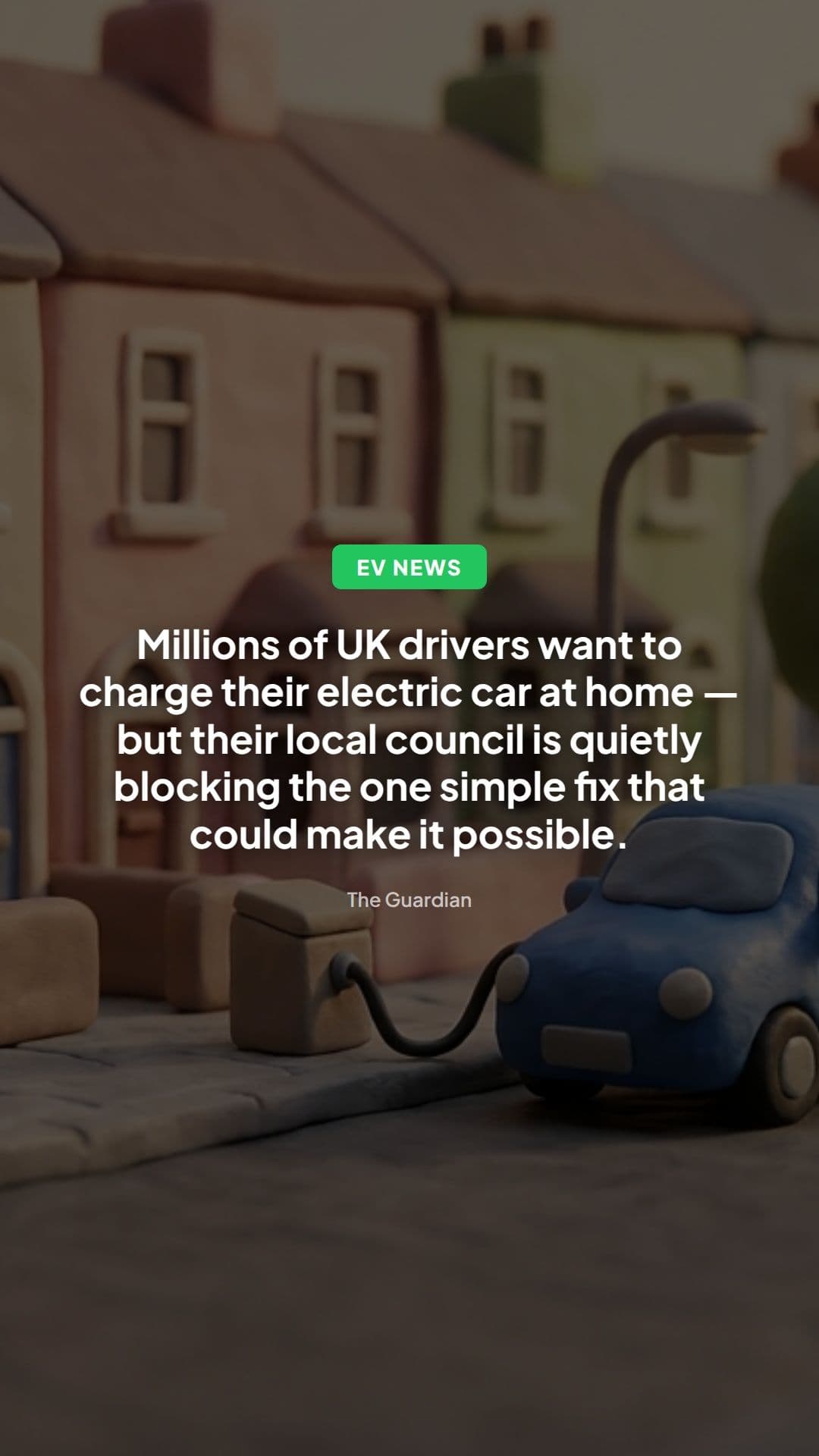
The EV Charging Postcode Lottery: Why Your Council Could Be Blocking Your Route to Going Electric
Imagine buying an electric vehicle in good faith — responding to government incentives, rising fuel costs, and the 2035 petrol ban looming on the horizon — only to discover that your street simply cannot support the technology you need to charge it. No driveway, no off-road parking, no charger. Just a kerb, a cable, and a council that says no.
That is the reality facing a growing number of UK drivers, and it is becoming increasingly difficult to ignore.
What's Actually Happening
A report by The Guardian has revealed that more than 20 local authorities across England are actively refusing to permit EV charging gullies — the small channels cut into pavements that allow cables to run safely from a home charger to a vehicle parked on the street. These gullies, sometimes called cable channels or kerb ramps, are widely considered one of the most practical solutions for the estimated 40% of UK households that have no off-street parking and therefore no obvious way to charge an EV at home.
The councils blocking these installations are citing a range of concerns: trip hazards and pavement safety, potential legal liability, conflicts with existing parking restrictions, and uncertainty about who bears responsibility if something goes wrong. Some authorities are pointing to the Highways Act 1980, which places a statutory duty on them to maintain the safety of public footways, as a reason to refuse consent.
The result is a deeply uneven landscape. In some areas, residents can apply for a gully permit within weeks and have a cable channel installed for a few hundred pounds. In others, the answer is a flat no — regardless of how many EVs are on the street or how much demand exists.
Why This Matters Far More Than It Might Seem
On the surface, this might look like a niche planning dispute. In reality, it cuts to the heart of whether the UK's transition to electric vehicles is genuinely achievable — or whether it will remain a privilege reserved for those lucky enough to own a driveway.
The government has committed to ending the sale of new petrol and diesel cars by 2035. That target requires millions of additional EVs on UK roads within the next decade. But the charging infrastructure needed to support those vehicles — particularly for the millions of drivers in terraced streets, flats, and older housing stock — is nowhere near ready.
Gullies are not a perfect solution. They require planning, maintenance, and community buy-in. But they are currently one of the only viable options for on-street charging without the expense of installing a full kerbside charge point. The Office for Zero Emission Vehicles (OZEV) has funded gully trials and actively encourages local authorities to explore them under the Electric Vehicle Infrastructure Strategy published in 2022. When councils refuse to engage, they are effectively stepping outside the national direction of travel.
There is also a social equity dimension here that deserves more attention. Wealthier homeowners with garages or driveways can install a home charger for around £800–£1,000, often with a government grant, and charge their vehicle cheaply overnight. Those in rented accommodation or older housing — disproportionately lower-income households — are left dependent on public charging, which remains significantly more expensive per kilowatt-hour. Blocking gullies does not just inconvenience EV drivers; it widens the gap between those who can afford to go electric and those who cannot.
The Legal Angle: Who Has the Power Here?
The legal picture is genuinely complicated, and that complexity is part of why councils are hesitating.
Under the Highways Act 1980, local highway authorities have a duty to maintain public roads and footways in a safe condition. Any modification to a pavement — including cutting a gully — technically requires consent from the highway authority. That authority is usually the council itself, which means councils are simultaneously the applicant, the decision-maker, and the body liable if something goes wrong.
The New Roads and Street Works Act 1991 also comes into play. It governs who can carry out works in the highway and under what conditions, requiring proper licensing and reinstatement standards. Councils worried about cowboy installations or inadequate repairs to gullies have legitimate grounds for caution here — though it does not justify blanket refusals.
What is notably absent is any statutory duty on councils to permit EV charging infrastructure of this kind. The government's EV strategy encourages local authorities to act, and OZEV has published guidance, but encouragement is not compulsion. Without a legal obligation to facilitate on-street charging, councils can — and evidently do — simply say no.
The Local Government Act 2000 gives councils broad powers to promote the economic, social, and environmental wellbeing of their areas, which could theoretically be used to justify approving gullies. But it does not force their hand.
There is a growing argument — made by EV advocates and some legal commentators — that the government needs to introduce secondary legislation specifically addressing on-street EV charging infrastructure, creating a clearer framework of rights and responsibilities. Without it, the postcode lottery will continue.
What Drivers Should Know
If you are an EV owner or considering buying one and you rely on on-street parking, here is what you need to understand right now:
- Check your council's position before you buy. Contact your local authority's highways or transport department and ask specifically about their policy on EV charging gullies and on-street charging. Some councils have published guidance; many have not.
- Look for OZEV-funded local schemes. A number of councils have received government funding to install kerbside charge points under the Local Electric Vehicle Infrastructure (LEVI) Fund. Your area may have charge points planned even if gullies are not permitted.
- Use the Zapmap or Zap-Home tools to see what public charging infrastructure already exists near your address. This will help you assess whether buying an EV is practical in your current location.
- Rental and leasehold residents face additional barriers. If you rent privately or live in a leasehold flat, you may need landlord or freeholder consent before any charging solution can be installed. The government has introduced regulations under the Building Regulations 2010 (as amended) requiring new builds and major renovations to include EV charging points — but this does not help those in existing stock.
- If your council refuses a gully application, ask for the decision in writing and the specific legal basis for refusal. This creates a paper trail that could be useful if you wish to challenge the decision or escalate to your local councillor or MP.
- Engage with your local councillors. This is ultimately a political decision as much as a legal one. Councils respond to pressure from residents, and a coordinated campaign by local EV drivers can shift the conversation.
Looking Ahead: Can the Postcode Lottery Be Fixed?
The honest answer is: not quickly, and not without political will.
The government has the tools to act. It could amend the Highways Act or introduce new regulations creating a presumption in favour of EV charging infrastructure in the highway. It could tie future LEVI funding to councils demonstrating a permissive approach to gullies. It could require councils to publish clear, consistent policies on on-street EV charging — something that does not currently exist in any standardised form.
What it cannot do is continue pretending that the 2035 target is achievable while leaving local authorities free to block the very infrastructure needed to reach it. The EV transition will not be delivered by motorway service stations alone. It will be delivered — or it will fail — in ordinary streets, outside ordinary homes, in the places where most people actually park their cars.
The 20-plus councils currently refusing gully installations are not necessarily acting in bad faith. Some have genuine safety concerns. Some are navigating real legal uncertainty. But the cumulative effect of their caution is a charging network that is fragmented, unfair, and increasingly incompatible with the national targets the government has set.
The postcode lottery needs to end. Whether that happens through new legislation, stronger guidance, or financial incentives for councils to get on board remains to be seen. But for the millions of drivers currently weighing up whether they can realistically go electric, the clock is ticking — and their local council may be the biggest obstacle standing in the way.
Source: The Guardian, 30 May 2026 — "On-street EV charging in UK is postcode lottery as drivers face council objections"
Written by
Marcus Campbell
Former Traffic Warden
Ready to Challenge Your Ticket?
Let our AI analyse your PCN and generate a professional appeal letter in minutes.
Start Free Appeal