Nissan shelves electric Qashqai: what it means for UK EVs
Nissan is reportedly shelving an all-electric Qashqai for Europe. We explain the implications for UK EV buyers, Sunderland jobs and the wider market.

Sophie Dubois
29 June 2026
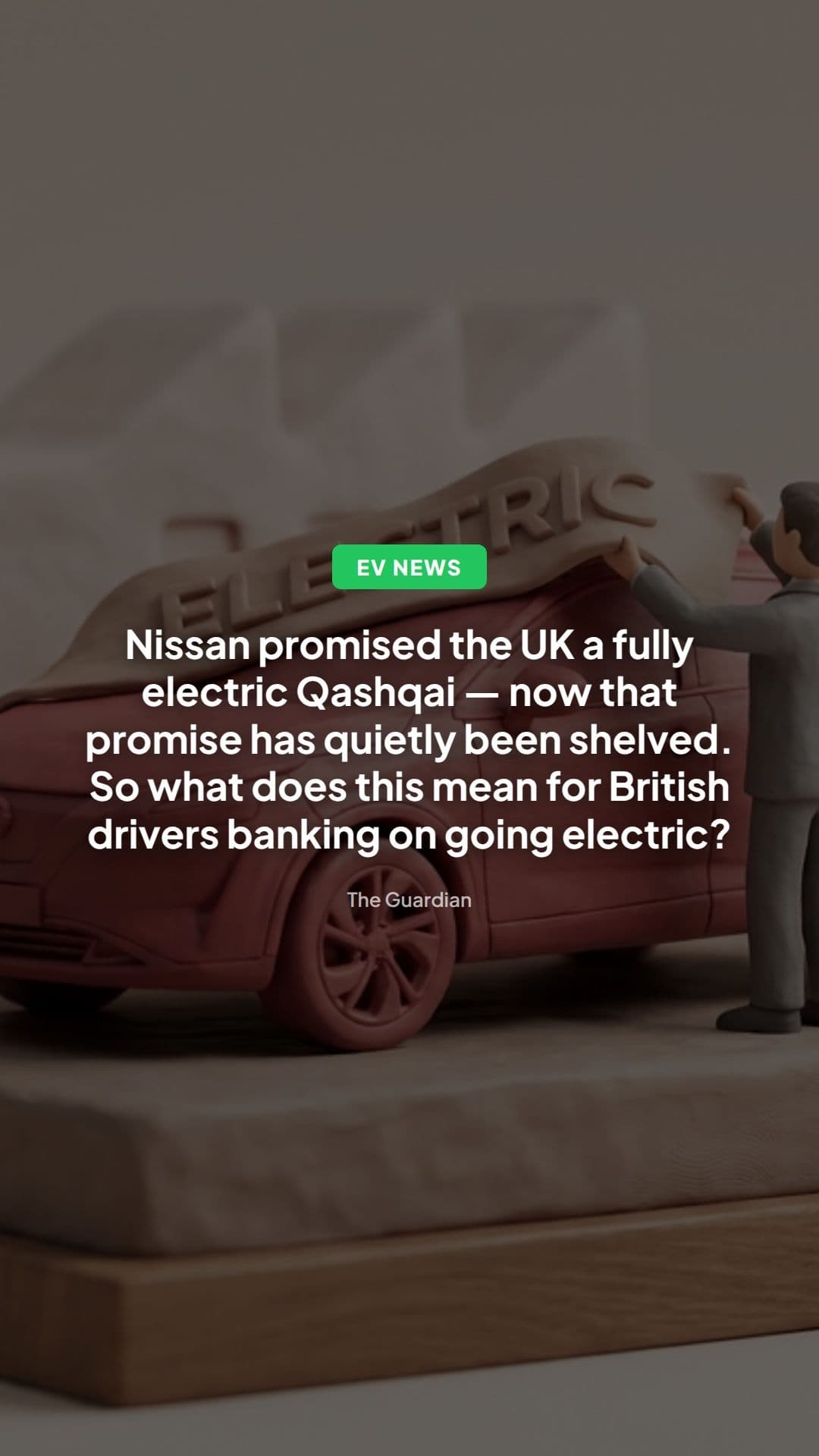
Nissan Kills the Electric Qashqai: What It Really Means for UK Drivers, EV Policy, and the Future of British Manufacturing
There's a particular kind of disappointment that comes not with a bang but with a quiet corporate announcement. Nissan's reported decision to shelve plans for an all-electric Qashqai is one of those moments — understated in its delivery, but potentially seismic in its implications. For UK drivers, for the workers at Nissan's Sunderland plant, and for anyone watching Britain's fragile transition to electric vehicles, this is a story that deserves far more attention than a single headline.
What Actually Happened
According to reporting by The Guardian, Nissan has quietly dropped development plans for a fully electric version of the Qashqai for European markets. The move is framed as part of broader cost-cutting measures as the Japanese manufacturer navigates a deeply challenging period financially — one that has seen the company announce significant global job losses and restructuring across its operations.
The Qashqai is not just any car. It is Nissan's best-selling model in Europe and, crucially, one of the flagship vehicles produced at the Sunderland plant in the north-east of England. That factory — which employs thousands of workers directly and tens of thousands more through the supply chain — has long been positioned as a cornerstone of the UK's automotive future. Nissan has previously committed to producing electric vehicles at Sunderland, with the site home to the AESC battery gigafactory (now operating under the Envision banner). An all-electric Qashqai was widely expected to be a central pillar of that EV future.
Now, it appears that pillar has been quietly removed from the blueprint.
Why This Matters Far Beyond Sunderland
To understand the full weight of this decision, you have to step back and look at the broader picture of UK automotive policy — and just how precarious the situation has become.
The UK government's Zero Emission Vehicle (ZEV) Mandate, introduced under the Automotive Sector Deal framework and given legal teeth through the Climate Change Act 2008 and subsequent statutory instruments, requires car manufacturers to ensure a rising percentage of their new vehicle sales are zero-emission. In 2024, the target was 22% of sales; by 2030, that figure rises to 80%, with a full phase-out of new petrol and diesel car sales by 2035.
These targets are not aspirational guidelines. Manufacturers who miss them face civil penalties of £15,000 per non-compliant vehicle under the ZEV Mandate regulations. For a company the size of Nissan, that is an enormous financial exposure if their EV product lineup fails to keep pace with the legal requirements.
Here's the tension: Nissan is simultaneously cutting EV development whilst being legally obligated to sell more EVs. That is not a sustainable position — and it signals something important about the broader health of the EV transition.
The decision also throws a spotlight on the UK's industrial strategy for automotive manufacturing. Post-Brexit, the government worked hard to secure commitments from manufacturers like Nissan, Jaguar Land Rover, and BMW to keep production in Britain. Sunderland's gigafactory was presented as proof that the UK could compete in the new era of electric mobility. Shelving the electric Qashqai does not necessarily mean the factory closes or that Sunderland's future is immediately in doubt — but it does raise legitimate questions about how those commitments will be honoured as market conditions tighten.
The Legal and Regulatory Angle
For drivers, the legal implications here are less direct than for manufacturers — but they are real.
The ZEV Mandate creates market distortions that affect what cars are available and at what price. When manufacturers pull back from EV development, they either have to buy "credits" from manufacturers who exceed their targets (such as Tesla), reduce overall sales volumes, or face fines. All of these outcomes can translate into higher prices or reduced choice for consumers.
Under the Consumer Rights Act 2015, buyers of new vehicles have the usual protections around satisfactory quality and fitness for purpose. However, there is no specific legal right to have a particular model available in a particular powertrain configuration. If Nissan chooses not to build an electric Qashqai, there is no regulatory mechanism that compels them to do so — the ZEV Mandate governs the proportion of EVs sold, not which specific models must be electrified.
What is worth watching, however, is whether the Competition and Markets Authority (CMA) takes any interest in the pricing dynamics that result. If manufacturers consistently use ZEV compliance costs as justification for inflating EV prices — effectively passing regulatory penalties onto consumers — that could attract scrutiny under competition law.
There is also a planning and employment law dimension to consider. If Nissan's restructuring ultimately leads to changes in production volumes at Sunderland, workers have rights under the Trade Union and Labour Relations (Consolidation) Act 1992, which requires meaningful collective consultation for large-scale redundancies. Any attempt to reduce headcount without proper process would expose the company to significant tribunal claims.
What Drivers Should Know Right Now
If you're in the market for a new car — or thinking about making the switch to electric — here is what this news means practically for you:
1. Don't assume your preferred model will go electric on schedule Manufacturer EV timelines have been slipping across the industry. Nissan is not alone — Ford, Volkswagen, and others have all revised their electrification roadmaps in recent years. If you're waiting for a specific electric version of a car you love, have a contingency plan.
2. Hybrid options are becoming the pragmatic middle ground With full EV versions being shelved or delayed, plug-in hybrids (PHEVs) and full hybrids are increasingly the realistic choice for drivers who want to reduce emissions without committing fully to pure electric. The current Qashqai already offers an e-POWER mild hybrid system — that technology is likely to continue and develop.
3. The used EV market is worth serious consideration Nissan's Leaf remains one of the most affordable used EVs in the UK, with prices starting well under £10,000 for earlier models. If your goal is to drive electric rather than to drive a specific new model, the second-hand market offers genuine value right now.
4. Check your eligibility for the UK EV grant The government's Plug-in Van Grant and Plug-in Car Grant (where applicable) can still reduce the upfront cost of qualifying new electric vehicles. Always check the OZEV (Office for Zero Emission Vehicles) website for the current list of eligible models before committing to a purchase.
5. Factor in the total cost of ownership, not just the sticker price Even if new EV prices remain higher than equivalent petrol models, Vehicle Excise Duty (VED) changes, lower fuel costs, and Benefit in Kind (BIK) tax rates (particularly relevant for company car drivers, where EVs attract just 2% BIK compared to up to 37% for petrol vehicles) can make electric significantly cheaper over three to five years.
Looking Ahead: A Crossroads for UK Motoring
Nissan's decision is a symptom of a wider industry-wide recalibration — one that the UK government cannot afford to ignore.
The pace of EV adoption in Britain has been uneven. Fleet sales have driven headline numbers upward, but private buyer uptake remains sluggish, constrained by charging infrastructure anxiety, high upfront costs, and — increasingly — uncertainty about where the market is heading. When a manufacturer as significant as Nissan visibly pulls back from a flagship EV project, it reinforces that uncertainty and risks becoming a self-fulfilling prophecy.
The government faces a genuine dilemma. The ZEV Mandate's targets are legally embedded and tied to the UK's broader net zero commitments under the Climate Change Act. Weakening them would invite legal challenge from environmental groups and undermine international credibility. But maintaining them whilst manufacturers retreat from investment creates a compliance crisis that ultimately hits consumers through higher prices and reduced choice.
What is needed — and what has been conspicuously absent — is a coherent industrial strategy that bridges the gap between regulatory ambition and commercial reality. That means targeted investment in charging infrastructure, meaningful incentives for private EV buyers (not just fleets), and honest dialogue with manufacturers about what is achievable on what timeline.
For Sunderland, for UK automotive workers, and for the millions of drivers trying to make sensible decisions about their next car, the stakes could hardly be higher. Nissan shelving the electric Qashqai is not the end of the story — but it is a warning that the current approach is not working as intended.
The question now is whether anyone in Westminster is listening.
Source: The Guardian, 23 June 2026. This article provides independent analysis and commentary on the reported news.
Written by
Sophie Dubois
Traffic Law Specialist
Ready to Challenge Your Ticket?
Let our AI analyse your PCN and generate a professional appeal letter in minutes.
Start Free Appeal