Newham Pedestrian Zone PCN Appeal Refused: Lessons
A London Borough of Newham tribunal case where a pedestrian zone PCN appeal was refused. Key evidence, signage points and practical steps for drivers.

Sophie Dubois
7 July 2026
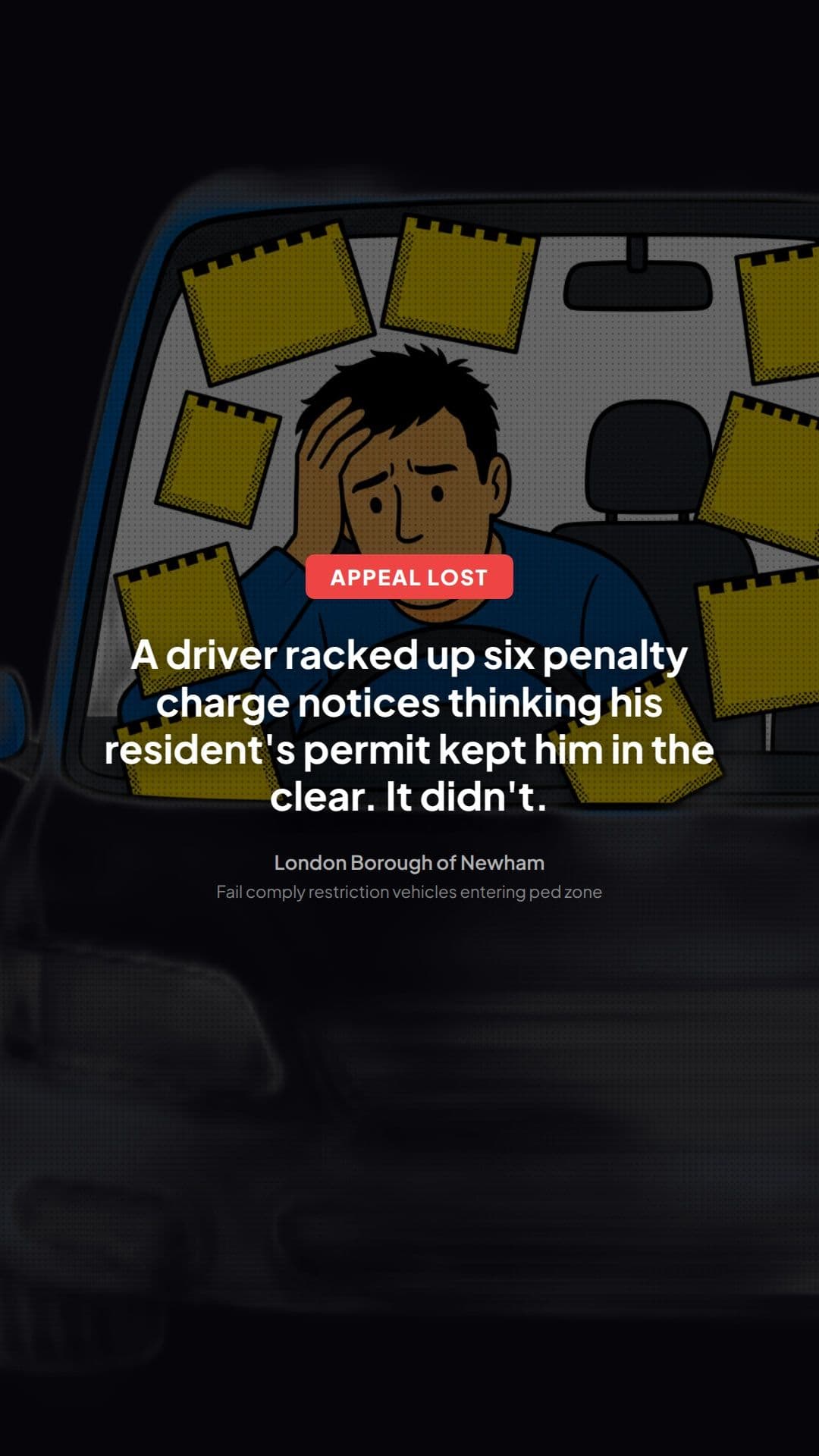
When Your Parking Permit Is Worthless: The Newham Pedestrian Zone Case That Every Driver Must Read
Imagine receiving not one, not two, but twenty parking fines — all for doing something you genuinely believed was perfectly legal. You have a valid resident's permit. You live nearby. Surely that's enough?
For one Newham driver, it was not. And the tribunal's decision in this case reveals a critical gap in how many drivers understand the relationship between their parking permit and the restrictions that govern where they can actually drive. This is a story about six Penalty Charge Notices, two months of repeated contraventions, and one very expensive misunderstanding about what a resident's permit actually permits.
The Case: Six Fines, One Driver, One Costly Assumption
Between 2 May 2025 and 3 July 2025, the London Borough of Newham issued a driver with multiple Penalty Charge Notices for entering a pedestrian zone during restricted hours. The driver appealed against six of those PCNs at the Traffic Penalty Tribunal.
The contravention in each case was the same: "Fail to comply with restriction — vehicles entering pedestrian zone." In other words, the driver had repeatedly taken their vehicle into an area that was closed to motor vehicles during certain hours.
The driver wasn't being reckless or dismissive of the rules. They had what they believed was a cast-iron defence: a valid resident's parking permit. They had even taken the time to gather evidence of that permit and present it to the adjudicator. From their perspective, the council itself had indicated that residents with valid permits for addresses within the pedestrianised zone were automatically exempt.
That belief, as it turned out, was based on a fundamental misunderstanding.
The Arguments: A Genuine But Flawed Defence
What the driver argued
The driver's case rested on two pillars:
- They held a valid resident's permit, which they believed entitled them to enter the pedestrian zone during restricted hours.
- The council's own guidance suggested that residents with permits for addresses within the pedestrianised zone were automatically exempt from the restrictions.
On the face of it, this sounds reasonable. Residents often do receive exemptions from traffic restrictions that apply to through-traffic. The driver appears to have genuinely believed they were one of those exempt residents.
What the council argued
Newham's enforcement authority pushed back on both points. They provided photographic evidence of the signage at the entry points to the pedestrian zone — including additional advance warning signs that go beyond what the law strictly requires. Their position was straightforward: the signs were clear, the restrictions were lawful, and this particular driver did not hold the right type of permit to be exempt.
The Decision: Appeal Refused on All Six PCNs
The adjudicator refused all six appeals. The decision was clear and unambiguous: each contravention had occurred, each PCN had been properly issued and served, and no exemption applied in any of the cases.
This was not a close call. The adjudicator was satisfied on every element of the council's case.
The Legal Reasoning: Why the Permit Was No Defence
This is where the case becomes genuinely instructive, because the adjudicator's reasoning cuts to the heart of something many drivers get wrong.
Not all permits are equal
The signage at the pedestrian zone entry points was clear. It indicated a "Pedestrian and Cycle Zone — No Motor Vehicles" during restricted hours, with one specific exemption: taxis and H34 permit holders.
The driver held a permit — but it was a U RPZ (Residents' Parking Zone) permit, not an H34 permit. These are entirely different documents serving entirely different purposes.
Think of it this way: a season ticket for one football ground does not get you into a different stadium. A residents' parking permit allows you to park in designated bays in your zone. An H34 permit is a specific authorisation to enter a pedestrian zone. They are not interchangeable.
The address mattered too
The adjudicator went further. Even if the driver had been arguing for some form of residency-based exemption, the evidence showed that the driver's address was not within the pedestrianised zone. The exemption for residents — to the extent it existed at all — was specifically for those living inside the zone, not merely nearby.
This is a crucial distinction. Many pedestrian zones do grant access rights to residents whose properties are physically located within the restricted area, because they would otherwise have no way to reach their homes by vehicle. But that exemption is geographically precise. Living close to a pedestrian zone is not the same as living within it.
The signage was adequate
The driver might have argued that the signs were unclear or non-compliant — a defence that has succeeded in other cases where signage has been found to be defective or ambiguous. Here, however, the adjudicator found the signage to be "substantially compliant, clear and adequate." The council had even gone beyond their legal obligations by erecting advance warning signs. There was simply no room for doubt about what the restrictions were.
Repetition made it worse
It is worth noting that this driver received what they described as 20 PCNs in total, with the tribunal considering six. Repeating the same journey through the same restriction, over a period of two months, significantly undermines any argument that the contravention was accidental or based on a momentary misunderstanding. By the time of the sixth offence, the driver had received multiple notices indicating that their entry was unlawful.
Lessons for Drivers: What This Case Teaches Us
1. Know exactly what your permit covers — and what it does not
A resident's parking permit is not a general-purpose pass for your local area. Read the conditions carefully. If you believe you are exempt from a particular restriction, find the specific permit or authorisation that grants that exemption — and make sure you actually hold it.
2. Check the signs, not just your assumptions
Before driving into any restricted area, look at the signs at the entry point. If they specify a particular permit type (such as H34), that is the only permit that will exempt you. Do not assume your existing permit is equivalent.
3. Living near a zone is not the same as living within it
Exemptions for residents in pedestrian zones are typically limited to those whose addresses fall inside the restricted area. If your home is on the boundary or nearby, check carefully whether you actually qualify.
4. Stop and appeal early — do not repeat the contravention
If you receive a PCN and believe you are exempt, appeal immediately and stop making the same journey until the matter is resolved. Continuing to enter the zone while an appeal is outstanding — or worse, before you have even appealed — creates a pattern that is very difficult to defend at tribunal.
5. Signage compliance is a strong defence, but only when it fails
Challenging the adequacy of signs can be an effective appeal strategy, but only when the signs are genuinely defective. In this case, the council's signage was found to be clear and even exceeded legal requirements. Always examine the actual signs before assuming this line of argument will succeed.
The Key Takeaway
Your parking permit only does what it says on the tin. A residents' parking permit lets you park in residents' bays. It does not automatically exempt you from traffic restrictions, pedestrian zones, or any other type of enforcement — unless the specific signs at that location explicitly say so, and unless you hold the precise permit type named on those signs.
Before you drive into any restricted zone relying on a permit, ask yourself one simple question: does the sign at the entry point actually name my permit as an exemption? If the answer is anything other than a clear yes, do not proceed.
This driver's experience — potentially 20 PCNs, six tribunal hearings, and a clean sweep of refused appeals — is an expensive lesson in the difference between having a permit and having the right permit.
Written by
Sophie Dubois
Traffic Law Specialist
Ready to Challenge Your Ticket?
Let our AI analyse your PCN and generate a professional appeal letter in minutes.
Start Free Appeal