New EVs now cheaper than petrol: what it means for UK drivers
Autotrader data show average new EV prices have dropped below petrol cars by about £785. See what this means for UK running costs, charging and uptake.

Yuki Tanaka
17 April 2026
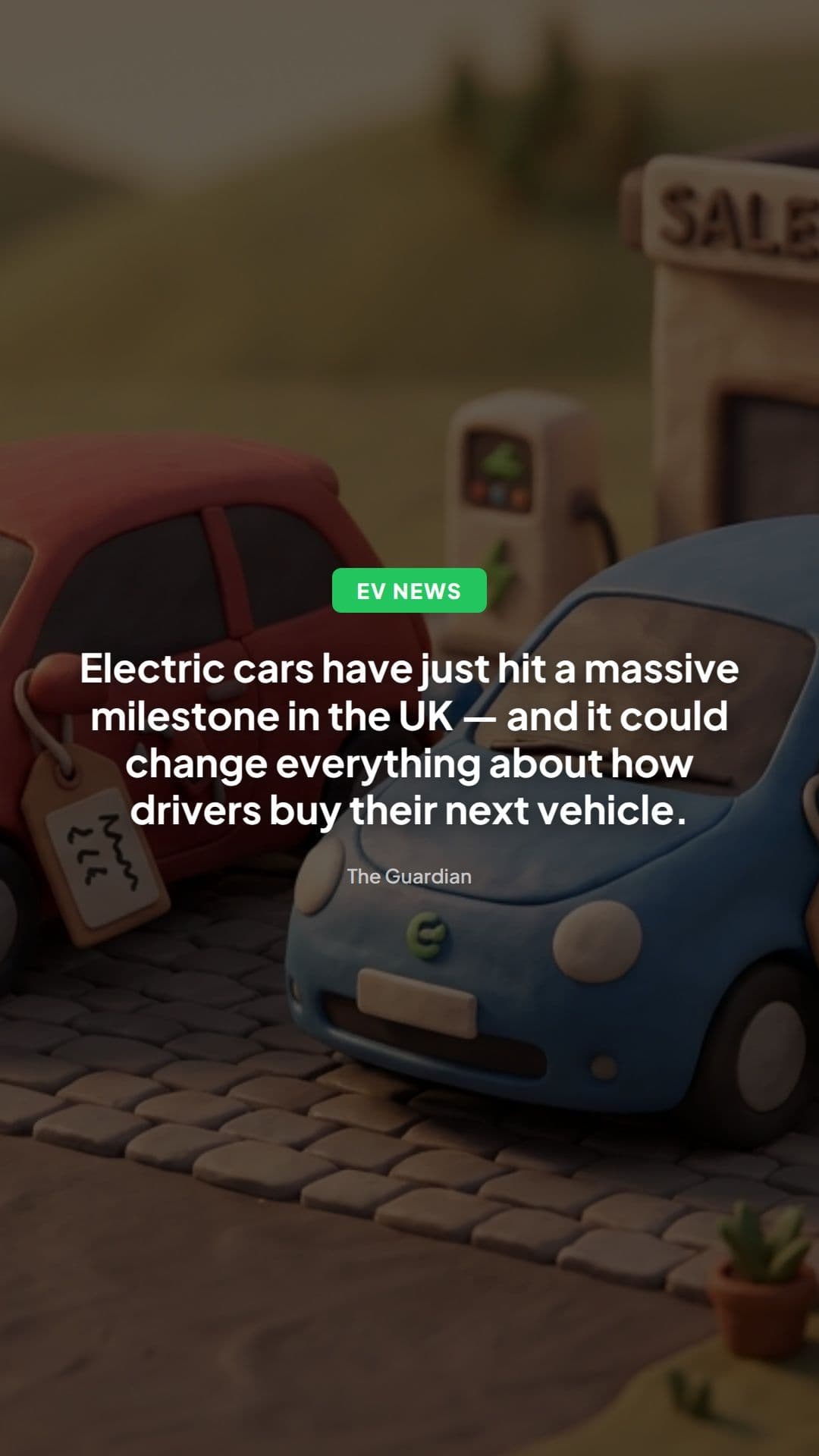
Electric Cars Now Cheaper Than Petrol: What This Milestone Really Means for UK Drivers
A 6-minute read | Category: EV
The Moment Everyone Has Been Waiting For
Cast your mind back five years. Mention buying an electric car to most British drivers and you'd get a familiar response — raised eyebrows, a sharp intake of breath, and something along the lines of "I'd love to, but I just can't afford it." Range anxiety got most of the headlines, but the real barrier was always simpler than that: price. EVs were, bluntly, expensive. They were aspirational purchases for people with long driveways, solar panels, and a healthy disposable income.
That narrative has just changed — officially and measurably.
According to data published by Auto Trader and reported by The Guardian, the average price of a new electric car in the UK has now fallen below that of a comparable new petrol vehicle. The gap isn't enormous — roughly £785 — but the symbolism is enormous. A threshold has been crossed, and the ripple effects will be felt across showrooms, insurance offices, government policy, and the daily lives of millions of UK drivers for years to come.
What the Data Actually Shows
The headline figure — a £785 average price advantage for EVs over petrol — deserves a little unpacking, because context matters enormously here.
Auto Trader's analysis compared average new car transaction prices across the UK market. The finding is that, on average, a new electric car now costs less to drive off the forecourt than a new petrol equivalent. That's a composite figure across a wide range of models, from compact city cars to family SUVs, and it reflects several converging trends that have been building for the best part of a decade.
Firstly, battery costs have fallen dramatically. Lithium-ion battery packs — the single most expensive component of any EV — have dropped in price by roughly 90% since 2010, according to BloombergNEF data. Manufacturers who were once absorbing enormous losses on entry-level EVs are now reaching or approaching profitability on those same vehicles.
Secondly, competition has intensified. Chinese manufacturers — BYD, MG, Ora, and others — have entered the UK market with aggressively priced electric vehicles, forcing established European and Korean brands to respond. The result is a price war that benefits consumers directly.
Thirdly, government incentives and manufacturer discounting have played their part. The UK's Electric Vehicle Homecharge Scheme, the Plug-in Van Grant, and various workplace charging incentives have all kept EV running costs suppressed, even as the headline purchase prices have been moving.
Why This Matters Beyond the Headline
The significance of this milestone goes well beyond the numbers on a price list. For years, the argument against EVs rested on a simple economic foundation: "They cost more to buy." That foundation has now crumbled, and it fundamentally changes the conversation.
Consider the total cost of ownership picture. Electric cars already benefit from:
- Lower fuel costs — charging at home overnight typically costs a fraction of filling a petrol tank, even accounting for recent energy price volatility
- Reduced servicing costs — no oil changes, fewer brake replacements (thanks to regenerative braking), and significantly fewer moving parts overall
- Vehicle Excise Duty (VED) — while EVs lost their permanent road tax exemption from April 2025 (now paying the standard £195 per year after the first year), they still attract lower first-year rates than high-emission petrol vehicles
- Benefit-in-Kind (BiK) tax advantages — for company car drivers, EVs remain extraordinarily tax-efficient compared to petrol equivalents
When you factor in that the purchase price has now equalised, the total cost of ownership argument shifts decisively in favour of electric. Over a typical three to four-year ownership period, a driver switching from petrol to electric could realistically save several thousand pounds.
The Legal and Regulatory Landscape Driving This Change
This price milestone doesn't exist in a vacuum — it's the direct product of regulatory pressure, and understanding that context helps drivers make informed decisions.
The UK's Zero Emission Vehicle (ZEV) Mandate, introduced under the Levelling-up and Regeneration Act 2023 framework and administered by the Department for Transport, requires that a rising percentage of new cars sold by each manufacturer must be zero-emission. In 2024, the target was 22%, rising to 28% in 2025, and continuing upward toward 80% by 2030 and 100% by 2035.
Manufacturers who fail to meet these targets face fines of £15,000 per non-compliant vehicle. That's a significant financial incentive — or more accurately, a significant financial deterrent — that has pushed manufacturers to price their EVs competitively, to ensure they actually sell. In practical terms, the ZEV Mandate has functioned as a price suppressor for electric vehicles, because an EV that sits unsold in a showroom doesn't count toward a manufacturer's compliance target.
The Consumer Rights Act 2015 is also worth noting here. As EVs move into mainstream purchase territory, the consumer protections that apply to any significant purchase apply equally: the right to goods that are of satisfactory quality, fit for purpose, and as described. If you're buying a new EV and the stated range proves significantly different from real-world performance, or if software updates materially alter the vehicle's capabilities, you have legal recourse — something worth bearing in mind as manufacturers increasingly treat cars as software platforms.
What Drivers Should Know Before Making the Switch
If you're considering making the move to electric — and the price parity news may well have nudged you closer to that decision — here's what to think about carefully before signing anything.
1. Look beyond the sticker price The £785 average difference masks a wide range of individual model pricing. Some EVs remain significantly more expensive than their petrol equivalents; others are considerably cheaper. Do your own comparison for the specific model you're considering, not just the market average.
2. Check your home charging situation first The economics of EV ownership change dramatically depending on whether you can charge at home. If you have off-street parking and can install a home charger (the Office for Zero Emission Vehicles offers a grant of up to £350 toward installation for eligible properties), your running costs will be substantially lower. If you're reliant entirely on public charging, the cost advantage narrows considerably.
3. Understand the VED position Since April 2025, new electric cars pay road tax. In their first year, EVs pay a reduced first-year rate based on zero CO₂ emissions (currently £10), then move to the standard rate of £195 per year from year two. Vehicles with a list price over £40,000 also attract the expensive car supplement of £425 per year for years two through six — something that catches many EV buyers off guard, given that many popular models sit above that threshold.
4. Finance carefully Many EVs are sold on PCP (Personal Contract Purchase) agreements. The ZEV Mandate pressure means manufacturers are currently subsidising finance rates and deposit contributions heavily to shift stock. These deals can be genuinely excellent — but read the terms carefully, particularly around mileage limits and what happens if battery technology shifts significantly during your agreement period.
5. Consider the used market too Used EV prices have been falling steadily, partly because of the influx of new models and partly because early adopters are cycling through their vehicles. A two or three-year-old EV can represent exceptional value, often with a significant portion of the manufacturer's battery warranty still intact.
Looking Ahead: What This Milestone Sets in Motion
Price parity is not the end of the story — it's the beginning of a new chapter. Several things are likely to follow from this moment.
Accelerated mainstream adoption seems almost inevitable. The psychological barrier of "EVs cost more" has been a powerful deterrent for many drivers who were otherwise open to the idea. Remove that barrier, and the conversation shifts to practicality, charging infrastructure, and range — all of which are improving rapidly.
Pressure on the used petrol market will intensify. As new EV sales accelerate, the residual values of used petrol cars — particularly higher-emission models — will come under increasing pressure. If you're planning to sell a petrol vehicle in the next few years, sooner may well be better than later.
Infrastructure investment will need to keep pace. The government's commitment to 300,000 public charge points by 2030 sounds impressive, but the current network — while growing — remains patchy outside major urban centres. Price parity in the showroom means nothing if drivers in rural areas still face a 30-mile trip to find a working rapid charger.
The insurance market will also need to adapt. EV insurance premiums have historically been higher than petrol equivalents, partly because of repair costs and partly because of limited claims data. As volumes increase and insurers build better actuarial models, those premiums should normalise — but it's worth shopping around aggressively right now, as pricing varies enormously between providers.
The crossing of this price threshold is, in the truest sense, a milestone. It doesn't solve every challenge facing EV adoption in the UK. But it removes the single most powerful argument against it. For millions of drivers who have been sitting on the fence, the fence just got a lot easier to climb over.
Source: The Guardian / Auto Trader, April 2026
Written by
Yuki Tanaka
Urban Planning Researcher
Ready to Challenge Your Ticket?
Let our AI analyse your PCN and generate a professional appeal letter in minutes.
Start Free Appeal