New British-built Nissan Juke EV: what UK drivers need to know
Nissan has unveiled a radically styled, British-built Juke EV. We break down what it means for UK motorists, charging, costs and EV uptake.

Emma Thompson
14 April 2026
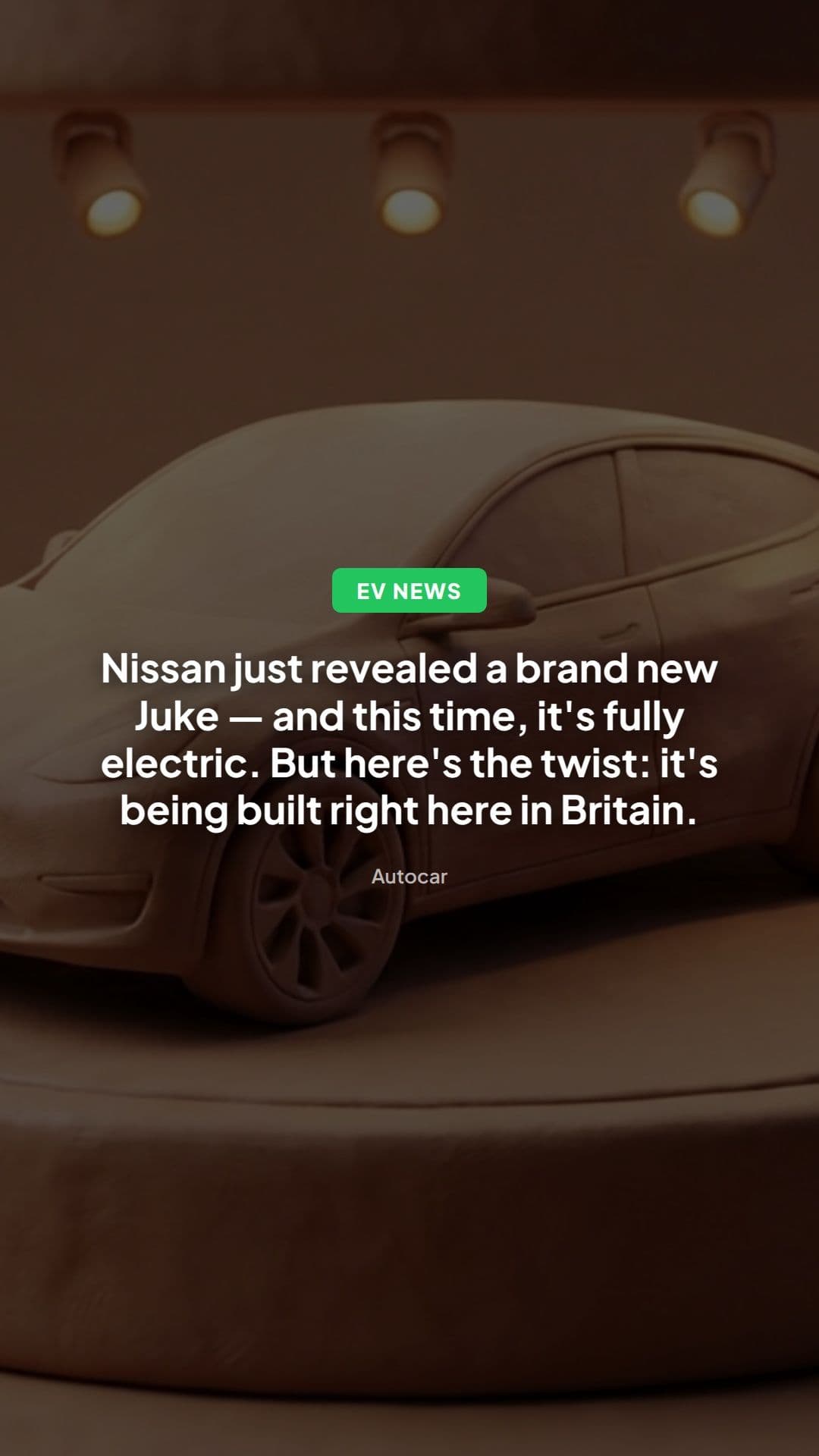
The New Electric Nissan Juke Is Built in Britain — But What Does It Mean for EV Drivers Right Now?
There's a moment in every automotive era when a familiar name gets reimagined for a new world. The Nissan Juke — that polarising, bulbous crossover that somehow became one of Britain's best-loved small SUVs — has just had that moment. Nissan has pulled back the curtain on a radically restyled, fully electric version of the Juke, and crucially, it will be built right here in the UK. That's a big deal. But beyond the design sketches and the press release fanfare, there are real, practical questions every British driver should be asking: Is this the EV that finally makes the switch feel sensible? What rights and regulations should you understand before you buy? And what does this tell us about where UK motoring is genuinely headed?
Let's dig in.
What Nissan Has Actually Announced
According to Autocar, Nissan has unveiled an all-electric version of the Juke with styling that goes significantly further than a simple facelift. This isn't a case of slapping a charging port on an existing model and calling it a day. The new Juke EV represents a ground-up rethink of the car's visual identity — sharper, more angular, and unmistakably designed to signal its electric credentials to anyone who glances at it on the road.
What makes this particularly significant is where it will be made. The new Juke EV will roll off the production line at Nissan's Sunderland plant — the same facility that has been producing cars in the North East of England since 1986. That factory, known internally as NMUK (Nissan Motor Manufacturing UK), is one of the most productive automotive plants in Europe, and its continued investment in electric vehicle production is a direct response to both government pressure and market demand.
Nissan has framed the new Juke EV as a cornerstone of its European EV strategy, and with the UK representing one of its most important markets, the timing is deliberate. The car is expected to sit in the increasingly competitive small electric SUV segment, going up against the likes of the Renault 5 E-Tech, the Vauxhall Mokka Electric, and the Jeep Avenger.
Why This Matters Beyond the Showroom
The Juke has always punched above its weight in terms of cultural relevance. When it launched in 2010, it was genuinely unlike anything else on sale in Britain. It was strange, bold, and divisive — and it sold in enormous numbers precisely because of that. The second generation, launched in 2019, smoothed off some of the rough edges while retaining the character. Now, the electric version needs to do something harder: convince drivers who are still on the fence about EVs that this is the car to make the leap.
And that matters because Britain's EV transition is at a genuinely critical juncture.
The UK Government's Zero Emission Vehicle (ZEV) mandate — introduced under the Automated and Electric Vehicles Act 2018 and tightened through subsequent regulations — requires that a rising percentage of new car sales from manufacturers must be zero-emission. In 2024, the target was 22%. By 2030, petrol and diesel new car sales will be banned outright under current legislation. Manufacturers who fail to hit their ZEV targets face civil penalties of £15,000 per non-compliant vehicle sold above their allowance.
For Nissan, a British-built electric Juke isn't just a product decision — it's a compliance strategy. The company needs volume EV sales, and the Juke name carries enormous brand equity in the UK. If any model can shift meaningful numbers of electric vehicles in the small SUV segment, it's this one.
The Legal Landscape EV Buyers Need to Understand
If you're considering buying the new Juke EV — or any electric vehicle — there are several legal and regulatory areas that will directly affect your ownership experience.
Consumer Rights and EV Purchases
Under the Consumer Rights Act 2015, any new vehicle must be of satisfactory quality, fit for purpose, and as described. This is straightforward enough. But EV buyers should pay particular attention to battery warranty terms. Nissan, like most manufacturers, offers a separate battery warranty on top of the standard vehicle warranty. Historically, Nissan has provided an 8-year/100,000-mile battery warranty on its Leaf — and buyers of the new Juke EV should scrutinise whether similar protections apply, and what "capacity retention" thresholds trigger a warranty claim.
If a battery degrades below a specified level (often 70–75% of original capacity) within the warranty period, you should be entitled to a repair or replacement. If a manufacturer refuses to honour this, the Consumer Rights Act and, where applicable, the Sale of Goods Act 1979 provide legal recourse through the courts.
Home Charging Installation Rights
One of the most overlooked legal aspects of EV ownership is home charging. Under the Electric Vehicles (Smart Charge Points) Regulations 2021, any new home charge point installed in England, Scotland, or Wales must be a "smart" charger — one capable of receiving and responding to signals to shift charging to off-peak periods. This isn't optional; it's a legal requirement for installers.
Importantly, if you live in a flat or rented property, your rights to install a charge point are more complex. The Leasehold Reform (Ground Rent) Act 2022 and ongoing leasehold reform legislation don't specifically address EV charging, but landlords cannot unreasonably withhold consent for EV charger installation under guidance from the Department for Energy Security and Net Zero. If you're a leaseholder, get any consent in writing before commissioning installation.
Workplace Charging and Tax Implications
For those buying the Juke EV as a company car, the Benefit in Kind (BIK) tax rate for fully electric vehicles remains significantly lower than for petrol or diesel equivalents. As of the 2025/26 tax year, the BIK rate for zero-emission company cars is just 3%, rising incrementally to 5% by 2027/28. This makes a compelling financial case for fleet buyers — and it's one reason the Juke EV will likely find strong demand in the company car market.
What Drivers Should Know Before Buying
If the new Juke EV is on your radar, here's what to keep front of mind before you sign anything:
- Check the real-world range figures carefully. Manufacturer WLTP range figures are measured under controlled conditions and routinely differ from real-world performance, particularly in cold weather or at motorway speeds. Look for independent tests from sources like Autocar, What Car?, and Fully Charged before committing.
- Understand your charging options. The Juke is a small SUV, so it's likely to carry a battery in the 50–65kWh range. Check the maximum AC and DC charging speeds — a higher DC charging speed means shorter rapid charging stops on longer journeys.
- Scrutinise the warranty documentation. Ask specifically about battery capacity retention thresholds and what evidence you'd need to make a claim. Get it in writing.
- Factor in home charging installation costs. A basic smart home charger typically costs £800–£1,200 installed, though the EV chargepoint grant (administered by the Office for Zero Emission Vehicles) provides up to £350 off for eligible homeowners and flat owners. Check eligibility at GOV.UK before purchasing.
- Consider the resale market. Used EV values have been volatile. A well-known nameplate like the Juke should offer better resale stability than lesser-known EV brands, but it's worth researching residual value projections before purchase.
- Check local parking and charging infrastructure. If you rely on public charging, use tools like Zap-Map to assess coverage in your area. The availability of rapid chargers near your regular routes will significantly affect day-to-day usability.
Looking Ahead: What the Juke EV Signals for British Motoring
The decision to build the electric Juke in Sunderland is more than a manufacturing footnote — it's a statement about the viability of UK automotive production in the electric age. The Sunderland plant has already committed to producing the electric Leaf successor and is central to Nissan's EV36Zero initiative, a £1 billion investment that includes a battery gigafactory partnership with Envision AESC.
For British drivers, this has real implications. A domestically produced EV is less exposed to the kind of supply chain disruptions and import tariff complications that have affected other manufacturers. It also means that when things go wrong — warranty claims, parts availability, dealer network support — you're dealing with a manufacturer with deep roots in the UK market and a genuine stake in its reputation here.
The broader picture is one of accelerating change. The ZEV mandate will tighten year on year. Petrol and diesel new car sales will end in 2030. The infrastructure — charging networks, grid capacity, home installation support — is improving, albeit unevenly. Against that backdrop, a familiar, well-trusted nameplate like the Juke arriving in electric form isn't just good news for Nissan. It's the kind of mainstream, accessible EV that could genuinely move the dial on British EV adoption.
The question is no longer whether EVs are coming. They're here. The Juke EV is simply the latest — and arguably one of the most important — proof of that.
Source: Autocar — "New British-built Nissan Juke unveiled as radically styled EV"
Written by
Emma Thompson
Traffic Law Specialist
Ready to Challenge Your Ticket?
Let our AI analyse your PCN and generate a professional appeal letter in minutes.
Start Free Appeal