New Albums Linked to 15% Rise in Fatal Road Crashes
A Harvard study says fatal road crashes rose 15% on big album-release dates. We examine music distraction risks, road safety evidence and UK drivers' duties.

The Parking Ticket Pal Editorial Team
22 August 2026
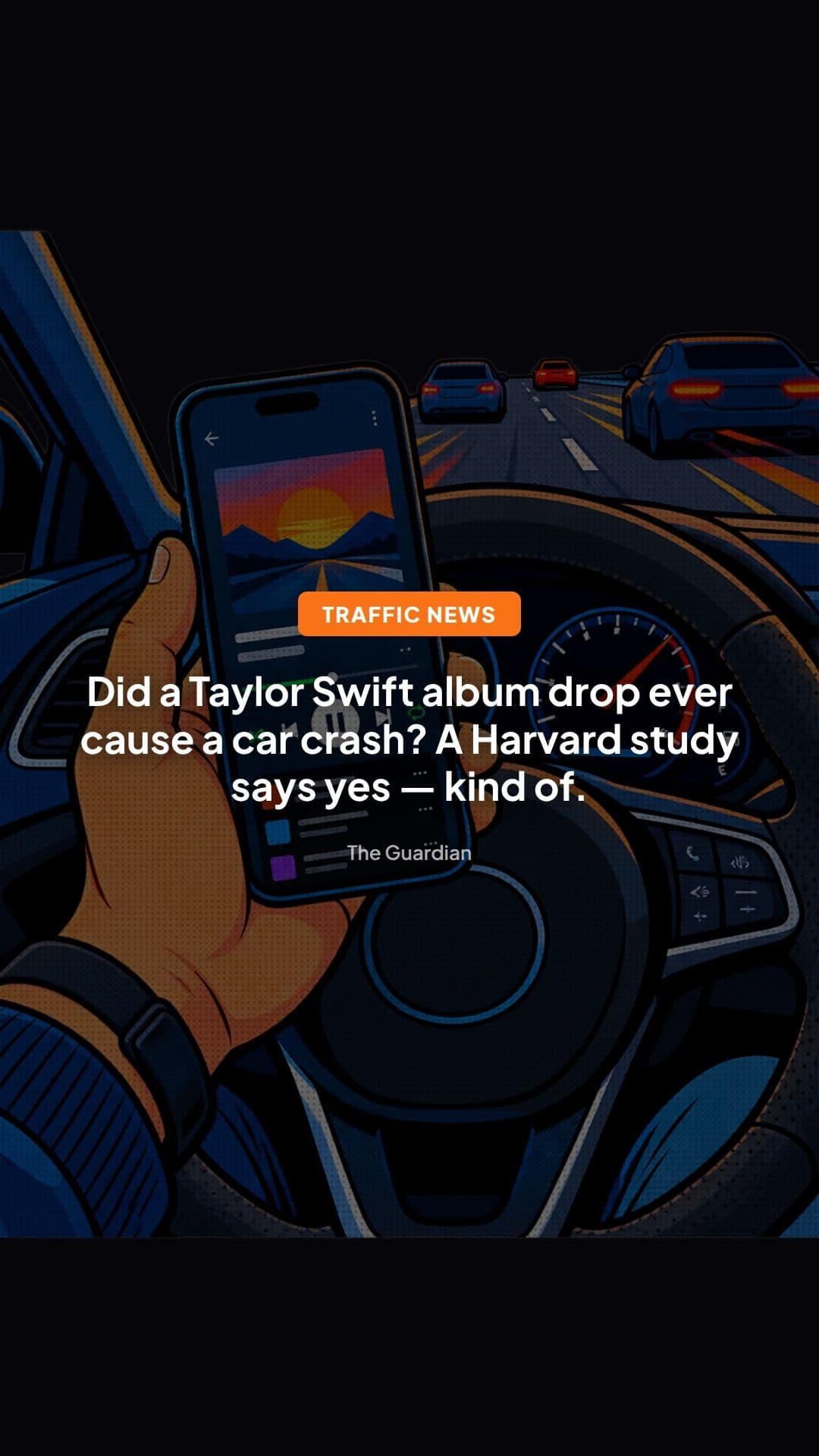
When the Playlist Becomes the Problem: What a US Album Study Tells Us About Distracted Driving on UK Roads
Picture this: a new album from a global superstar drops at midnight, and within hours millions of fans are streaming it on their commute, in traffic queues, or on the school run. It sounds harmless enough, background noise for a Monday morning. But according to new Harvard research reported by the Guardian, that seemingly innocent act of queuing up a fresh album might be quietly contributing to a measurable spike in fatal road crashes.
It is a strange, slightly unsettling idea. Music doesn't kill people. Phones, screens, and split-second decisions do. And that is exactly where this story gets interesting, because it is not really about music at all. It is about what we do with our hands and eyes the moment something new and exciting becomes available on a device sitting inches from the steering wheel.
What Happened
The Harvard study cited by the Guardian found that traffic fatalities were 15% higher on the dates when major albums were released, compared with other days. The researchers' theory is straightforward: when a hotly anticipated album lands, drivers reach for their phones to find it, queue it up, skip through tracks, or simply fiddle with settings while the car is moving. That fiddling, even for a few seconds, is enough to meaningfully increase crash risk.
This isn't a study about the dangers of Taylor Swift or Drake specifically. It is a study about behaviour triggered by novelty and access. A big release date creates a moment of mass, simultaneous distraction, essentially a natural experiment that lets researchers isolate the effect of "phone interaction while driving" from other confounding factors. Because the release date is fixed and predictable regardless of weather, traffic volume, or time of year, the researchers could compare crash data on those specific days against a baseline and detect the difference.
The scale of the finding, a 15% jump in fatalities, is striking precisely because it did not require anything as obvious as drink driving or excessive speed. It required nothing more dramatic than a driver wanting to hear a new song immediately.
Why It Matters
This story lands at an important moment for anyone thinking about road safety in Britain. In-car technology has changed dramatically over the past decade. Where once a driver might have fumbled with a CD or a radio dial, now the temptation is a smartphone paired to Apple CarPlay or Android Auto, or a built-in touchscreen infotainment system offering instant access to any song, podcast or audiobook ever recorded.
The convenience is real. So is the risk. Streaming services are built around instant gratification, notifications, new releases, personalised recommendations, all designed to capture attention. That is precisely the opposite of what you want from anything competing for a driver's focus.
There is also a broader pattern here that UK road safety researchers have been flagging for years: distraction-related collisions do not always look like the stereotypical "driver texting" image. They often involve seemingly mundane secondary tasks, adjusting a satnav, answering a call through a dashboard screen, or yes, changing a song. The Harvard findings simply provide one of the clearest, most quantifiable examples of how a single triggering event, an album drop, can ripple out into real-world harm on the roads.
It is also a useful reminder that distraction is not a fixed, static risk. It spikes around specific moments: big sporting events, breaking news alerts, and now, apparently, chart-topping music releases. Anticipating those spikes is something road safety campaigners and even manufacturers of in-car tech could, in theory, plan around.
The Legal Angle
UK law is unambiguous about handheld phone use while driving, but the legal picture around interacting with music or other content through in-car systems is more nuanced, and this is where many drivers unknowingly expose themselves to risk.
Under the Road Traffic Act 1988 and the Highway Code, using a handheld mobile phone while driving, including to select a song, skip a track, or scroll through a playlist, is illegal. Since the law was tightened, the offence covers virtually any interactive use of a handheld device, not just calls and texts. A conviction typically carries an automatic six penalty points and a fixed penalty of £200, though it can escalate to a court appearance, a higher fine and disqualification, particularly for new drivers within two years of passing their test who can lose their licence entirely under the totting-up rules for that period.
Where things get murkier is with built-in, integrated systems, such as a car's own touchscreen or a phone mounted in a cradle and controlled via voice command or steering wheel buttons. These are not automatically illegal to use while driving. However, if a driver's use of any device, handheld or not, causes them to drive without due care and attention, they can still be prosecuted for careless driving under Section 3 of the Road Traffic Act 1988. In the most serious cases involving death, this can escalate to causing death by careless or dangerous driving, offences that carry substantial custodial sentences.
In other words, the law does not require a phone to be physically in your hand for distraction to become a criminal matter. If police or prosecutors can show that fiddling with an infotainment system, even a supposedly "hands-free" one, contributed to a collision, that evidence can and does form part of careless or dangerous driving cases. Courts have shown increasing appetite for treating distraction seriously, reflecting wider public concern about road safety.
For drivers wanting a fuller picture of what counts as illegal phone use, and how the rules have evolved for hands-free and voice-activated systems, it's worth reading up on the current mobile phone driving laws, since enforcement and definitions continue to shift.
What Drivers Should Know
The practical takeaway from this research is refreshingly simple, even if it is not always easy to follow in the moment.
Set your music before you set off. Queue your album, playlist or podcast while the car is stationary, ideally before you even start the engine. If you know a big release is dropping and you are desperate to hear it, resist the urge to explore it live behind the wheel.
Use voice commands where genuinely hands-free. Most modern systems allow voice-activated track skipping or searching. This reduces, though does not eliminate, the visual and manual distraction, since voice commands still demand cognitive attention away from the road.
Treat any screen interaction as a hazard, not a convenience. Whether it's a phone mount, a built-in touchscreen, or a smartwatch, the underlying risk is the same: attention diverted from the road, even briefly, at speed. Several seconds looking away from the road at 60mph covers a significant distance travelling blind.
Understand that "hands-free" is not the same as "risk-free" in law. Even if you avoid an automatic mobile phone offence by using an integrated system, you can still be prosecuted for careless or dangerous driving if that interaction leads to a collision or near miss. There is no legal grey area protecting distracted driving simply because a handset wasn't in your hand.
Passengers can help. If you are travelling with others, delegate the DJ duties. It costs nothing and removes the temptation entirely.
Looking Ahead
This Harvard study adds to a growing body of evidence that modern in-car technology, for all its convenience, has created new and sometimes unexpected distraction risks that road safety law is still catching up with. As streaming culture accelerates, with album drops, viral audio trends and algorithm-driven recommendations designed to be irresistible, the temptation to interact with devices mid-journey is only going to grow, not shrink.
It seems likely that road safety campaigners and possibly regulators will start paying closer attention to how in-car entertainment systems are designed, and whether manufacturers should build in stronger safeguards, such as locking certain functions while the vehicle is in motion. Some cars already restrict text input and video playback while driving, but music browsing remains largely unrestricted.
For individual drivers, the lesson from this research is not really about music at all. It is about recognising that distraction often arrives in disguise, wrapped in something exciting, urgent, or seemingly trivial. A new album, a notification, a text from a friend, all compete for the same finite attention that keeping a two-tonne vehicle safely on the road actually requires. The data suggests that when millions of people reach for their phones at once, the consequences on the road are anything but background noise.
Written by
The Parking Ticket Pal Editorial Team
Source-checked parking guidance
Ready to Challenge Your Ticket?
Let our AI analyse your PCN and generate a professional appeal letter in minutes.
Start Free Appeal