NCP collapse: what it means for UK motorists & parking
NCP has entered administration. Find out which car parks may close, what happens to season tickets and parking charges, and your rights as a driver.

Raj Patel
19 April 2026
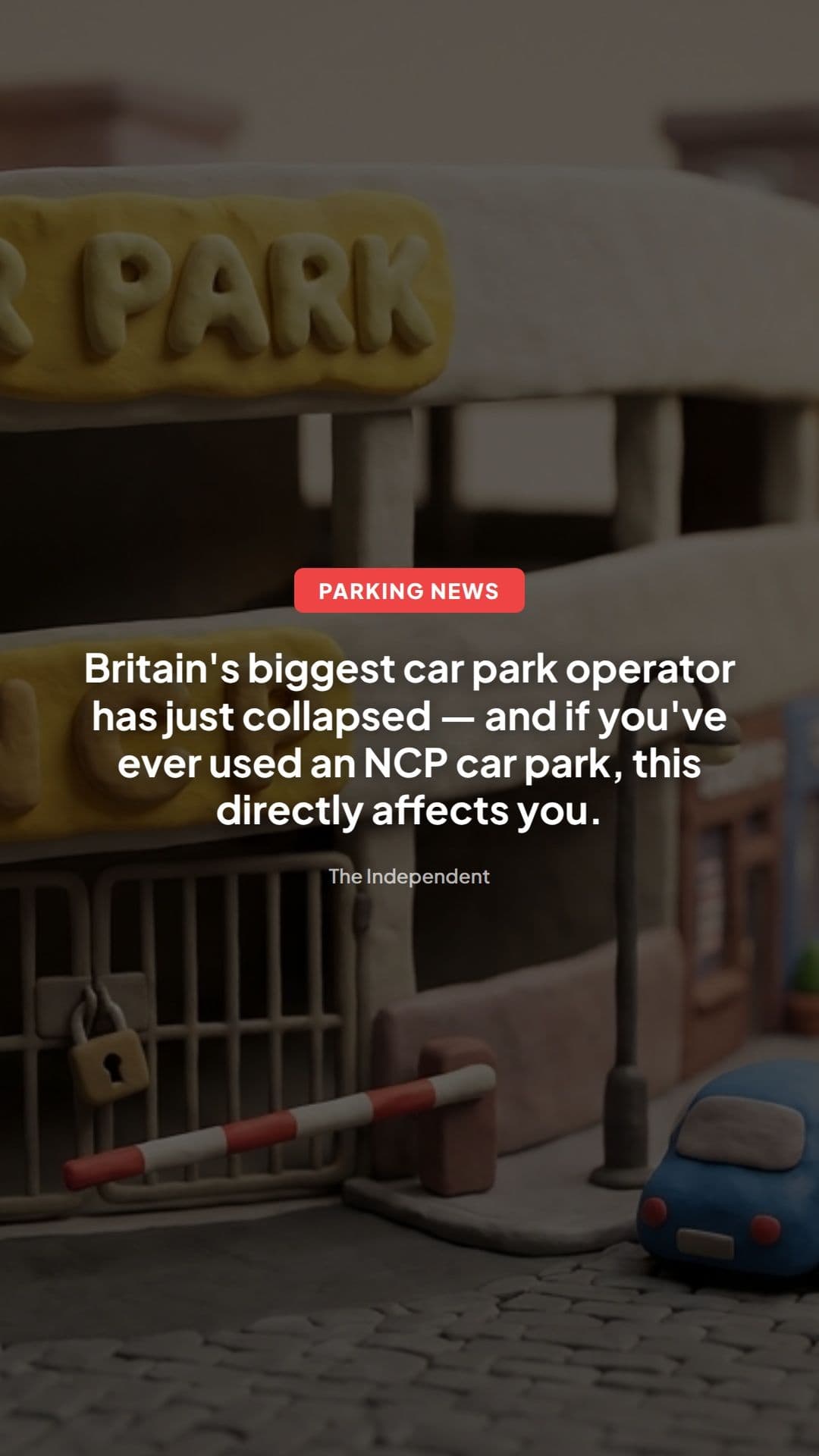
NCP Collapse: What Britain's Biggest Parking Operator Going Bust Really Means for Drivers
The fall of National Car Parks raises serious questions about consumer protection, parking contracts, and the future of urban mobility — here's the full picture
It was the car park you never really thought about until you needed one. The blue and yellow signage, the ticket machines that occasionally swallowed your coins, the multi-storey that somehow always smelled faintly of diesel and damp concrete. National Car Parks — NCP — was simply there, a fixture of British high streets, airports, and city centres for decades. Until, quite suddenly, it wasn't.
NCP's entry into administration marks one of the most significant collapses in British motoring infrastructure in recent memory. But beyond the headlines about shuttered car parks and redundant staff, there are real, immediate consequences for ordinary drivers — and some genuinely murky legal territory that deserves a much closer look.
What Actually Happened to NCP?
National Car Parks, which operates hundreds of sites across the United Kingdom and bills itself as the country's largest parking operator, has entered administration following mounting financial pressures. Administrators have been appointed to oversee the business, with a number of commercially unviable sites earmarked for closure while others continue to trade under the administrators' management.
The company's roots go back to 1931, making it one of the oldest parking businesses in the country. At its peak, NCP managed well over 400 car parks and held long-term leases on prime urban real estate across England, Scotland, and Wales. It has changed hands multiple times over the decades — passing through private equity ownership and various corporate restructurings — accumulating significant debt along the way.
The administration is not a sudden event. NCP has been navigating a difficult financial environment for several years, squeezed by a combination of rising commercial property rents, reduced footfall following the pandemic-era shift to remote working, and increasing competition from both council-run car parks and app-based parking alternatives. When urban centres hollowed out and commuters stopped commuting, NCP's revenue model — built on predictable daily and monthly parking demand — took a serious hit from which it never fully recovered.
Why This Matters Beyond the Business Pages
You might be tempted to file this under "corporate news" and move on. Don't. The collapse of NCP has implications that ripple outward in ways that aren't immediately obvious.
The scale is significant. NCP isn't a regional operator with a dozen sites. It holds leases, contracts, and agreements with local authorities, private landowners, airports, hospitals, and shopping centres across the country. The sudden closure of even a fraction of those sites creates an immediate supply problem in cities where parking is already scarce and expensive.
It disrupts existing agreements. Thousands of drivers hold monthly or annual NCP parking contracts — season tickets, in effect — that they've paid for in advance. When a business enters administration, those contractual relationships don't simply transfer smoothly to the next operator. Depending on how the administration proceeds, some customers may find themselves holding contracts that are worth considerably less than what they paid.
It signals a broader structural problem. NCP's difficulties aren't unique. Commercial parking operators across the UK are grappling with the same fundamental tensions: expensive urban leases, changing commuting habits, the growth of cashless and app-based alternatives, and local authorities increasingly treating parking as a revenue and behaviour-management tool rather than a neutral service. NCP's collapse is the most dramatic expression of pressures that are reshaping the entire sector.
The Legal Angle: What Are Your Rights When a Parking Operator Collapses?
This is where things get genuinely complicated — and where drivers need to pay close attention.
Pre-paid contracts and season tickets
If you hold a monthly or annual NCP parking contract and the site you use closes, you are an unsecured creditor of the company in administration. Under the Insolvency Act 1986, unsecured creditors sit behind secured lenders and preferential creditors (such as employees owed wages) in the queue for any money recovered. In practical terms, this means that recovering the full value of a pre-paid contract through the administration process is unlikely.
However, if you paid by credit card, you may have a route to recovery under Section 75 of the Consumer Credit Act 1974, which makes your card provider jointly liable for breaches of contract where the transaction was between £100 and £30,000. If you paid by debit card, a chargeback request through your bank is worth pursuing, though this is a voluntary scheme rather than a statutory right and outcomes vary.
What happens to outstanding parking charges?
This is a question that confuses many drivers. If you received a parking charge notice (PCN) from an NCP-managed site and it remains unpaid or in dispute, the administration complicates matters. Debt obligations don't disappear when a company enters administration — they transfer to the administrators, who will decide whether pursuing individual debts is commercially worthwhile. If the site itself is sold to a new operator, outstanding charges may be assigned as part of that transaction.
Crucially, private parking charges issued by NCP are governed by the Protection of Freedoms Act 2012 and must comply with the British Parking Association (BPA) or International Parking Community (IPC) codes of practice. These obligations don't evaporate because the company is in financial difficulty.
Site closures and signage obligations
When NCP closes a site, there are obligations around notice and signage. Parking enforcement on a closed or transitioning site becomes legally precarious. If a site is closed but signage remains in place and enforcement continues — whether by NCP staff, administrators, or a contracted third party — any charges issued during that transitional period could be challengeable on the grounds that the contractual basis for enforcement has materially changed.
What Drivers Should Do Right Now
If you're an NCP customer or regularly use their car parks, here's what you need to do:
- Check your payment method. If you have an active monthly or annual contract, identify whether you paid by credit card. If so, contact your provider about a Section 75 claim. If you paid by debit card, raise a chargeback request promptly — time limits apply.
- Document everything. Keep records of your contract, payment receipts, and any correspondence with NCP. If your usual site closes, photograph the signage and note the date. This documentation will be essential for any financial claim.
- Don't assume your monthly contract is still valid. If your site has been announced for closure, stop relying on it and make alternative arrangements immediately. Continuing to park there without clarity on the contractual position could leave you exposed to enforcement action.
- If you have an outstanding dispute with NCP, continue to pursue it through the standard appeals process. The administration does not suspend your appeal rights, and the independent appeals services (POPLA for BPA members) remain operational.
- Contact the administrators directly if you have a financial claim. The administrators are legally required to establish a creditors' process, and registering your claim promptly is essential.
- For day-to-day parking, start identifying alternative car parks in the areas you use most frequently. Local authority car parks, which are not affected by NCP's administration, are worth mapping out now rather than in a rush.
Looking Ahead: What NCP's Collapse Tells Us About Parking's Future
NCP's administration is a watershed moment, but it is unlikely to be the last disruption in this sector. The commercial parking model as it has existed for the past half-century — large operators holding expensive urban leases, monetising captive demand — is under structural pressure that isn't going away.
Several trends are converging. Working-from-home patterns have permanently reduced daily commuter parking demand in many city centres. Electric vehicles are changing the economics of car park infrastructure, as operators face pressure to install costly charging equipment. Local authorities are increasingly using parking policy as a lever for reducing car use and meeting climate commitments, which puts commercial operators in an uncomfortable position.
At the same time, the regulatory environment for private parking is tightening. The Parking (Code of Practice) Act 2019 and the ongoing development of a statutory code of practice signal that Parliament intends to impose stricter standards on the industry. Operators who cannot demonstrate compliance while also managing their finances sustainably will face an increasingly difficult future.
For drivers, the practical lesson is clear: the infrastructure you rely on is less permanent than it appears. The blue and yellow signage, the familiar ticket machine, the app you've used for years — none of it is guaranteed. Building flexibility into your parking habits, understanding your consumer rights, and knowing what to do when things go wrong aren't just useful skills. In an era of corporate instability and rapid change in urban transport, they're essential.
NCP's story isn't just about a parking company running out of road. It's a signal that the way Britain parks is changing — whether drivers are ready for it or not.
Written by
Raj Patel
Transport Policy Analyst
Ready to Challenge Your Ticket?
Let our AI analyse your PCN and generate a professional appeal letter in minutes.
Start Free Appeal