Merton and Camden Roadworks Charges: Impact on Drivers
Utility firms may face peak-time roadworks charges in Camden and Merton. See how the plans could curb congestion and affect drivers' daily journeys in London.

Amara Okafor
31 July 2026
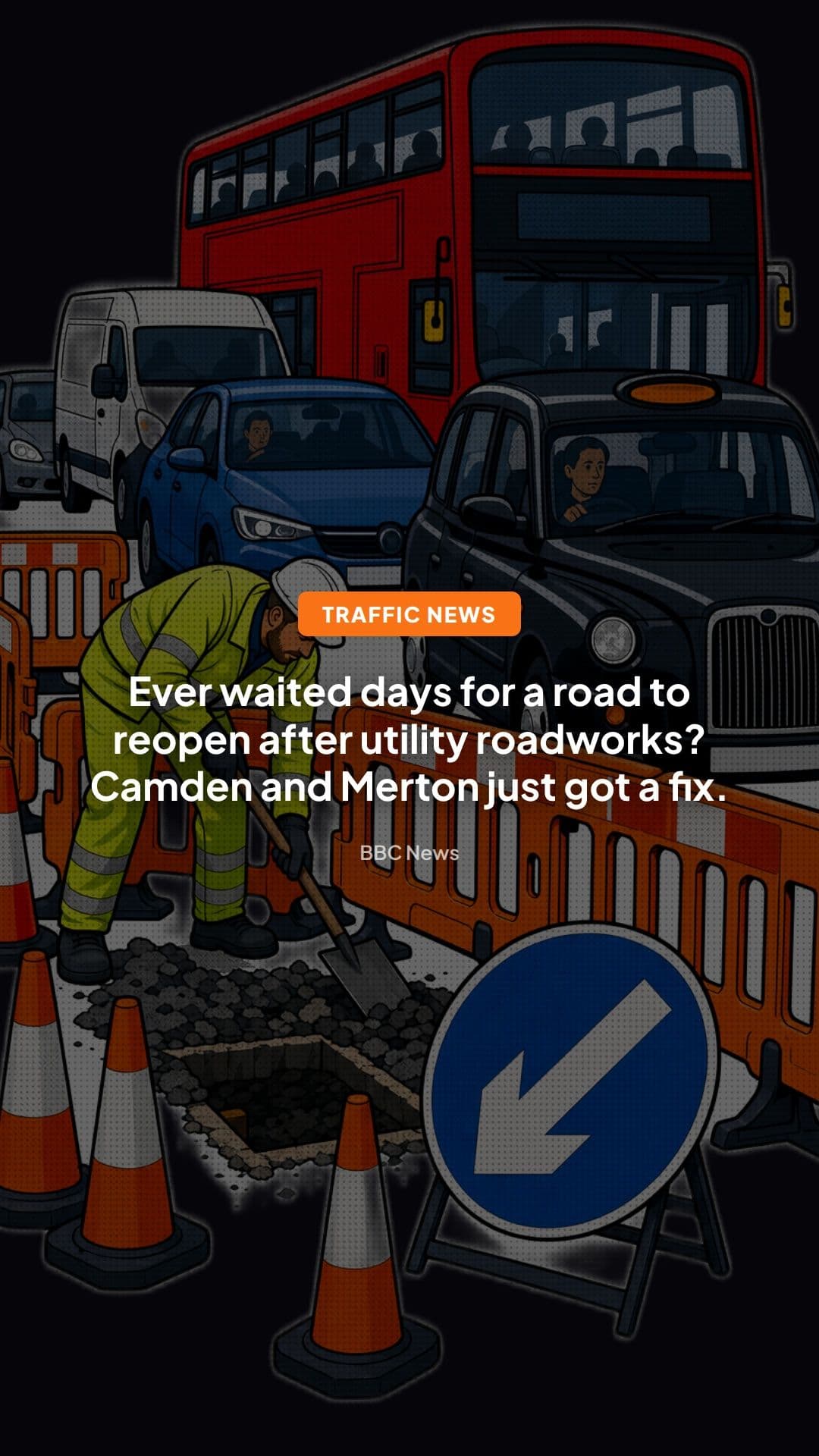
Firms to be Charged for Key Route Roadworks in Merton and Camden: What It Means for Drivers
Anyone who has crawled along a single lane past a fenced-off trench, wondering why the workers seem to have knocked off for the day, will know the particular frustration of urban roadworks. Now two London boroughs are trying a different approach: making it expensive for utility companies to dig up the busiest streets at the busiest times.
What Happened
Camden and Merton councils are moving to charge utility companies for carrying out roadworks on key routes during peak periods. The idea, as reported by the BBC, is straightforward in principle. If a gas, water, electricity or telecoms company wants to open up the road on one of the borough's busiest streets during rush hour, it will have to pay for the privilege. Do the same work overnight or at a quieter time, and the charge disappears or shrinks significantly.
This is not a blanket ban on daytime works, nor is it a punishment aimed at drivers. It is a financial nudge aimed squarely at the companies that plan and schedule street works, encouraging them to think twice about timing before they send a crew out with a jackhammer.
The logic is simple economics. Utility companies have a statutory right to dig up public roads to install, maintain or repair pipes and cables. For decades, that work has often happened whenever suits the contractor's schedule, with congestion and disruption to residents and businesses treated as somebody else's problem. By putting a price on peak-time disruption, councils hope to shift that calculation.
Why It Matters
Roadworks are one of the most persistent irritants in British driving life, and they are not going away. Ageing pipework, the rollout of full-fibre broadband, electric vehicle charging infrastructure, and routine gas and water maintenance all mean utility companies are constantly opening up streets across the country. For residents of Camden and Merton, and for anyone who commutes through them, the difference between a dig happening at 3am versus 3pm can be the difference between a minor inconvenience and a lost hour stuck in traffic.
There's also a fairness argument buried in this policy. Congestion caused by roadworks doesn't just cost drivers time. It affects bus reliability, cycling safety, air quality from idling engines, and the ability of local businesses to receive deliveries or welcome customers. Councils bear a lot of that cost indirectly, through complaints, congestion-related enforcement issues and reputational pressure, while utility companies have historically borne relatively little of it themselves.
This isn't a wholly new idea nationally. London has had various forms of coordinated street works permitting for years, and some authorities elsewhere in the country have experimented with similar "pay to dig at peak times" schemes to discourage disruptive scheduling. What makes the Camden and Merton move notable is the specific focus on key routes, the streets that carry the most traffic and where the knock-on congestion effects are worst. It's a targeted approach rather than a blunt instrument applied everywhere.
Given the state of council finances across the country, it's also worth noting the obvious secondary benefit: revenue. Charges collected from utility companies working at inconvenient times can, in principle, help fund highway maintenance or enforcement elsewhere. Whether that materialises in practice will depend heavily on how the schemes are administered and how much utility companies simply factor the charges into their operating costs rather than change their behaviour.
The Legal Angle
Roadworks and street works in England sit within a fairly dense legal framework, and it's worth understanding roughly how it fits together.
The starting point is the New Roads and Street Works Act 1991, which gives utility companies (known in law as statutory undertakers) the right to open up public highways to install and maintain their apparatus, subject to giving notice to the relevant highway authority. This is why you can't simply stop a utility firm digging up your street; the right is baked into legislation, though it comes with obligations around notice periods, reinstatement standards and coordination with other works.
The mechanism that allows councils to charge for disruptive timing comes from the Traffic Management Act 2004, specifically the powers around permit schemes. Under a permit scheme, a highway authority can require anyone carrying out street works to obtain a permit before starting, and can attach conditions to that permit, including conditions about when work can take place and charges for working at particularly disruptive times or on particularly sensitive roads. These are sometimes referred to as "lane rental" schemes, because in effect a company is renting the use of a traffic lane and paying more for the privilege during the hours when that lane is most valuable to everyone else.
London has had experience with this model for some years through borough-level and Transport for London permit schemes, and a handful of authorities elsewhere, including Kent County Council and Surrey County Council, have run their own lane rental style schemes under similar statutory permission from the Department for Transport. Camden and Merton's move should be understood as part of this same legal family: local authorities using their Traffic Management Act powers to make peak-time disruption costly rather than free.
For any scheme like this to operate lawfully, the council typically needs approval from the Secretary of State for Transport, must consult on the scheme, and must be able to demonstrate that charges are proportionate and linked to genuine disruption rather than simply being a revenue-raising exercise dressed up as traffic management. Utility companies affected by such schemes can, and sometimes do, challenge charges they consider excessive or improperly applied.
What Drivers Should Know
For most ordinary drivers, this policy shift won't require you to do anything differently, but it's worth understanding the practical implications.
Fewer peak-time closures on key routes, in theory. If the scheme works as intended, utility companies will increasingly schedule disruptive works outside the busiest hours on the roads that matter most for traffic flow. Don't expect roadworks to vanish entirely, but the timing of them on major routes may shift.
Roadworks won't disappear overnight (literally or figuratively). Charging schemes change incentives, they don't eliminate the underlying need for repairs and upgrades. Ageing infrastructure still needs maintaining, and some works genuinely cannot be done safely at night, such as those requiring daylight for certain safety checks or where noise restrictions apply to protect residents.
Check before you travel. Whatever the policy intentions, the most reliable way to avoid getting caught out is still to check for planned works before setting off, particularly on unfamiliar routes through Camden or Merton. Council websites and services such as one.network publish planned street works, and it's a habit worth building if you regularly drive through areas prone to disruption.
Diversions can create their own pitfalls. Temporary road layouts, contraflows and diversion signage around roadworks are a common source of confusion, and confusion can lead to inadvertent traffic contraventions. If you ever find yourself issued with a penalty charge notice because temporary signage around works was unclear, contradictory or missing, that can form a legitimate ground for appeal, and it's worth documenting the scene with photographs if you believe the signage was inadequate.
This is a local, not national, change for now. The charging scheme applies specifically to Camden and Merton's key routes. Drivers elsewhere in the country may see similar schemes discussed by their own local authorities in future, but there's no indication yet of a nationwide rollout.
Looking Ahead
The success of this approach will ultimately be judged by whether utility companies actually change their behaviour, or simply treat the charges as a cost of doing business and pass them on elsewhere in their pricing. If Camden and Merton's experience shows a meaningful reduction in peak-time disruption on their busiest streets, it would strengthen the case for other London boroughs and councils across England to adopt similar lane rental style schemes under their existing Traffic Management Act powers.
There's also a broader conversation this taps into, about who bears the cost of ageing and expanding infrastructure. As electric vehicle charging points, fibre broadband and renewed water mains all compete for space under our streets in the years ahead, the tension between necessary works and liveable, navigable roads isn't going to ease off. Charging schemes like this one are one tool among several that councils are exploring to try to manage that tension more fairly, alongside broader efforts around road funding and maintenance backlogs that continue to strain local authority budgets nationwide.
For now, drivers in Camden and Merton can reasonably hope for slightly less rush-hour chaos around utility works on key routes. Whether that hope is fully realised will depend on how rigorously the charges are enforced, and how utility companies respond once the invoices start arriving.
Written by
Amara Okafor
Council Liaison Officer
Ready to Challenge Your Ticket?
Let our AI analyse your PCN and generate a professional appeal letter in minutes.
Start Free Appeal