May bank holiday traffic: RAC warns of record jams
RAC predicts the busiest May bank holiday traffic in years. See UK hotspot routes, peak travel times, rail disruption knock-ons and how to avoid delays.

Mohammed Al-Hassan
2 May 2026
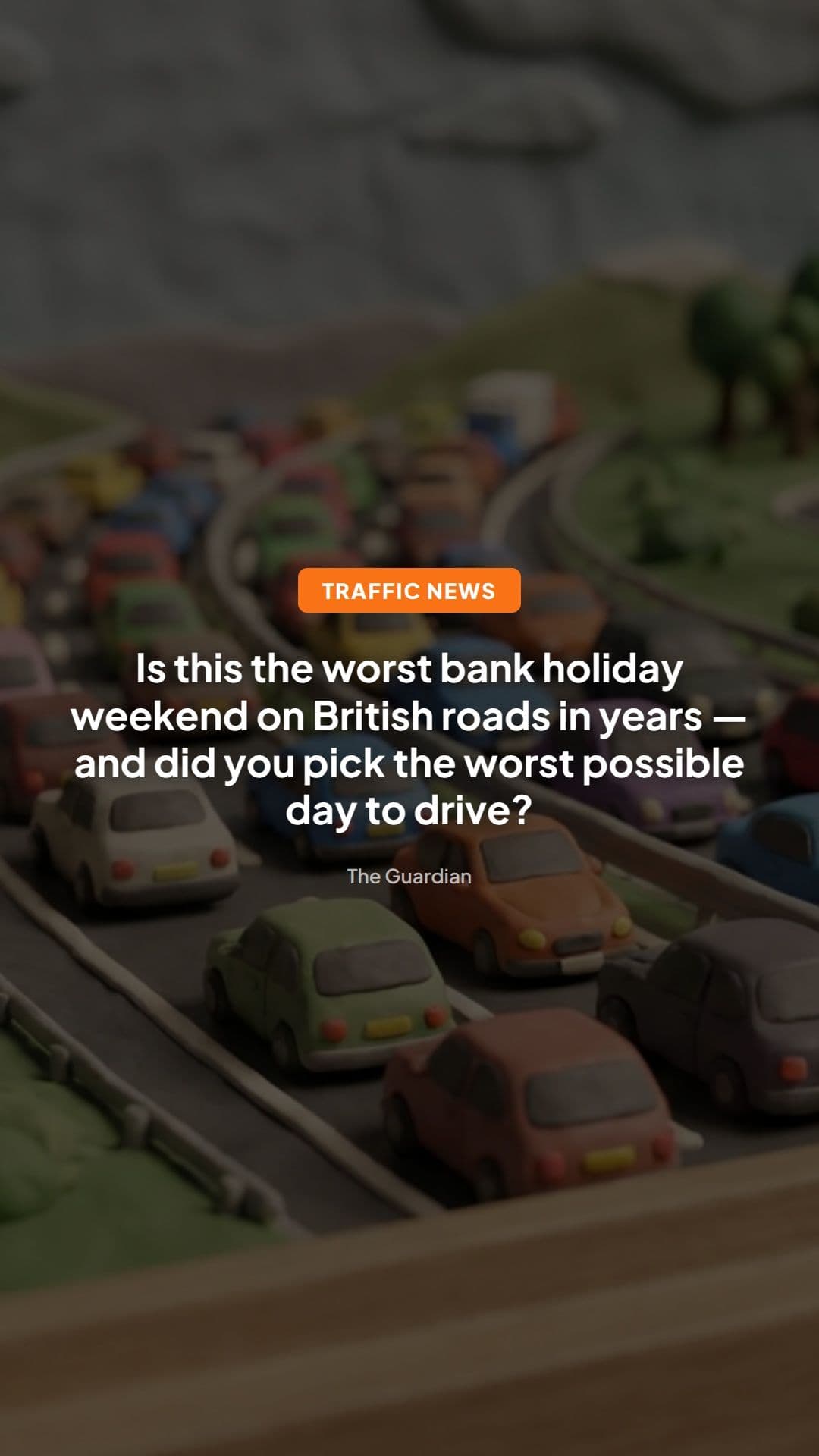
Bank Holiday Traffic 2026: What Millions of UK Drivers Need to Know Before They Set Off
Picture this: it's the early hours of a May bank holiday morning. You've packed the car, the kids are (somehow) still asleep in the back, and you're congratulating yourself on beating the rush. Then, somewhere on the M5, you hit a wall of red tail lights stretching to the horizon. Sound familiar? This year, according to the RAC, that scenario is more likely than ever — and the reasons why go considerably deeper than "it's a bank holiday."
The RAC's warning ahead of the May 2026 bank holiday period isn't just routine traffic forecasting. It reflects a confluence of factors — from record rail disruption to shifting post-pandemic travel habits — that are pushing more drivers onto already-strained roads at exactly the same time. If you're planning to travel, understanding why the roads will be so busy, and what your rights are when things go wrong, could save you considerably more than just time.
What the RAC Is Actually Warning About
The RAC's forecast, reported by The Guardian, identifies the May 2026 bank holiday as one of the busiest for road traffic in several years. That's a striking claim when you consider that bank holiday travel has been steadily increasing since the post-Covid rebound of 2022. The organisation points to a combination of high demand for leisure travel, concurrent rail engineering works disrupting services across major routes, and the ongoing squeeze on household budgets pushing families towards self-drive holidays over flights or trains.
The rail engineering works are particularly significant. When Network Rail schedules major maintenance over bank holidays — a long-standing practice designed to minimise weekday disruption — it pushes passengers who would otherwise take the train onto the roads. In May 2026, with works affecting multiple intercity and regional routes simultaneously, the displacement effect is expected to be substantial. Drivers who had no intention of travelling by car may find themselves with little alternative.
Fuel prices add another layer of complexity. Despite remaining elevated compared to pre-2022 levels, prices have not deterred travel to the degree that some analysts predicted. Drivers appear to have adapted to higher costs, treating fuel as an unavoidable expense rather than a reason to stay home.
Why This Matters More Than Usual
Bank holiday congestion is hardly new, but several factors make 2026's May period worth taking seriously as a distinct challenge rather than just a bigger version of the usual rush.
The concentration effect is the most important. When rail engineering works cancel or severely delay services on routes like the West Coast Main Line, CrossCountry, or Great Western, hundreds of thousands of journeys shift to the road network in a compressed timeframe. Unlike routine commuter traffic, which is spread across the day, leisure travel clusters heavily around Friday evenings, Saturday mornings, and Sunday evenings — creating peak-within-a-peak conditions.
Smart motorway concerns remain live for many drivers. A significant proportion of the UK's busiest bank holiday routes — the M1, M6, M25, M5 — include stretches of all-lane running smart motorway where the hard shoulder has been permanently converted to a running lane. Despite the government's 2023 announcement pausing further smart motorway conversions and committing to additional emergency refuge areas, existing stretches remain in operation. In heavy, slow-moving traffic, the absence of a traditional hard shoulder means that a breakdown can rapidly become a serious hazard.
Under the Traffic Management Act 2004, Highways England (now National Highways) has statutory duties around the safe operation of the strategic road network. Drivers who break down on smart motorways are legally entitled to assistance, and the stopped vehicle detection technology installed on these roads is supposed to trigger automatic red X signals. However, investigations by the Transport Select Committee have repeatedly highlighted response time failures. Knowing how to use emergency refuge areas — and crucially, where they are on your planned route — is not optional knowledge this bank holiday.
Road works compound the picture further. National Highways' own data shows that thousands of miles of roadworks cones are typically in place across the network at any given time, and while there is a voluntary commitment to lift cones during peak holiday periods, this is not a legal requirement and compliance has historically been inconsistent. Drivers have no automatic right to compensation for delays caused by roadworks, but they do have the right to expect that temporary traffic signals and lane restrictions comply with the Traffic Signs Regulations and General Directions 2016.
The Legal Angle: What Are Your Rights on the Road?
When traffic grinds to a halt, frustration often leads drivers into decisions that carry real legal risk. Here's what you need to know.
Using the hard shoulder illegally on a conventional motorway — where one still exists — remains a serious offence under the Road Traffic Act 1988 and the Motorways Traffic (England and Wales) Regulations 1982. The only exceptions are genuine emergencies or when directed by police or a variable message sign. Driving on the hard shoulder to bypass stationary traffic can result in a Fixed Penalty Notice of £100 and three penalty points, or a court summons carrying an unlimited fine and potential disqualification.
Contraflow and diversion routes through towns and villages often pass through areas with local parking restrictions, bus lanes, and prohibited turns. Drivers unfamiliar with these routes — particularly those following sat-nav diversions — are not exempt from enforcement simply because they were redirected. If a PCN is issued in these circumstances, there can be grounds for appeal if signage was inadequate or the diversion route itself was poorly signed, but this is not guaranteed.
Fuel stops and service stations raise their own considerations. Private car parks at motorway services are governed by the Protection of Freedoms Act 2012 and, since 2022, the Code of Practice for Parking overseen by the British Parking Association (BPA) and International Parking Community (IPC). Maximum charges are capped, and drivers must be given adequate grace periods. If you're delayed returning to your vehicle because of a queue at the services — entirely plausible during a bank holiday — photograph the queues and retain any receipts as potential evidence if a parking charge notice follows.
Breakdown rights are worth understanding clearly. If your vehicle breaks down on a motorway, you are legally required to move it to a place of safety if possible. Remaining stationary in a live lane is not a matter of choice. Under the Highway Code Rule 274, you must switch on hazard lights, leave the vehicle via the nearside door if it's safe to do so, and move behind the barrier. Calling your breakdown provider or 999 (if there is immediate danger) should follow immediately.
Practical Advice for Drivers This Bank Holiday
The difference between a manageable journey and a miserable one often comes down to preparation. Here's what experienced drivers know that occasional holiday travellers often don't.
- Travel at off-peak times. The RAC consistently identifies Friday afternoon between 3pm and 7pm, and Sunday afternoon between 2pm and 6pm, as the worst windows. Departing before 11am on Friday or after 7pm dramatically reduces exposure to the worst congestion.
- Check National Highways' traffic information at nationalhighways.co.uk before departure. Their interactive map shows current roadworks, incidents, and closures in real time.
- Know your emergency refuge area locations. On smart motorway stretches, ERAs are marked by blue signs with an orange SOS telephone symbol. They are spaced approximately every 1.5 miles — further apart than many drivers realise. If your vehicle shows any warning signs, move left and aim for the next ERA rather than stopping in a live lane.
- Carry a basic emergency kit. A warning triangle, high-visibility vest, torch, and first aid kit are not legally required in the UK (unlike in many European countries), but they are strongly advisable. The Highway Code recommends them explicitly.
- Document everything. If you receive any kind of penalty notice during your journey — whether from a council, National Highways, or a private operator — photograph the signs, the road markings, and the surrounding context immediately. This evidence is frequently decisive in appeals.
- Keep fuel above a quarter tank. In heavy, slow-moving traffic, fuel consumption rises significantly. Running low on a congested motorway with service stations miles away is an avoidable problem.
- Inform your insurer if you're towing. Many drivers use bank holidays for caravan and trailer trips. Towing without informing your insurer, or exceeding your licence's towing entitlement (which changed for drivers who passed their test after 1 January 1997), can invalidate your cover.
Looking Ahead: A Structural Problem, Not a One-Off
The RAC's warning for May 2026 is not an isolated forecast — it reflects a growing structural tension in UK travel infrastructure. Rail investment has repeatedly been delayed or scaled back, most visibly with the HS2 truncation, leaving the road network to absorb demand that a functioning rail alternative would otherwise carry.
Meanwhile, the government's Road Investment Strategy commits significant funding to motorway and A-road improvements, but major schemes take years to deliver. In the short term, the roads we have are the roads we're stuck with — and on bank holidays, those roads will be tested to their limits.
For drivers, the takeaway is simple but important: preparation and awareness are your best tools. The law won't make the traffic move faster, but knowing your rights — and your responsibilities — means that when things go wrong, you're in the best possible position to deal with them calmly and effectively.
Safe travels.
Written by
Mohammed Al-Hassan
Appeals Tribunal Specialist
Ready to Challenge Your Ticket?
Let our AI analyse your PCN and generate a professional appeal letter in minutes.
Start Free Appeal