Market Day Parking Restrictions UK: Signs, Times & PCNs
Confused by market day parking restrictions? Learn how UK councils enforce them, what signs and hours apply, and how to challenge a market-day PCN.

Emma Thompson
23 June 2026
Market Day Parking Restrictions UK: Signs, Times & PCNs
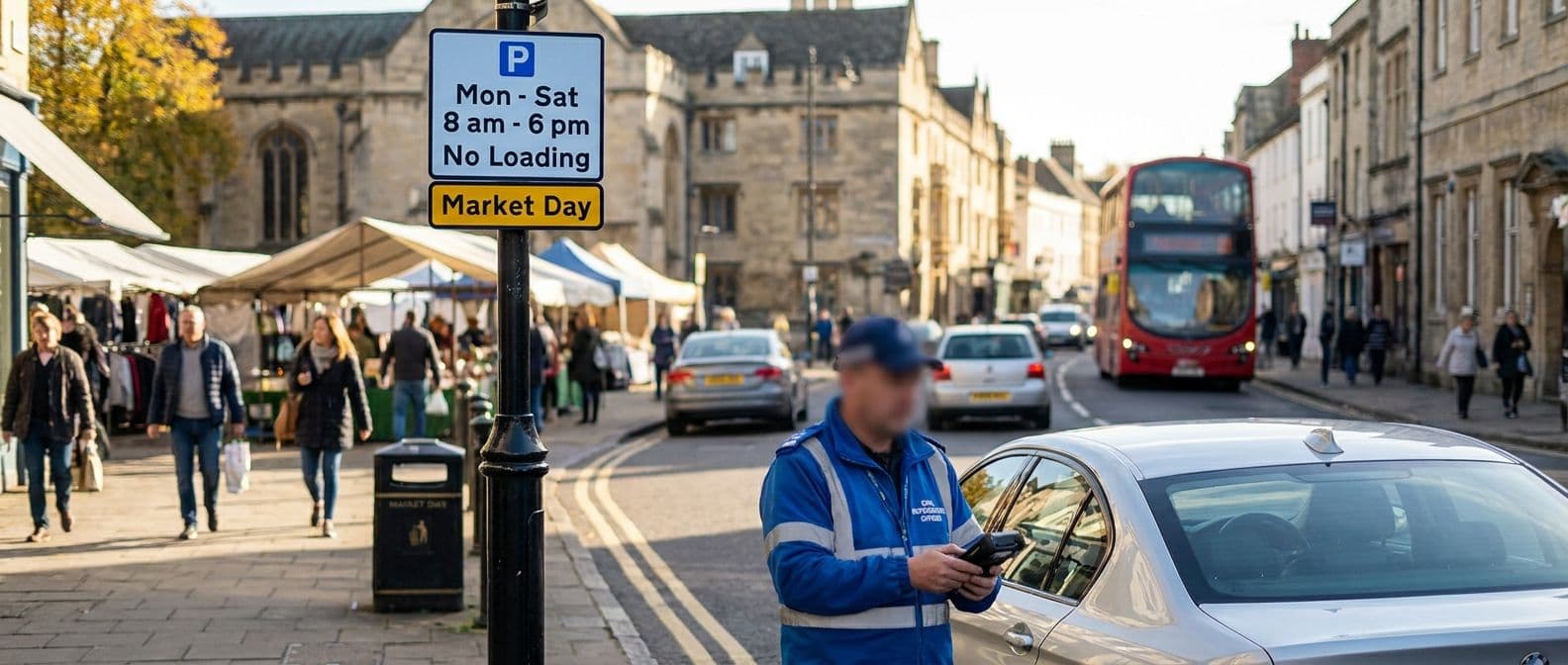
Picture this: you pull into a town centre on a Wednesday morning, park up in what looks like a perfectly normal bay, nip off to run a few errands — and come back to find a Penalty Charge Notice (PCN) tucked under your wiper. The bay looked fine. There were no cones. You didn't see a single sign. So what went wrong?
Welcome to the world of market day parking restrictions — one of the most overlooked and least understood forms of parking enforcement in the UK. Every week, thousands of drivers fall foul of these temporary-looking-but-legally-binding rules, often because the signs are easy to miss or the restrictions only kick in once a week. Here's everything you need to know to avoid a fine — and what to do if you've already received one.
What Are Market Day Parking Restrictions?
Market day parking restrictions are localised rules that suspend or modify normal parking arrangements on specific days of the week — typically when a street market is in operation. Councils introduce these restrictions to:
- Free up road space for market stalls and traders
- Allow loading and unloading of market goods
- Manage pedestrian flow through busy town centres
- Maintain access for emergency vehicles
They're most common in traditional market towns — think Bury St Edmunds, Shrewsbury, Barnstaple, or Skipton — but you'll also find them operating in urban London boroughs and larger cities like Leeds, Norwich, and Exeter.
Crucially, these aren't informal arrangements. They are legally enforceable restrictions backed by a Traffic Regulation Order (TRO), which means ignoring them carries exactly the same consequences as parking on a yellow line or in a permit bay without a permit.
The Legal Basis: Traffic Regulation Orders
Every market day restriction in the UK must be underpinned by a Traffic Regulation Order (TRO) made under the Road Traffic Regulation Act 1984. Without a valid TRO, the council has no legal power to issue PCNs.
This matters enormously if you're thinking about challenging a fine. If a council cannot produce the relevant TRO — or if the TRO doesn't actually cover the specific restriction applied to your vehicle — the PCN should be cancelled. More on that shortly.
Reading the Signs: What to Look Out For
Market day restriction signs are where most drivers come unstuck. Unlike standard parking signs, they often include multiple lines of text, additional plates, and day-specific information that's easy to gloss over in a hurry.
Here's what a typical market day sign might show:
- "No Parking" or "Parking Suspended" — the main prohibition
- Day of the week — e.g., "Wednesday" or "Thu & Sat"
- Times — e.g., "6am – 3pm" or "7am – 2pm"
- Additional plates — often a smaller sign beneath stating "Market Day" or "Street Market in Operation"
Pro tip: Always read the entire sign, including any supplementary plates below the main sign. A bay that's free to use Monday to Tuesday might be completely off-limits from 5am on Wednesday morning.
Some councils also use yellow suspension notices — physical notices attached to lampposts, sign posts, or bay markings — to indicate that bays have been temporarily suspended. These bright yellow notices are often posted several days in advance and are considered sufficient notice under UK parking law, even if you didn't personally see them.
Market Day Parking Times: What's Typical?
There's no single national standard for market day restriction hours — it's entirely down to each council's TRO. That said, most market day restrictions tend to follow a broadly similar pattern:
| Restriction Type | Typical Hours | |---|---| | Full bay suspension | 5am – 3pm or 6am – 4pm | | Loading/unloading only | 5am – 9am | | No return period | 10am – 2pm | | Pedestrianised access | 9am – 5pm |
The early start time catches a lot of drivers out. You might park at 7am thinking you're ahead of the market, only to find the restriction began at 5am. Always check the sign carefully — and if in doubt, don't park there.
Suspended Bays on Market Days: How Councils Enforce Them
When a council suspends a bay for market day, civil enforcement officers (CEOs) — formerly known as traffic wardens — are typically deployed from the moment the restriction begins. Enforcement tends to be robust on market days because:
- The streets are busy — CEOs are usually out in numbers
- Turnover is critical — councils need the space cleared quickly for traders
- Complaints from market operators drive prompt action
In some areas, councils use ANPR (Automatic Number Plate Recognition) cameras mounted on vehicles to patrol suspended bays efficiently. A drive-by scan is enough to generate a PCN without a CEO ever leaving the vehicle.
Loading Restrictions on Market Days
Even if you're not parking — just stopping briefly to drop something off — market day loading restrictions can catch you out. Many market day TROs include a loading ban during peak setup and takedown hours.
These loading bans typically apply:
- During setup hours (early morning, often 5am–9am) when traders are bringing in stock
- During takedown hours (early afternoon, often 1pm–4pm) when stalls are being cleared
If you stop in a suspended bay to load or unload during these times, you can still receive a PCN. The only exception is if the TRO specifically permits loading — and that needs to be clearly stated on the signage.
Received a Market Day PCN? Here's What to Do
If you've been issued a PCN on a market day, don't panic — and don't just pay it immediately. There are several grounds on which market day PCNs can be successfully challenged.
Step 1: Check the Signs
Go back to where you parked (or use Google Street View as a starting point) and photograph every sign in the vicinity. Ask yourself:
- Was the restriction clearly signed?
- Were the signs visible from where you parked?
- Did any signs contradict each other?
Unclear, obscured, or contradictory signage is a strong appeal ground under UK parking law.
Step 2: Request the TRO
You have the right to request a copy of the Traffic Regulation Order that underpins the restriction. Submit this request with your informal representation to the council. If the TRO is defective, out of date, or doesn't cover the exact location or restriction applied, the PCN must be cancelled.
Step 3: Check the Yellow Suspension Notice (If Applicable)
If your bay was suspended via a yellow notice rather than permanent signage, check:
- Was the notice properly affixed and legible?
- Did it give adequate advance notice?
- Was it posted in a position you could reasonably have seen?
Councils must follow proper procedure when suspending bays. Defects in the suspension notice process have led to successful PCN appeals.
Step 4: Submit Your Informal Representation
You have 28 days from the date of the PCN to submit an informal representation to the council. Do this in writing, clearly stating your grounds. Keep it factual and attach any photographic evidence.
Pro tip: The discount period (usually 50% off the full charge) applies for the first 14 days. If you're going to appeal, do so quickly — but note that submitting a representation within the 28-day window pauses the discount clock in most cases.
Step 5: Escalate to the Traffic Penalty Tribunal
If the council rejects your informal representation and you still believe the PCN was wrongly issued, you can escalate to a formal representation and then — if necessary — to the Traffic Penalty Tribunal (TPT) in England (outside London) or the London Tribunals in the capital. These are independent adjudicators and councils don't always win.
Actionable Next Steps
Whether you're trying to avoid a market day PCN or challenging one you've already received, here's your quick-reference checklist:
- ✅ Before you park: Read every sign in the area, including supplementary plates and any yellow suspension notices
- ✅ Check the day and time: Market day restrictions are often day-specific — confirm the current day applies
- ✅ If in doubt, don't park there: Find a nearby car park or check the council's website for market day information
- ✅ If you get a PCN: Photograph the signs immediately, note the time, and keep a record of everything
- ✅ Request the TRO: This is your most powerful tool in any appeal — councils must provide it
- ✅ Appeal promptly: Submit your informal representation within 28 days and escalate if needed
Market day parking restrictions exist for good reason — they keep town centres functioning on their busiest trading days. But that doesn't mean every PCN issued under them is automatically valid. Know your rights, read the signs carefully, and don't be afraid to challenge a fine if you have genuine grounds to do so.
Written by
Emma Thompson
Traffic Law Specialist
Ready to Challenge Your Ticket?
Let our AI analyse your PCN and generate a professional appeal letter in minutes.
Start Free Appeal