London Underground heatwave: commuter rights & safety
Tube passengers report ‘sauna’ conditions as station temperatures soar. What this means for commuter rights, accessibility and travel safety in UK heatwaves.

Hannah MacLeod
11 July 2026
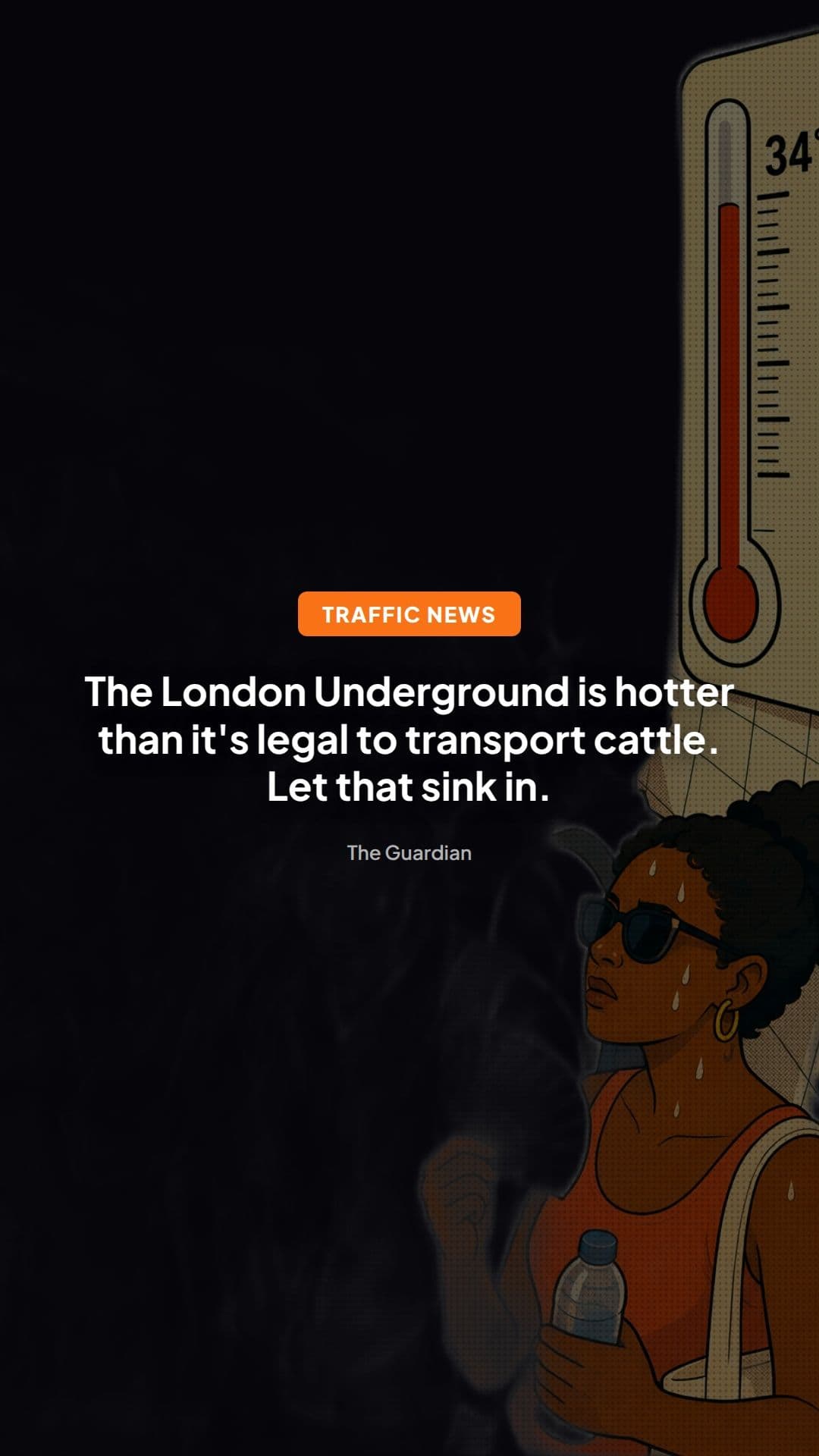
London Underground Heat Crisis: What the 'Cattle Law' Scandal Really Means for Commuters and Drivers
The Tube is literally hotter than the legal limit for transporting livestock. Here's why that matters — and what it means for how you travel this summer.
The Sweltering Reality Beneath Our Streets
Picture this: you're standing on a Tube platform, suit jacket long since abandoned, sweat soaking through your shirt, staring at a digital display that cheerfully informs you your train is "2 minutes away." The air is thick, stale, and hot enough to make you feel faintly dizzy. Around you, fellow passengers fan themselves with free newspapers, their faces flushed.
This isn't a scene from a dystopian novel. It's a Tuesday morning commute on the London Underground in July 2026.
Reports from The Guardian have highlighted something that will make your jaw drop: temperatures on parts of the London Underground are climbing well above the legal limit that applies to transporting cattle. Let that sink in for a moment. There are specific legal protections ensuring livestock are not transported in excessive heat — protections that simply do not extend to the millions of human beings who rely on the Tube every single day.
It's a headline that sounds almost satirical, but it points to a genuinely serious infrastructure crisis, one with real implications for public health, accessibility, and the choices millions of drivers and commuters make every summer.
What's Actually Happening Underground
The London Underground is, by any measure, an extraordinary feat of Victorian engineering. The oldest sections of the network — including the Metropolitan, Circle, District, and Central lines — were built in the mid-to-late 1800s, bored through London's clay subsoil at depths that made sense for the technology of the era.
That Victorian heritage is precisely the problem. Unlike modern metro systems in cities such as Copenhagen, Singapore, or even newer sections of the Paris Métro, the deep-level Tube tunnels were never designed with air conditioning in mind. The tunnels are too narrow to accommodate the large refrigeration units that modern rolling stock requires. There is, quite literally, nowhere for the hot air to go.
During the summer of 2026, station temperatures on some lines have reportedly exceeded 30°C, with platforms on the Central and Bakerloo lines — which run at significant depth — regularly hitting even higher. Transport for London (TfL) has installed some cooling measures over the years, including ground water cooling systems at Victoria station and ventilation shafts at various points on the network, but these are partial solutions at best.
The result is that commuters are enduring conditions that experts describe as genuinely dangerous for vulnerable groups, including the elderly, pregnant women, young children, and those with cardiovascular or respiratory conditions.
Why the 'Cattle Law' Comparison Cuts Deep
The legal comparison that has sparked public outrage is rooted in very real regulation. Under Council Regulation (EC) No 1/2005 on the protection of animals during transport — retained in UK law following Brexit as the Welfare of Animals (Transport) (England) Order 2006 — livestock transporters must ensure that temperatures inside vehicles do not cause distress or harm to animals. Guidance from the Animal and Plant Health Agency (APHA) indicates that cattle should not be transported in conditions exceeding approximately 30°C, with specific provisions requiring adequate ventilation and space.
Meanwhile, there is no equivalent statutory temperature limit for public transport passengers in the UK. The Health and Safety at Work etc. Act 1974 imposes a general duty on employers to maintain a safe working environment — and TfL does have obligations to its staff under this legislation. The Workplace (Health, Safety and Welfare) Regulations 1992 set a minimum workplace temperature of 16°C (or 13°C for physically demanding work), but there is no corresponding maximum temperature enshrined in law.
The Trades Union Congress (TUC) has campaigned for years for a maximum workplace temperature of 30°C (or 27°C for physically demanding roles), but this has never been legislated. For passengers — as opposed to workers — the legal protections are even thinner. Passengers have no direct statutory right to travel in thermally comfortable conditions. Their only recourse lies in TfL's general duty of care and, arguably, the broader framework of the Consumer Rights Act 2015, which requires services to be provided with reasonable care and skill.
The irony — and the public anger — stems from the fact that the law is more prescriptive about the thermal comfort of a Hereford cow on a lorry than it is about a human being on the Northern line.
The Accessibility Dimension
Beyond the general discomfort, there is a serious and underreported accessibility crisis here. For passengers with multiple sclerosis, extreme heat can trigger relapses and significantly worsen symptoms — a condition known as Uhthoff's phenomenon, where elevated body temperature causes temporary neurological deterioration. For those with heart conditions, sustained heat stress increases the risk of cardiac events. For wheelchair users and those with mobility impairments who cannot easily exit a hot carriage or platform, the risks are compounded.
The Equality Act 2010 requires transport operators to make reasonable adjustments for disabled passengers. Whether consistently exposing passengers with heat-sensitive conditions to temperatures that exacerbate their disability constitutes a failure of that duty is a question that, to date, has not been tested in the courts — but it is not an unreasonable one to ask.
Disability charities have long pointed out that the Underground's heat problem disproportionately affects people who have the fewest alternatives. A non-disabled commuter can choose to cycle, walk, or drive. For many disabled Londoners, the Tube is the only viable option.
What Drivers and Commuters Should Know This Summer
If you're weighing up whether to take the Tube or drive into London during a heatwave, here are some practical considerations:
If you're driving:
- Check the Congestion Charge before you travel. The charge rose to £18 per day in 2026, and the zone operates Monday to Friday, 07:00–18:00, and on weekends and bank holidays, 12:00–18:00.
- ULEZ remains in force across Greater London. Check your vehicle's compliance at the TfL website before travelling — non-compliant vehicles face a £12.50 daily charge, with a £180 penalty (reduced to £90 if paid within 14 days) for non-payment.
- Parking in central London during summer is both expensive and heavily enforced. If you're driving in due to Tube heat concerns, factor in parking costs — central London car parks regularly charge upwards of £8–10 per hour.
- Keep water in your vehicle. The Highway Code does not mandate this, but the DVSA strongly advises against driving when fatigued or dehydrated. Heat significantly accelerates both conditions.
If you're still using the Tube:
- Travel outside peak hours where possible — platforms are cooler before 07:30 and after 10:00.
- Carry water. TfL's own guidance recommends this during hot weather.
- Identify the air-conditioned lines before you travel. The S-Stock trains on the Metropolitan, Circle, District, and Hammersmith & City lines are air-conditioned. The Jubilee, Victoria, and Elizabeth lines also operate air-conditioned rolling stock. The Central, Bakerloo, Piccadilly, and Northern lines do not.
- If you feel unwell, exit the train at the next station. Station staff are trained to assist, and most stations have cooler areas near the surface.
Looking Ahead: Can the Tube Ever Be Fixed?
TfL and successive Mayors of London have acknowledged the heat problem for decades. The honest answer from engineers is deeply uncomfortable: retrofitting air conditioning to the deep-level Tube lines is extraordinarily difficult and prohibitively expensive.
The tunnels on the deep lines are simply too small to accommodate the heat exchangers that air-conditioned trains require. Installing them would mean either boring new, larger tunnels — a multi-billion-pound undertaking — or developing entirely new refrigeration technology that can dissipate heat without enlarging the tunnel cross-section. Some experimental ground-source cooling projects have shown promise, but none have been deployed at scale.
What is more achievable — and what TfL has been slowly implementing — is platform-level cooling, improved ventilation, and the gradual replacement of rolling stock on lines where air conditioning is physically possible. The Elizabeth line, opened in 2022, was designed from the outset with climate in mind, and it shows: passengers on Crossrail trains enjoy a noticeably cooler environment even in summer.
For the Victorian deep-level lines, however, there is no quick fix. Climate change is making the problem worse — London's average summer temperatures have risen measurably over the past three decades, and extreme heat events are projected to become more frequent under all credible climate scenarios.
The cattle law comparison will continue to sting precisely because it is accurate. Until Parliament legislates a maximum temperature for public transport — or until TfL finds the engineering and financial means to cool its oldest tunnels — millions of Londoners will continue to swelter in conditions that the law deems unacceptable for livestock.
That is, frankly, not good enough.
Sources: The Guardian (11 July 2026); Welfare of Animals (Transport) (England) Order 2006; Health and Safety at Work etc. Act 1974; Workplace (Health, Safety and Welfare) Regulations 1992; Equality Act 2010; TfL operational guidance.
Written by
Hannah MacLeod
Traffic Law Specialist
Ready to Challenge Your Ticket?
Let our AI analyse your PCN and generate a professional appeal letter in minutes.
Start Free Appeal