London to Bruges in One Tank: BMW X3 MPG & Range Test
We break down the London-to-Bruges one-tank run in a 393bhp BMW X3: real-world MPG, range, motorway costs, Eurotunnel and UK rules for drivers.

Emma Thompson
10 May 2026
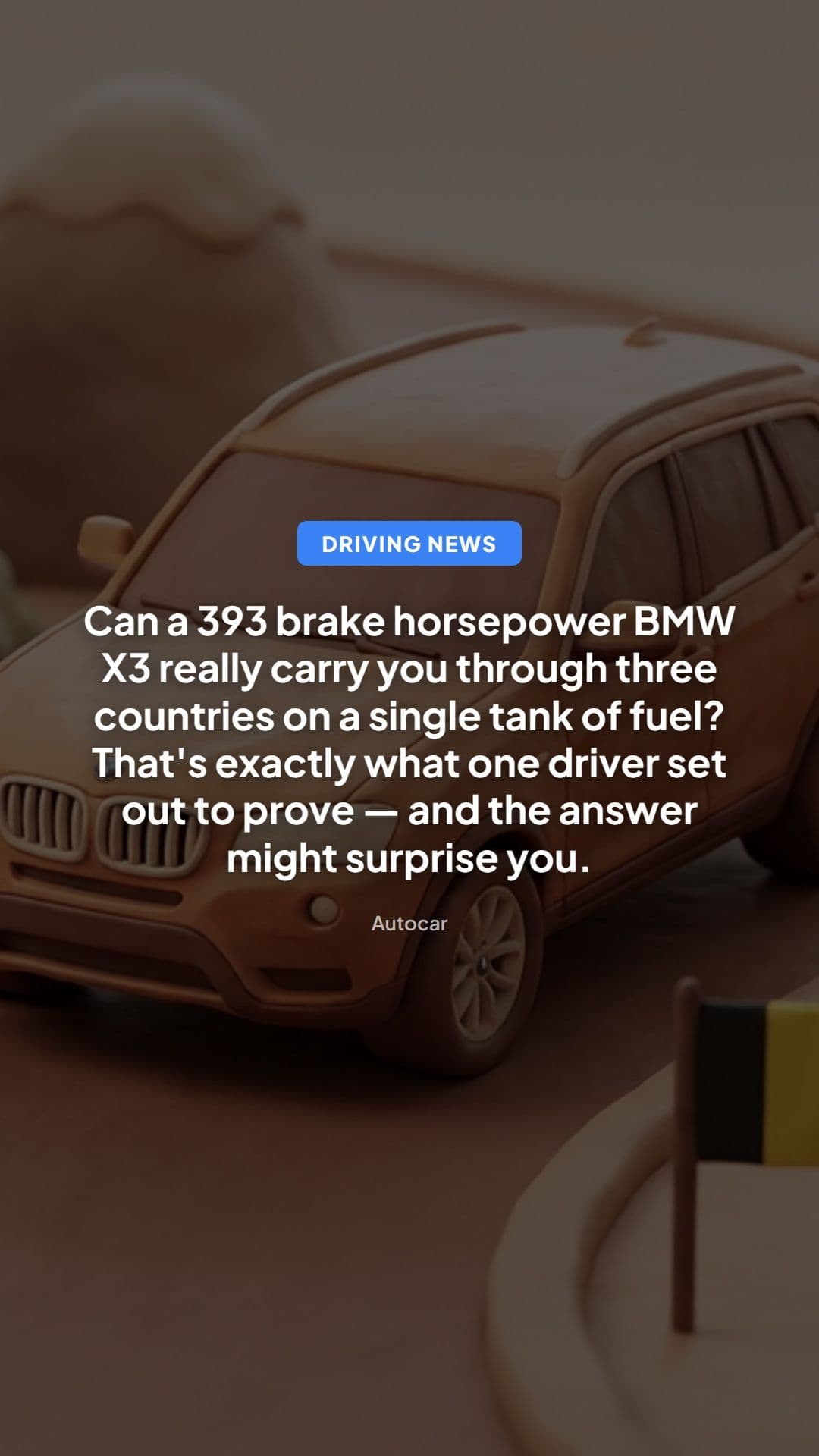
Three Countries, One Tank of Fuel: What a BMW X3 Road Trip Tells Us About Modern Long-Distance Driving
London to Bruges in a high-performance SUV — and why the real story is bigger than the miles per gallon
There's something almost rebellious about the premise. A 393-horsepower SUV, a full tank of fuel, and a route that crosses three countries before you've had time to finish your travel playlist. Autocar's recent feature drive — London to Bruges in the latest BMW X3 — reads like a love letter to the grand touring tradition. But beneath the romance of the open road lies a genuinely important story about how modern cars are changing the economics, logistics, and legal landscape of long-distance driving in 2025.
Let's go significantly deeper than the headline.
What Happened: The Drive Itself
Autocar's feature documents a long-distance journey from London to Bruges, Belgium — a route that takes in England, France (via the Channel Tunnel or a cross-Channel ferry), and Belgium. The hook is that the entire journey can be completed on a single tank of fuel in the new BMW X3, despite the car packing a 393bhp punch under the bonnet.
This is a car that, on paper, should be thirsty. High-performance SUVs have historically been the poster children for poor fuel economy — the kind of vehicles that make environmentalists wince and fuel station attendants smile. Yet BMW's engineering has reached a point where a near-400bhp machine can cover the roughly 220–250 miles from London to Bruges — factoring in the tunnel crossing — without requiring a stop at the pumps.
The real-world fuel economy figures being achieved by modern turbocharged petrol engines, particularly when paired with mild-hybrid systems (as found in many current BMW models), are genuinely impressive. The X3's ability to manage that kind of range is a testament to how far internal combustion technology has come, even as the industry simultaneously races toward electrification.
Why It Matters: The Bigger Picture for Long-Distance Drivers
This isn't just a story about one car doing something impressive. It's a snapshot of a pivotal moment in British motoring.
The range anxiety conversation is shifting. For years, the debate around range has been dominated by electric vehicles — and rightly so. But the Autocar piece quietly reminds us that modern petrol and hybrid cars have also made enormous strides. A 393bhp SUV completing a multi-country journey on one tank reframes the conversation: it's not just EVs that have been reinventing what's possible in terms of range and efficiency.
Cross-Channel driving is back in fashion. Post-Brexit travel to Europe by car has been somewhat dampened by increased bureaucracy, new entry requirements, and the lingering psychological hangover from the pandemic. But Eurotunnel Le Shuttle figures have shown consistent recovery, and the appetite for road trips to continental Europe is clearly returning. The London-to-Bruges route is a popular one — Bruges itself is one of the most visited cities in Belgium, drawing British tourists year-round.
The performance SUV segment is booming. The BMW X3 sits in one of the fastest-growing vehicle categories in the UK market. According to SMMT data, SUVs now account for more than half of all new car registrations in Britain. The high-performance variants — cars that blend genuine sporting credentials with family practicality — are increasingly the default choice for affluent drivers planning long journeys.
The Legal Angle: What UK Drivers Must Know Before Crossing the Channel
Here's where things get genuinely important, and where many drivers — even experienced ones — come unstuck.
Driving in France and Belgium carries specific legal requirements that differ from UK law. These aren't optional suggestions; they're enforceable rules with real fines attached.
In France, you must carry:
- A warning triangle
- A high-visibility vest (which must be accessible from inside the vehicle — not in the boot)
- A breathalyser kit (though the fine for not carrying one has been suspended, the requirement technically remains)
- Your driving licence, vehicle registration document (V5C or rental agreement), and proof of insurance
In Belgium, requirements include:
- A warning triangle
- A high-visibility vest
- A first aid kit is recommended, though not legally mandated for private vehicles
Speed limits change significantly once you leave the UK. In France, the motorway limit is 130km/h (approximately 81mph) in dry conditions, dropping to 110km/h in rain. Belgium's motorway limit is also 120km/h (approximately 75mph). Crucially, France uses average speed cameras on some stretches — meaning you cannot speed between cameras and brake at them. The system calculates your average over a distance.
Your UK driving licence is valid across the EU, but post-Brexit, you may need an International Driving Permit (IDP) in certain non-EU European countries. For France and Belgium specifically, your UK licence remains sufficient — but always carry the physical licence, not just a digital copy.
Insurance considerations are critical. Since Brexit, the Green Card system no longer automatically applies in the same way. Most UK insurers do provide EU cover, but the level of cover (comprehensive vs. third-party only) can differ. Check your policy documents carefully before departure, and contact your insurer if you're unsure. A phone call before you travel costs nothing; discovering you're underinsured after an accident costs considerably more.
The Channel Tunnel and ferry operators have their own rules around dangerous goods, LPG vehicles, and certain vehicle modifications. High-performance vehicles are generally fine, but if your car has been modified — particularly to the fuel or exhaust system — it's worth checking with Eurotunnel Le Shuttle or your ferry operator in advance.
What Drivers Should Know: Practical Advice for the Long Haul
Whether you're inspired by the Autocar feature to attempt your own multi-country drive, or simply planning a longer UK journey in a modern performance car, here's what experienced long-distance drivers know that occasional travellers often don't.
Plan your fuel stops strategically, not reactively. Even if your car can theoretically complete the journey on one tank, knowing where the motorway services are — and their operating hours — is sensible. French autoroute services are generally excellent and well-spaced. Belgian motorway services are less frequent.
Tyre pressure and load matter more than you think. A heavily laden SUV at motorway speeds for several hours will behave differently to the same car lightly loaded around town. Check your tyre pressures before departure, and consult your vehicle handbook for the recommended pressures under load. Under-inflated tyres at sustained high speeds are a safety risk and will also worsen your fuel economy — undermining that impressive single-tank achievement.
Use your car's driving modes intelligently. Modern performance SUVs like the BMW X3 typically offer multiple drive modes — Eco, Comfort, Sport, and so on. For long motorway stretches where fuel efficiency matters, Eco or Comfort modes will genuinely make a measurable difference to range. Save Sport mode for the moments it's actually enjoyable, not for cruising at a steady 70mph.
Factor in the Eurotunnel or ferry crossing time. The Le Shuttle crossing takes approximately 35 minutes once you're on board, but check-in, loading, and unloading add considerably to that. Budget at least 90 minutes from arrival at Folkestone to driving off in Coquelles. This affects your overall journey planning, particularly if you're targeting a specific arrival time in Bruges.
Know the toll system. French autoroutes are extensively tolled. You can pay by card at most toll booths, but a dedicated tag (such as the Liber-t badge, compatible with UK-registered vehicles) speeds up the process considerably. Belgian motorways are currently toll-free for private cars, though a vignette system has been discussed.
Looking Ahead: What This Journey Tells Us About the Future of Driving
The Autocar feature is, in one sense, a celebration of the internal combustion engine at its most refined. A 393bhp SUV completing a multi-country journey on one tank is an engineering achievement worth acknowledging.
But it also raises a question that the motoring industry is grappling with in real time: as electric vehicles improve their range and charging infrastructure expands across Europe, what role does the high-performance petrol SUV play?
For now, the answer is: a significant one. The UK's public charging network, while growing rapidly, still makes long continental drives considerably more straightforward in a petrol or hybrid vehicle. The calculation changes as fast-charging infrastructure improves, but for many drivers today, a capable petrol car remains the pragmatic choice for ambitious long-distance journeys.
What the BMW X3 trip demonstrates most powerfully is that modern engineering has quietly solved many of the compromises that once made performance and efficiency feel like opposites. You no longer have to choose between a car that's thrilling to drive and one that won't bankrupt you at the pumps.
For British drivers, the practical lesson is this: the barriers to ambitious long-distance European driving are lower than they've been in years — provided you do your legal homework before departure, respect the rules of the countries you're passing through, and plan your journey with the same care you'd give to any serious undertaking.
The road to Bruges is open. Just make sure your paperwork is in order before you hit it.
Based on Autocar's feature drive: "Three countries, one tank of fuel: London to Bruges in a 393bhp BMW X3." [Read the original here.](https://www.autocar.co.uk/car-news/features/three-countries-one-tank-fuel-london-brugges-393bhp-bmw-x3)
Written by
Emma Thompson
Traffic Law Specialist
Ready to Challenge Your Ticket?
Let our AI analyse your PCN and generate a professional appeal letter in minutes.
Start Free Appeal