London Self-Driving Taxis: What Drivers Need to Know
London has approved Wayve and Uber autonomous taxis for summer 2026. See how safety drivers, minicab licences, insurance and road rules may affect motorists.

Fatima Benali
6 August 2026
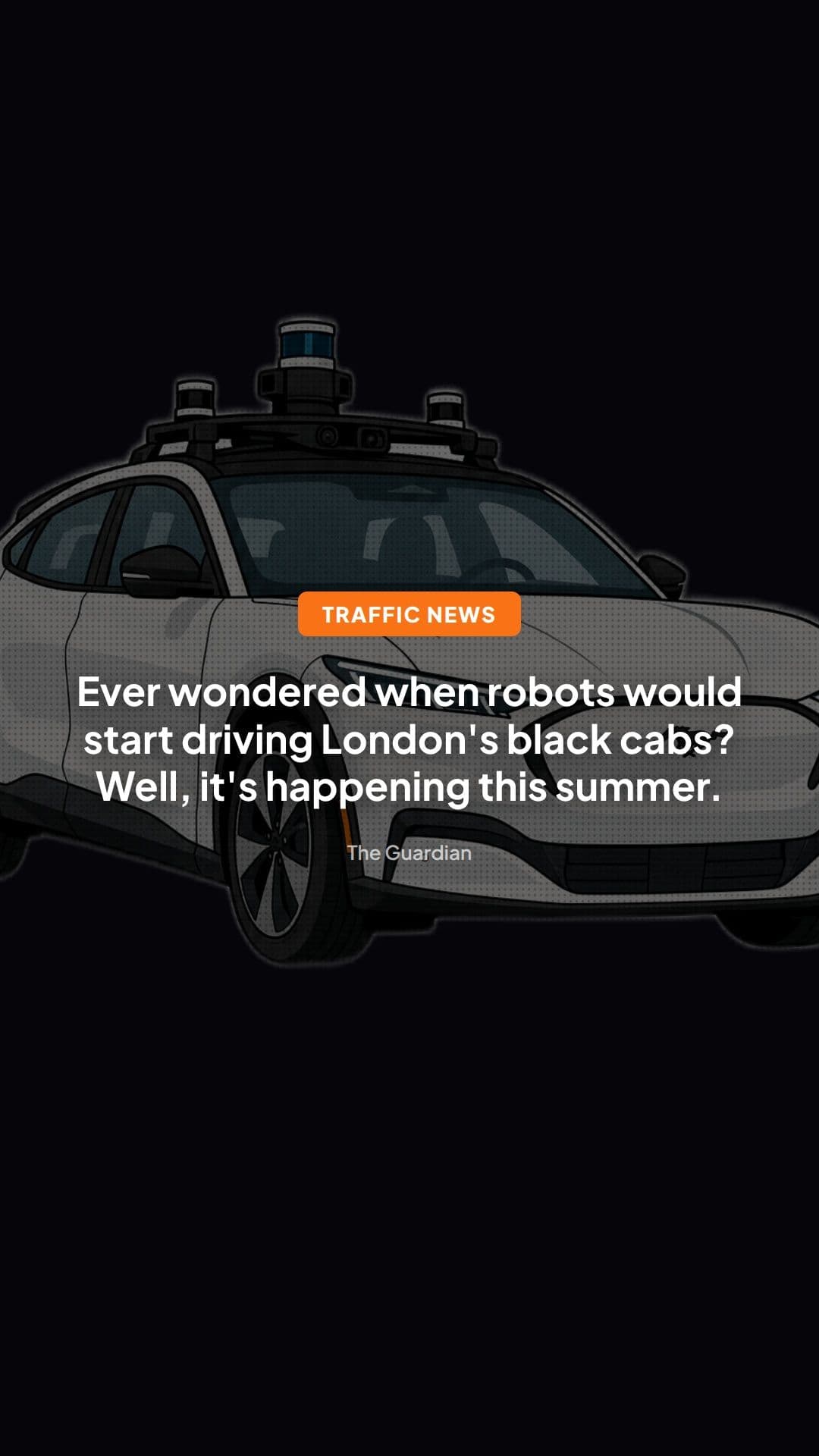
Robot Taxis Are Coming to London: What Uber and Wayve's New Licences Actually Mean
Picture this: you're standing on a London street corner, and the minicab that pulls up has no driver behind the wheel, just an empty seat where you'd expect one, and a human "safety operator" sitting quietly in case things go wrong. That's not a scene from a sci-fi film anymore. It's what The Guardian reports will start appearing on London's streets later this summer, as Wayve and Uber become the first companies to secure minicab licences for autonomous taxi services in the capital.
It's a genuinely significant moment for UK transport, and it raises a string of questions that go well beyond "will it be weird to ride in one". Who's liable if something goes wrong? What does this mean for London's already congested and heavily regulated streets? And should ordinary drivers, cyclists and pedestrians be worried, excited, or both?
What's Actually Happening
According to the Guardian's report, Wayve, a British autonomous driving technology company, has teamed up with Uber to obtain the first licences permitting self-driving minicabs to operate in London. Crucially, this isn't a fully driverless launch. The vehicles will run with a safety driver on board when the service begins later in the summer of 2026, acting as a human backstop who can take control if the technology falters.
This is an important distinction. We're not talking about empty cars roaming the streets with nobody able to intervene. We're talking about a phased, cautious introduction, one where a licensed human remains present specifically to monitor the vehicle's behaviour and step in when needed. Think of it as training wheels for the technology, at least in this first stage.
Wayve itself is a notable name in this space. The company has built its reputation on an approach to autonomous driving that relies heavily on machine learning models trained on real-world driving data, rather than the more traditional route of pre-programmed rules for every possible road scenario. Partnering with Uber gives Wayve's technology an obvious route to commercial deployment and a familiar app-based interface that millions of Londoners already use to book rides.
Why This Matters Beyond the Novelty Factor
It's tempting to treat this as simply a curiosity, a bit of futuristic flavour on London's streets. But the implications run much deeper, and they touch on several areas that regular readers of ours will recognise: road safety, regulation, and the practical realities of driving and parking in a crowded capital.
A regulatory first for the UK. London's minicab licensing regime is overseen by Transport for London, and private hire vehicles have long been subject to strict requirements around driver conduct, vehicle standards and safety. Extending that licensing framework to cover autonomous vehicles, even with a safety driver present, represents a genuine first. It suggests that TfL and the relevant authorities have developed a regulatory pathway that allows this technology to be tested commercially, rather than confined purely to closed trials or research programmes.
The UK's broader push on self-driving legislation. This development doesn't exist in isolation. The UK has been steadily building a legal framework for automated vehicles, most notably through the Automated Vehicles Act 2024, which established a system for authorising self-driving vehicles and set out how liability should be handled when a vehicle is operating in "self-driving mode". Under that framework, the entity that obtains authorisation for a vehicle, sometimes called the Authorised Self-Driving Entity, takes on responsibility for the vehicle's behaviour while it's driving itself, rather than the human occupant being treated as the driver in the traditional sense. Wayve and Uber's licences appear to be an early, practical application of that broader legal architecture finally reaching London's streets.
Competitive and international pressure. Autonomous ride-hailing isn't a new idea globally. Robotaxi services have already been running in parts of the United States for some time, with mixed results, some impressive, some involving well-publicised safety incidents. The UK's more cautious, safety-driver-first approach seems designed to avoid some of the reputational pitfalls seen elsewhere, while still allowing the country to stake a claim as a serious player in autonomous vehicle development. Given the size of Uber's global platform and Wayve's ambitions, London becoming an early adopter carries real weight for the UK's tech and automotive credentials.
The Legal Angle: Who's Responsible When There's No Driver?
This is where things get genuinely interesting for anyone with an interest in motoring law, and it's worth taking a moment to unpack.
Under ordinary road traffic law, a huge amount of liability, for speeding, careless driving, causing an accident, even certain parking contraventions, rests on identifying "the driver" of the vehicle. The Automated Vehicles Act 2024 was designed specifically to address the problem this creates when a vehicle is capable of driving itself. It introduces the concept that when a vehicle is legally operating in self-driving mode, the human in the vehicle isn't treated as responsible for how it drives. Instead, responsibility shifts to the authorised organisation behind the technology.
That said, the presence of a safety driver in these initial London vehicles complicates the picture slightly, in a good way for regulators. While the vehicle is being trialled with a human on board specifically to intervene, questions about exactly when the vehicle is "in control" versus when the safety driver has taken over become critical. If an incident occurs, establishing whether the automated system or the human safety driver was in charge at that moment will likely determine where liability falls, whether that's for a road traffic offence, an insurance claim, or in the event of a collision.
Insurance is another area worth watching closely. The Automated Vehicles Act also anticipated changes to motor insurance arrangements to make sure victims of collisions involving self-driving vehicles aren't left without a route to compensation, even where fault sits with the software rather than a person. How this plays out in practice, especially in London's dense, unpredictable traffic environment full of cyclists, pedestrians and delivery riders, will be watched closely by lawyers, insurers and safety campaigners alike.
There's also the question of penalty notices and traffic contraventions. If an autonomous minicab strays into a bus lane, enters a restricted zone, or gets caught by an ANPR camera in a controlled area, who receives the penalty charge notice? For now, with a licensed safety driver present, it's likely that responsibility would be treated similarly to any other private hire vehicle, but as the technology matures towards genuinely driverless operation, this is a question regulators will need to answer clearly and publicly.
What Drivers and Passengers Should Know
For everyday motorists, cyclists and pedestrians sharing the road with these vehicles, a few practical points are worth bearing in mind as the rollout begins:
- Expect a gradual, limited rollout, not a sudden flood of driverless cars. The presence of a safety driver in every vehicle initially means the practical experience of sharing the road won't be radically different from any other minicab, at least at first.
- Autonomous vehicles are typically programmed to be cautious. Early real-world data from other markets suggests self-driving systems often drive more conservatively than human drivers, which can occasionally cause friction with impatient traffic behind them. Give them a bit of space and patience while the technology beds in.
- If you're a passenger, ask questions. As these services become bookable through Uber's app, it's worth understanding whether you're being offered an autonomous vehicle with a safety driver, and what that means for your journey, particularly if you have accessibility needs or specific concerns.
- Keep an eye on official guidance. The Department for Transport and TfL are the authorities to watch for updates on rules, safety requirements and any incidents involving these vehicles. If you're ever involved in an incident with an autonomous vehicle, whether as a driver, cyclist or pedestrian, treat it as you would any road traffic matter: gather evidence, note the vehicle's identifying details, and seek advice from a solicitor experienced in road traffic law if injury or significant damage is involved. This is not a situation where informal assumptions about liability should be relied upon.
- This isn't legal advice for any specific situation. If you find yourself dealing with a penalty notice, insurance claim or dispute involving an autonomous vehicle, the unusual legal territory involved means it's worth getting professional advice tailored to your circumstances rather than relying on general commentary.
Looking Ahead
This summer's launch is best understood as a foot in the door rather than a finished product. The safety driver requirement signals that regulators, Wayve and Uber all recognise the technology needs proving in the messy, unpredictable reality of London traffic before anyone considers removing the human safety net entirely.
Expect scrutiny to intensify quickly. Safety campaigners, black cab drivers' representatives, and insurers will all be watching closely for how these vehicles behave around cyclists, at complex junctions, and in the kind of chaotic scenarios London throws up daily, think roadworks, temporary road closures, and the sheer density of pedestrians in central areas. Any high-profile incident, however minor, is likely to generate significant public and media attention given the novelty of the service.
For now, London joins a small but growing list of global cities experimenting seriously with autonomous ride-hailing. Whether this becomes a genuine fixture of the capital's transport landscape, or a cautious experiment that quietly winds down, will depend heavily on how safely and smoothly this first phase unfolds. Either way, it marks a notable moment where UK regulation, insurance law and cutting-edge technology are being tested together on real streets, with real consequences, for the very first time.
Written by
Fatima Benali
Dispute Resolution Specialist
Ready to Challenge Your Ticket?
Let our AI analyse your PCN and generate a professional appeal letter in minutes.
Start Free Appeal