London seizes 2,500 rental e-bikes over pavement parking
A London borough has seized 2,500+ rental e-bikes over pavement parking and obstruction. What it means for riders, operators and enforcement powers in the UK.

Priya Sharma
3 June 2026
London's E-Bike Crackdown: What 2,500 Seized Bikes Tell Us About the Future of Urban Parking
Imagine stepping out of your front door to find the pavement completely blocked by a tangle of rental electric bikes, dumped haphazardly across the path by riders who simply walked away. No apology, no consideration, no consequence — or so they thought. For one London borough, enough was finally enough.
What Happened
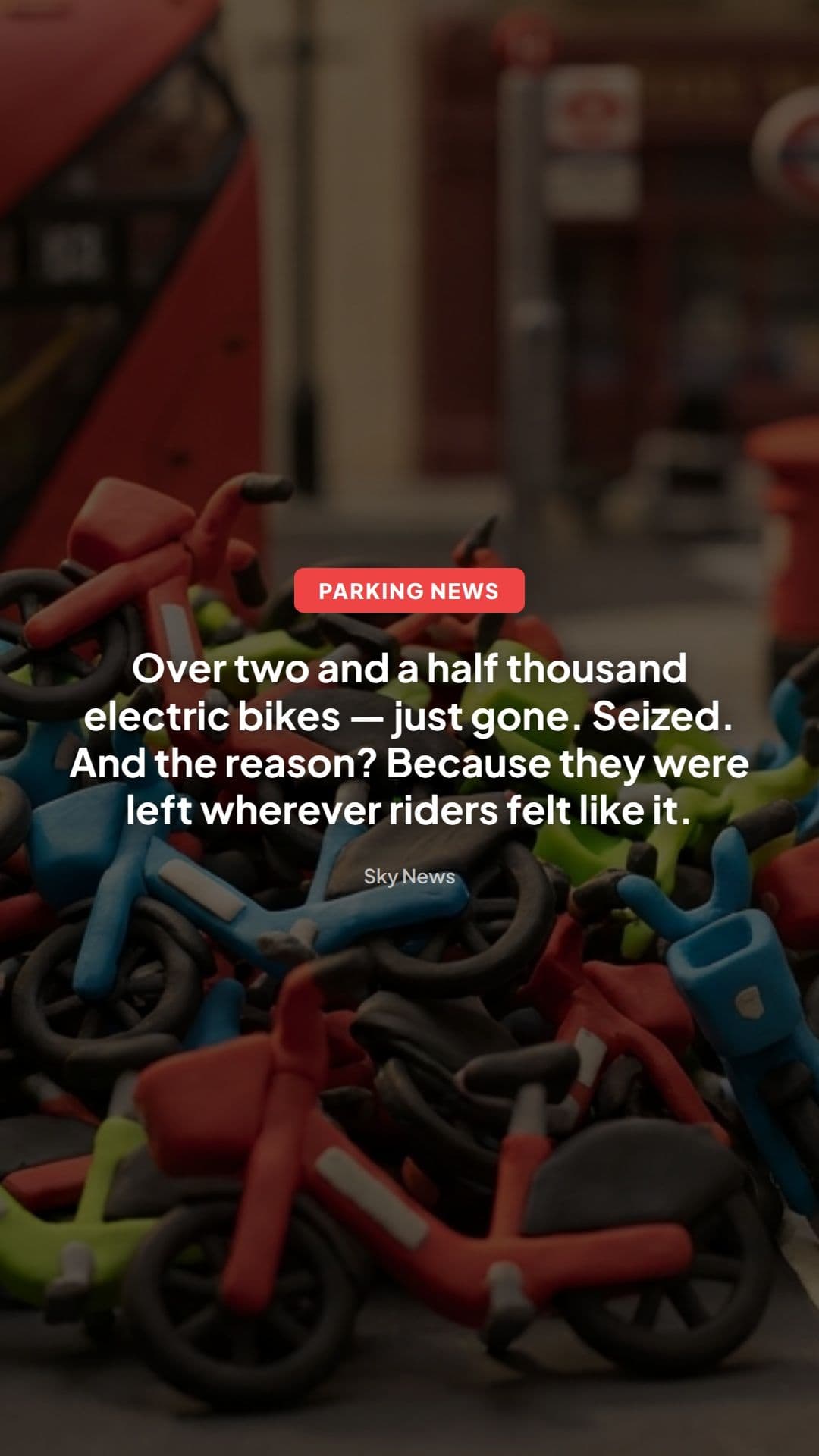
According to a report by Sky News, a London borough has confiscated more than 2,500 rental electric bikes in a targeted crackdown on so-called "micromobility clutter." The bikes, belonging to commercial rental operators, had been abandoned or poorly parked across pavements, public spaces, and access routes — creating hazards for pedestrians, wheelchair users, and parents with pushchairs alike.
The scale of the operation is significant. This wasn't a handful of rogue riders being made an example of — this was a sustained, systematic enforcement campaign that netted thousands of bikes over a relatively short period. The council involved made clear that abandoned and badly parked rental bikes would not simply be moved on; they would be seized, with operators required to pay to retrieve them.
Rental e-bike schemes, operated by companies such as Lime, Forest, and Tier, have expanded rapidly across London and other UK cities over the past few years. Unlike the capital's docked Santander Cycles — which must be returned to a fixed docking station — most modern rental e-bike schemes are dockless, meaning riders can end their journey and leave the bike almost anywhere within a designated operating zone. It's that freedom, of course, that creates the problem.
Why It Matters
The rise of dockless micromobility has been one of the most disruptive changes to urban transport in a generation. For city planners and councils, it presents a genuine dilemma: these schemes reduce car journeys, cut emissions, and improve first- and last-mile connectivity. They are, in many respects, exactly the kind of transport innovation that urban authorities want to encourage.
But the flip side is real and visible. Bikes dumped across dropped kerbs. Scooters toppled across the middle of a busy high street. Rental bikes blocking the entrance to a GP surgery or a school gate. For disabled people and those with visual impairments in particular, the consequences of carelessly abandoned micromobility vehicles can be genuinely dangerous — and even frightening.
The numbers tell a stark story. With over 2,500 bikes seized in a single borough, and rental fleets across London numbering in the tens of thousands, the scale of the problem is clearly not trivial. Operators have long argued that the vast majority of riders park responsibly, and that rogue parking represents a small minority of journeys. That may well be true in percentage terms — but when you're operating a fleet of 5,000 bikes, even a 5% poor-parking rate means 250 badly parked bikes on any given day.
There's also a broader question about who bears the cost of enforcement. When councils deploy officers to locate, photograph, and seize abandoned bikes, that costs money. When residents complain and officers respond, that costs money. The argument being made — quietly but insistently — by several London boroughs is that operators should be doing far more to police their own fleets in real time, using the GPS and app data they already possess.
The Legal Angle
Here's where things get interesting for anyone trying to understand the legal framework behind all of this.
Rental e-bikes operating in public spaces in the UK are subject to a patchwork of legislation. At the most fundamental level, leaving any vehicle in a position that causes an obstruction can constitute an offence under the Highways Act 1980, which makes it unlawful to wilfully obstruct free passage along a highway. Pavements are part of the highway, and a bike blocking a pavement could, in theory, constitute an obstruction offence — though in practice, enforcement against individual riders is rare.
More practically, local authorities have powers under the Road Traffic Regulation Act 1984 and various London Local Authorities Acts to remove vehicles — including cycles — that are causing an obstruction or have been abandoned. Councils can also draw on their licensing powers to impose conditions on operators as part of the permits that allow rental schemes to operate in the first place.
This is a crucial point. Most dockless rental bike operators in London require a licence or operating permit from the relevant borough to deploy their fleet. These permits typically include conditions around:
- Maximum fleet size within the borough
- Response times for removing reported badly parked bikes
- Geofencing requirements to prevent bikes being left in prohibited areas
- Penalties for repeated non-compliance, up to and including suspension of the operating permit
When a council seizes 2,500 bikes, it is almost certainly acting under a combination of these licensing powers and its general highway obstruction enforcement powers. The bikes aren't being stolen — they're being impounded, with operators required to pay a release fee for each vehicle, in much the same way a car might be clamped or towed.
For the operators, this creates a direct financial incentive to manage their fleets better. A release fee of even £25 per bike across 2,500 vehicles represents a bill of £62,500 — and that's before any reputational damage or risk to the operating licence itself.
It's also worth noting that the pavement parking reforms currently working their way through English law — which are expected to give councils stronger powers to enforce against vehicles obstructing pavements — could eventually extend in spirit to micromobility, even if the current legislative focus is on motor vehicles.
What Drivers and Commuters Should Know
You might be wondering what any of this has to do with you if you drive a car rather than ride a rental bike. Quite a lot, as it turns out.
If you use rental e-bikes:
- Always end your journey in a designated parking zone if one is marked in the app — many operators now use geofencing to prevent journey completion outside approved areas
- Park parallel to the kerb, away from dropped kerbs, bus stops, and building entrances
- Take a photo of how you've left the bike — some apps require this, but it's worth doing regardless as evidence of responsible parking
- Be aware that you may be held liable for fines or charges if a bike you've rented is subsequently found to be causing an obstruction, depending on the operator's terms and conditions
If you're a driver affected by badly parked bikes:
- You can report abandoned or obstructive bikes directly to the operator via their app — most have a dedicated reporting function and are contractually obliged to respond within a set timeframe
- You can also report to your local council's street cleansing or parking enforcement team, who may have powers to remove the vehicle
- Do not move the bike yourself — while the instinct is understandable, moving someone else's property without authority could expose you to an accusation of interference with it
For businesses and residents:
- If rental bikes are repeatedly obstructing access to your property, document it thoroughly with photographs and timestamps, and write formally to both the operator and the council. A pattern of evidence significantly strengthens any complaint and may trigger licence review proceedings against the operator.
Looking Ahead
This crackdown feels like a watershed moment. For years, the implicit bargain between rental operators and local authorities has been: we'll bring the bikes, you tolerate the mess. That bargain is fraying.
Several London boroughs are now reviewing the terms of their operating licences, with some considering stricter geofencing requirements that would physically prevent riders from ending a journey anywhere other than a designated parking bay. Others are looking at operator liability clauses that would make companies financially responsible for any enforcement action triggered by their fleet.
At a national level, the Department for Transport is watching closely. The government has been broadly supportive of micromobility as part of its active travel agenda, but it has also signalled that this support is conditional on operators demonstrating responsible fleet management. If the pattern of seized bikes and pavement obstruction continues, expect tougher national guidance — and potentially legislation — to follow.
There's also the question of public trust. E-bikes and e-scooters will only achieve their potential as genuine transport alternatives if the public — including pedestrians, disabled people, and older residents — feels that their use of shared public space is being respected. Right now, for many people, that trust has been eroded. Winning it back will require operators to do considerably more than simply paying to retrieve seized bikes and carrying on as before.
The 2,500 bikes sitting in a council compound somewhere in London are more than just an enforcement statistic. They're a sign that the era of consequence-free dockless parking is drawing to a close — and that cities are beginning to mean business.
Written by
Priya Sharma
Legal Aid Coordinator
Ready to Challenge Your Ticket?
Let our AI analyse your PCN and generate a professional appeal letter in minutes.
Start Free Appeal