London Congestion Charge: EVs to pay from Jan 2026
TfL confirms EVs will lose full Congestion Charge exemption from Jan 2026, paying a discounted daily rate via Auto Pay, plus tiered discounts.

Grace O'Sullivan
16 April 2026
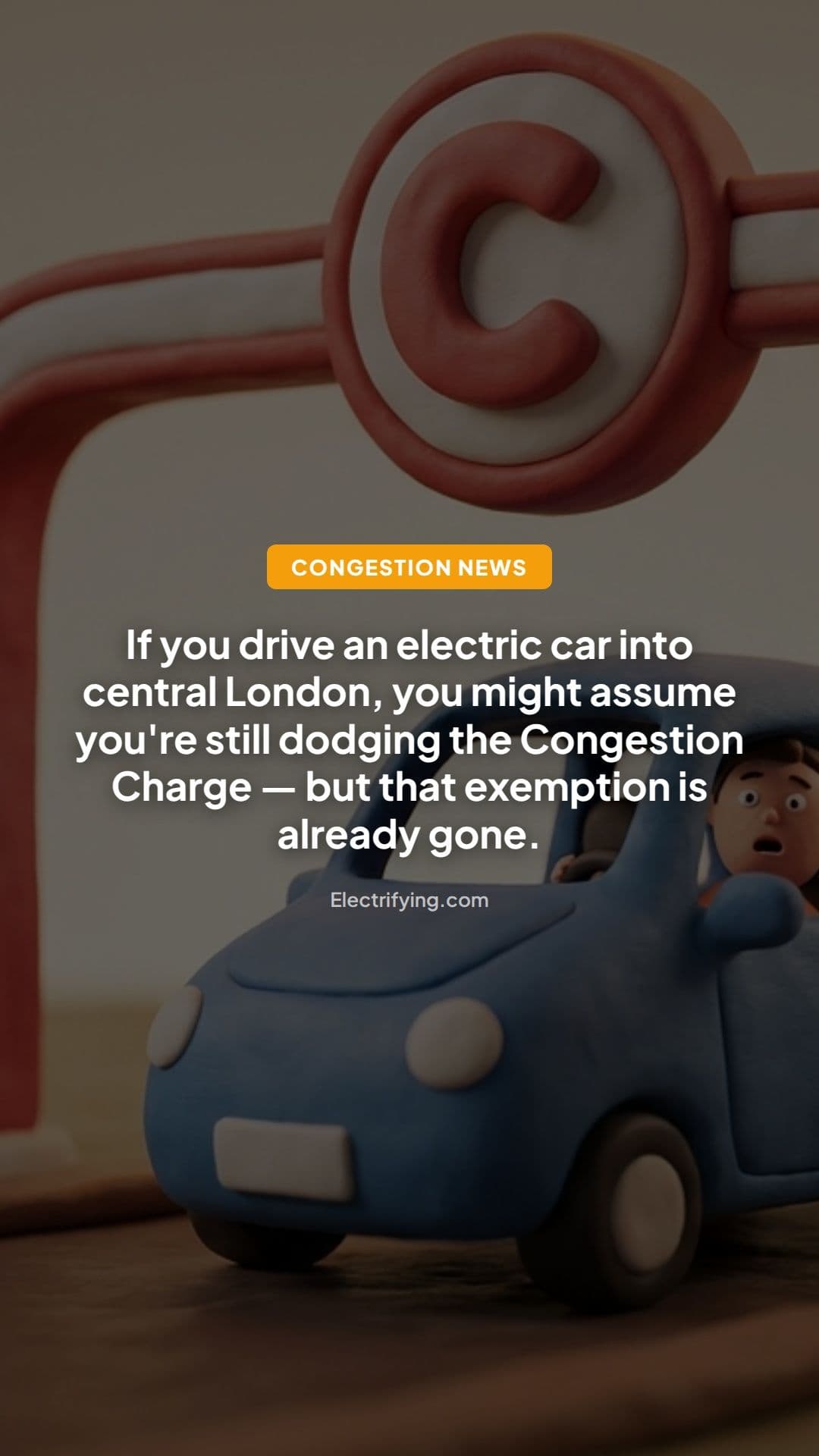
The End of Free London Driving for EV Owners: What the 2026 Congestion Charge Changes Really Mean
Imagine spending £40,000 or more on an electric vehicle, partly because you were told it would be exempt from London's Congestion Charge. You've planned your commute around it, factored the savings into your monthly budget, and perhaps even chosen where to live based on the assumption that driving into central London would remain cost-free. Then, with roughly six months' notice, the rules change.
That's exactly the situation facing tens of thousands of EV drivers across the capital and beyond. From January 2026, Transport for London will end the full Congestion Charge exemption for electric vehicles — a policy shift that has significant financial, legal, and practical implications for anyone who drives into central London.
This isn't simply a story about a daily charge going up. It's about broken expectations, shifting policy, and what it means to be an EV driver in a city that once championed clean vehicles as the future.
What's Actually Changing — and When
Transport for London confirmed that from January 2026, electric cars will no longer be fully exempt from the Congestion Charge. Instead, EV drivers will pay a discounted daily rate of £13.50 via Auto Pay — compared to the standard £15 charge for petrol and diesel vehicles. That's a 10% discount, which sounds generous until you consider that EV owners currently pay nothing at all.
The changes don't stop with private cars. The new structure introduces a tiered system:
- Electric cars — £13.50 per day via Auto Pay (down from £15 standard)
- Electric vans — a separate, higher discounted rate
- Residents living within the Congestion Charge zone — access to a resident discount, though still not free
- Motorcycles and mopeds — currently exempt; their status post-2026 is subject to further review
The charge applies Monday to Friday, 7am to 6pm, and Saturday and Sunday, 12pm to 6pm — the same operating hours introduced when TfL extended the scheme during the pandemic in 2020. Crucially, there is no overnight or weekend full exemption for EVs under the new rules.
Why This Matters — and Why Now
The Congestion Charge was introduced in February 2003 under the then-Mayor Ken Livingstone, making London one of the first major cities in the world to implement large-scale road pricing. At its inception, the charge was primarily about reducing traffic. The environmental dimension — rewarding cleaner vehicles — came later, with EV exemptions introduced as part of a broader effort to incentivise the switch away from fossil fuels.
For years, the EV exemption served a clear policy purpose: encouraging drivers to make the expensive leap to electric motoring. But the landscape has changed dramatically. Electric vehicles now make up a significant and growing share of new car registrations in the UK. In 2024, EVs accounted for around 20% of new car sales. The exemption, in TfL's view, is no longer needed as an incentive — and it's costing the authority real money at a time when it is under sustained financial pressure.
TfL has been operating under a series of emergency funding agreements with the government since the pandemic decimated its fare revenues. The Congestion Charge is one of its most reliable income streams. With EV adoption rising, maintaining a blanket exemption would increasingly hollow out that revenue base.
There's also a traffic management argument. An EV produces zero tailpipe emissions, but it still occupies road space. A Tesla sitting in a traffic jam on Regent Street causes the same congestion as a Ford Transit. If the Congestion Charge's original purpose was to reduce vehicles in central London, exempting EVs indefinitely undermines that goal entirely.
The Legal Angle: What Rights Do EV Drivers Actually Have?
Here's where things get complicated — and contentious.
The Congestion Charging scheme operates under the Transport Act 2000 and the Greater London Authority Act 1999, which together give TfL and the Mayor of London broad powers to set, vary, and remove road user charges, including any exemptions attached to them. Crucially, there is no statutory guarantee that any particular vehicle category will remain exempt indefinitely.
When EV drivers purchased their vehicles partly on the basis of the Congestion Charge exemption, they were relying on a policy commitment, not a legally enforceable right. This is an important distinction. Policy can change; legislation can be amended; and TfL's discretion over exemptions is wide.
Some consumer advocates have argued that removing a benefit that was actively promoted as an incentive to purchase could constitute a form of legitimate expectation — a principle in UK administrative law that says public bodies should not act in a way that frustrates reasonable expectations created by their own representations. However, legitimate expectation claims in this context are extremely difficult to pursue. Courts have consistently held that public authorities retain the right to change policy in the public interest, particularly where financial or environmental circumstances have shifted materially.
In short: EV drivers have a reasonable grievance, but they are unlikely to have a legal remedy.
What drivers can do is engage with TfL's consultation processes. Any significant changes to the Congestion Charge scheme require a period of public consultation under the scheme's own procedural rules. If you feel the changes were not properly consulted upon, or that the notice period was insufficient, formal representations to TfL — and ultimately to the Mayor's office — are the appropriate channels.
What Drivers Should Know Right Now
If you drive an electric vehicle into central London, here's what you need to do before January 2026:
1. Register for Auto Pay immediately if you haven't already The £13.50 discounted rate is only available via TfL's Auto Pay system. If you pay daily or by other means, you will pay the full standard rate. Auto Pay links your vehicle registration to a payment method and charges you automatically. Register at tfl.gov.uk — it takes minutes and could save you hundreds of pounds per year.
2. Check whether your vehicle qualifies for the discount Not all electric vehicles will automatically receive the discounted rate. Your vehicle must be registered with TfL as qualifying. Plug-in hybrids (PHEVs) and mild hybrids are treated differently and may not qualify for the EV-specific discount. Check TfL's vehicle checker tool with your registration number.
3. Calculate your annual cost exposure If you commute into the zone five days a week, the new charge at £13.50 per day adds up to roughly £3,500 per year — a substantial new cost that many EV drivers have not budgeted for. Factor this into any decisions about lease renewals, vehicle purchases, or commuting patterns.
4. Explore alternatives Consider whether your journey genuinely requires driving into the zone, or whether park-and-ride options, public transport, cycling, or flexible working arrangements could reduce your exposure to the charge. TfL's own journey planner can help identify alternatives.
5. If you live within the zone Apply for the residents' discount as soon as the application window opens. Residents have historically received significant reductions, and this is expected to continue under the new structure, though the precise discount rate for EV-owning residents should be confirmed directly with TfL as details are finalised.
Looking Ahead: The Bigger Picture for EV Drivers
The London Congestion Charge changes are unlikely to be an isolated event. They signal something broader: the era of blanket EV incentives is ending, and drivers who made purchasing decisions based on those incentives need to recalibrate.
The UK government's Zero Emission Vehicle mandate requires manufacturers to ensure a rising percentage of their new car sales are electric — 80% by 2030, rising to 100% by 2035. As EV adoption becomes the norm rather than the exception, the case for special treatment weakens. We are already seeing this logic applied to Vehicle Excise Duty, with EVs now subject to road tax from April 2025. The Congestion Charge exemption is simply the latest domino to fall.
What this means for drivers is a fundamental shift in how to think about the cost of EV ownership. The early-adopter benefits — free road tax, free congestion charging, cheap public charging — are being steadily withdrawn as EVs move from niche to mainstream. That doesn't make EVs a bad financial choice, but it does mean the calculations need to be made with eyes wide open.
For London specifically, there is also a longer-term question about road pricing reform. The Government is under pressure to consider a national pay-per-mile system as fuel duty revenues decline with falling petrol and diesel consumption. If that happens, the Congestion Charge may eventually be absorbed into a broader national framework — one in which no vehicle, electric or otherwise, gets a free ride.
For now, though, the message for EV drivers is clear: register for Auto Pay, check your eligibility, and start budgeting. The free ride into London is over.
Written by
Grace O'Sullivan
Municipal Enforcement Expert
Ready to Challenge Your Ticket?
Let our AI analyse your PCN and generate a professional appeal letter in minutes.
Start Free Appeal