London Congestion Charge 2026: Which Cars Get Discounts?
TfL’s London Congestion Charge rises in 2026 and the 100% EV exemption ends. See which cars qualify for Auto Pay discounts and what it means for drivers.

Kwame Asante
30 March 2026
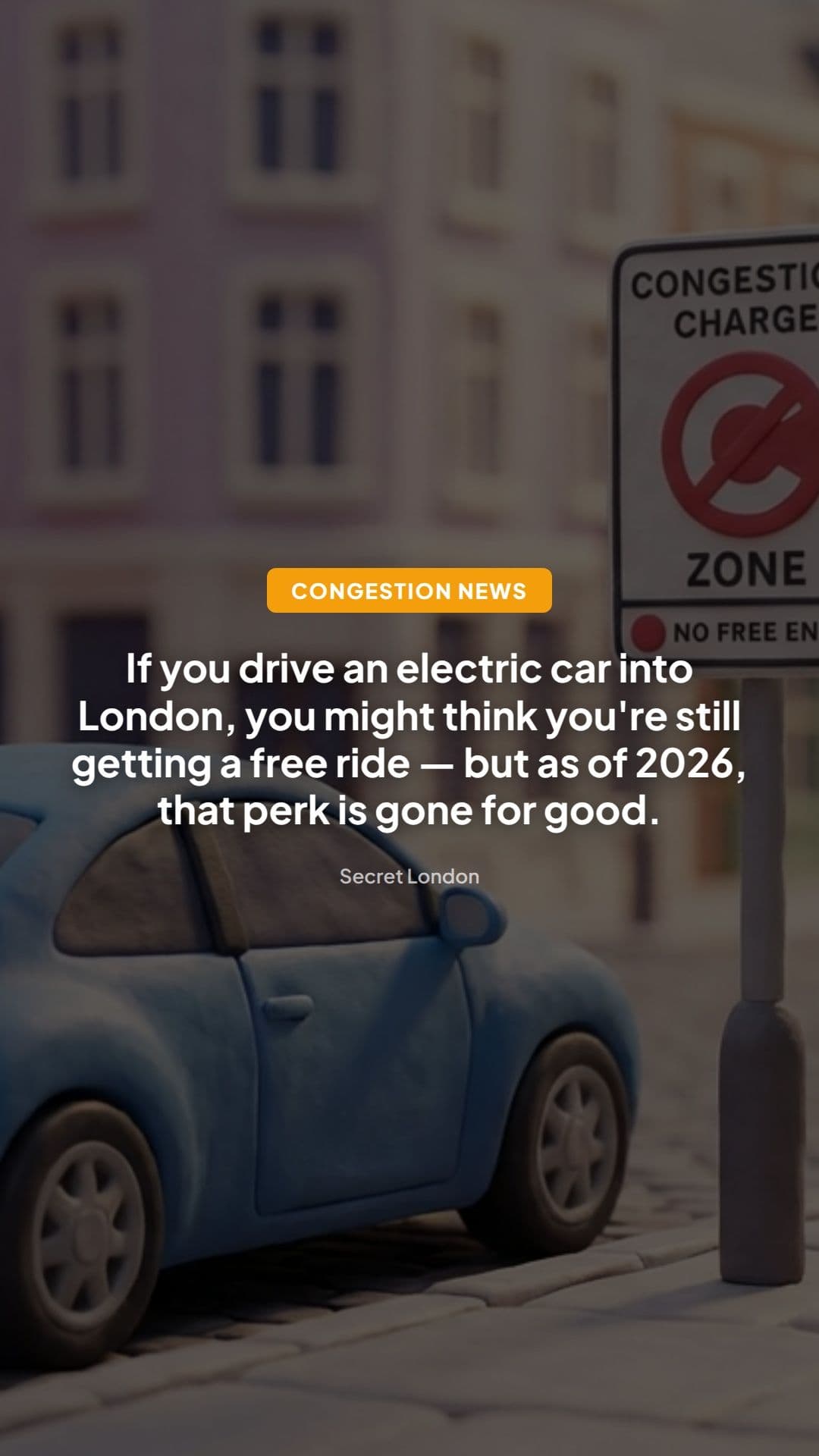
London's Congestion Charge Is About to Change Forever — Here's What Every Driver Needs to Know
Imagine pulling up to the edge of the Congestion Charge zone in your shiny new electric vehicle, confident that your zero-emission credentials will spare you the daily toll — only to discover that the rules have fundamentally shifted beneath your feet. From 2026, that's precisely the reality facing tens of thousands of London drivers. The capital's iconic Congestion Charge is undergoing its most significant structural overhaul in years, and the consequences will ripple far beyond the M25.
What's Actually Changing in 2026
Transport for London (TfL) has confirmed that the Congestion Charge — currently set at £15 per day for most vehicles — will rise in 2026, and crucially, the blanket 100% exemption for electric vehicles (EVs) will be scrapped entirely.
In its place, TfL is introducing a tiered Auto Pay discount system. Under the new structure, electric car drivers who register for Auto Pay will receive a 25% discount on the charge rather than paying nothing at all. Other cleaner vehicles may attract smaller discounts depending on their emissions classification, while the most polluting vehicles will pay the full rate — which, once the rise takes effect, is expected to climb to £18 per day.
This means an EV driver commuting into central London five days a week could face an annual bill of roughly £2,800 — compared to zero under the current regime. That is not a marginal adjustment. That is a fundamental change to the financial calculus that led many Londoners to switch to electric vehicles in the first place.
The Auto Pay discount structure is designed to retain some incentive for cleaner motoring without eliminating the congestion control function of the charge altogether. TfL's argument is straightforward: an electric car still takes up the same road space as a petrol one. If the goal is to reduce congestion — not just emissions — then exempting EVs entirely undermines the scheme's core purpose.
Why This Matters: The Bigger Picture
The Congestion Charge was introduced in February 2003 under then-Mayor Ken Livingstone, making London one of the first major cities in the world to implement large-scale road pricing. The scheme is governed by the Greater London Authority Act 1999 and the Transport Act 2000, which granted TfL and the Mayor of London broad powers to introduce road user charging schemes within Greater London.
Since its launch, the charge has been remarkably effective. TfL's own data has consistently shown reductions in traffic volumes within the zone of around 10–15% compared to pre-charge levels. But over the years, successive exemptions — for residents, for low-emission vehicles, and for EVs — have steadily eroded that impact.
By 2023, EV registrations in London had grown substantially enough that TfL began openly acknowledging the paradox: the very success of the EV transition was undermining congestion reduction. More exempt vehicles meant more vehicles on the road. Something had to give.
The 2026 changes represent TfL's attempt to rebalance the scheme — maintaining environmental incentives through a discount rather than a full exemption, while restoring the financial deterrent that keeps cars out of central London. It is, in policy terms, a logical evolution. But for drivers who made purchasing decisions based on the existing exemption, it feels like a betrayal.
The Legal Angle: Can Drivers Challenge This?
This is where things get genuinely interesting. When drivers purchased EVs partly on the basis of the Congestion Charge exemption, did TfL or the Mayor of London create any enforceable expectation that the exemption would continue?
Under English administrative law, the doctrine of legitimate expectation holds that public bodies should not resile from clear representations made to individuals without good reason. However, the courts have consistently held that legitimate expectation is difficult to establish where the representation concerns a general policy rather than a specific promise made to an identifiable individual or group.
TfL's exemption was always a policy position, not a contractual right. The Transport Act 2000 explicitly preserves TfL's ability to vary the terms of road user charging schemes, and the Mayor's powers under the Greater London Authority Act 1999 include the authority to amend or revoke charging notices. In short, there is no legal right to a perpetual EV exemption, and any challenge on legitimate expectation grounds would face very steep odds in the courts.
What drivers can do is engage with the statutory consultation process. TfL is required to consult publicly on significant changes to the Congestion Charge scheme, and responses from individuals and organisations do carry weight — particularly when they are well-evidenced and numerous. If you feel strongly about these changes, a formal consultation response is your most effective legal avenue.
Additionally, drivers who purchased vehicles under the Electric Vehicle Homecharge Scheme (EVHS) or similar government-backed incentives may wish to raise concerns with their MP, given that public funding was used to encourage EV adoption partly on the basis of ongoing running cost benefits.
What Drivers Should Know: Practical Advice
Whether you drive an EV, a hybrid, or a conventional petrol or diesel car, the 2026 changes require action now. Here is what you need to do:
1. Register for Auto Pay immediately if you haven't already The discount structure only applies to Auto Pay users. If you are driving an EV into the zone and you are not registered, you will pay the full daily rate. Registration is free and straightforward via the TfL website. Do not leave this until 2026.
2. Check your vehicle's emissions classification Not all EVs are treated equally under TfL's framework, and hybrid vehicles have their own classification rules. Plug-in hybrids (PHEVs) have historically received smaller discounts than fully battery-electric vehicles. Verify exactly where your specific make and model sits in TfL's vehicle checker tool.
3. Reconsider your commuting patterns At £18 per day (less 25% for EV Auto Pay users, so approximately £13.50), daily driving into the zone becomes a significant annual expense. If you travel into central London three or more days per week, it may be worth calculating whether a season ticket on public transport, cycling, or adjusting your working-from-home arrangements could reduce your exposure.
4. Explore the Residents' Discount Central London residents within the charging zone remain eligible for a 90% discount on the Congestion Charge, regardless of vehicle type. If you live within the zone, ensure your residents' discount registration is current and correctly linked to your vehicle.
5. Plan for the financial impact now If you are a small business operating a fleet of EVs in central London, the change from zero to approximately £13.50 per vehicle per day is a material cost increase. Update your financial projections, review driver expense policies, and consider whether vehicle routing adjustments can reduce zone entries.
Looking Ahead: What This Signals for UK Road Pricing
London's 2026 Congestion Charge changes are not happening in isolation. They are a bellwether for a much broader national conversation about road pricing reform in the United Kingdom.
The Office for Budget Responsibility has repeatedly flagged the long-term fiscal risk of EV adoption: as more drivers switch away from petrol and diesel, fuel duty receipts — which currently raise approximately £25 billion per year for the Treasury — will decline sharply. The government has already introduced Vehicle Excise Duty for EVs from April 2025 as a partial response, but this does not come close to replacing the lost revenue.
A national road pricing scheme, replacing or supplementing fuel duty, has been discussed by successive governments for decades. The 2026 London changes effectively demonstrate that pay-per-use road charging for EVs is politically deliverable — even if it generates significant public backlash. That is an important proof of concept for policymakers eyeing a national scheme.
For drivers outside London, the lesson is clear: the era of free or heavily subsidised EV motoring is drawing to a close. The financial advantages of electric vehicles are being recalibrated, not eliminated — but anyone who assumed that running costs would remain negligible indefinitely is facing a rude awakening.
The Congestion Charge has always been about more than money. It is about behaviour change, urban planning, and the kind of city London wants to be. The 2026 reforms reflect a maturing understanding of what that means in a world where the car on the road is just as likely to be electric as it is to run on petrol. The road ahead is changing — and it is going to cost you either way.
Source: Secret London. Analysis and legal commentary are original.
Written by
Kwame Asante
Community Rights Advisor
Ready to Challenge Your Ticket?
Let our AI analyse your PCN and generate a professional appeal letter in minutes.
Start Free Appeal