Lidl EV Charger Parking Charge: Driver Hit With £90
A driver was issued a £90 private parking charge after using a Lidl EV charger outside store hours. Learn the rules and how to challenge a PCN.

The Parking Ticket Pal Editorial Team
18 August 2026
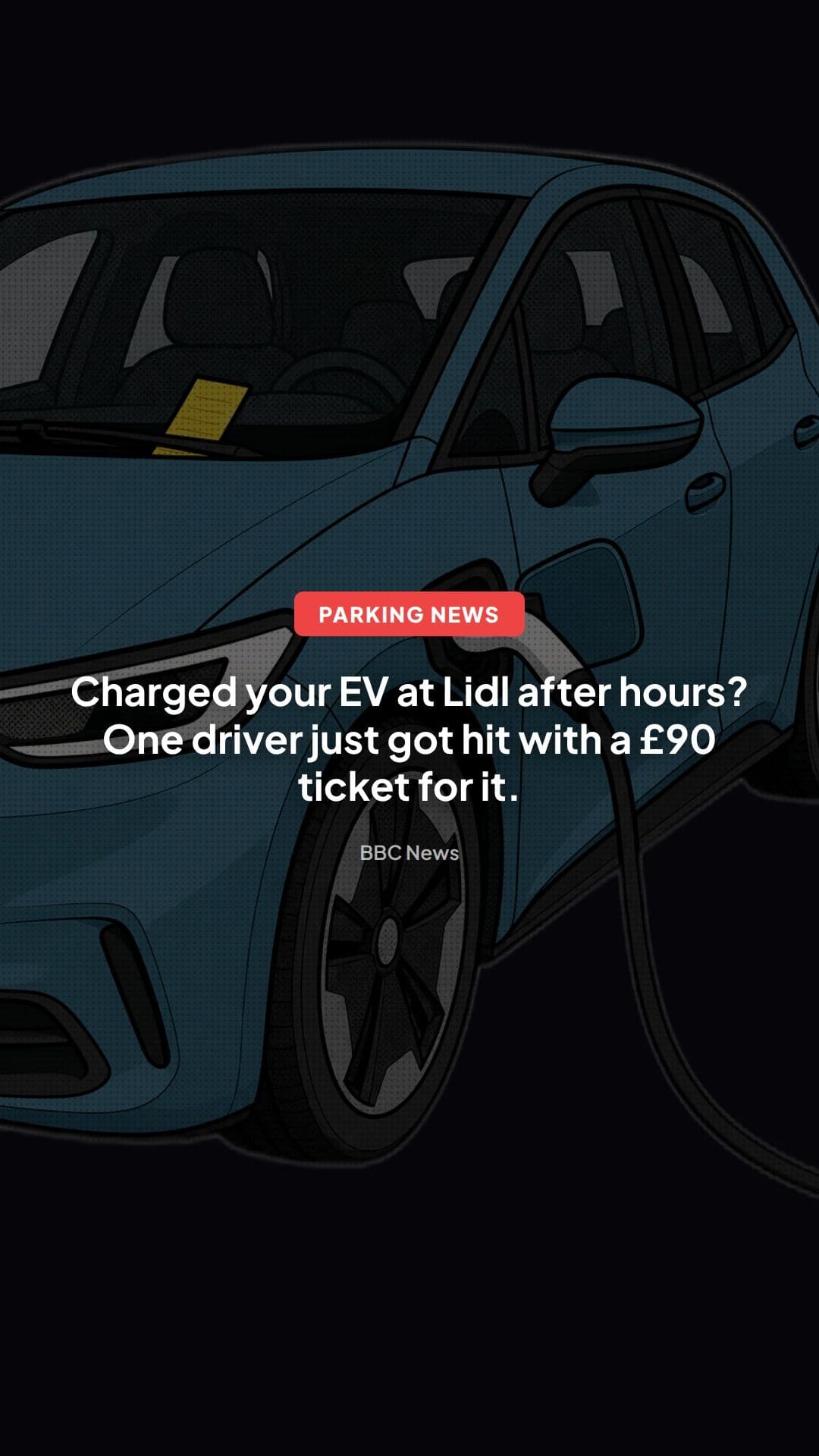
When "Free" EV Charging Comes With a Catch: The Lidl Car Park Ticket That's Sparked a Debate
Picture this: you pull into a Lidl car park late one evening, plug your electric car into the charging point, pop inside for a few essentials, and drive off feeling rather pleased with your thrifty timing. Weeks later, a letter lands on your doormat. It's not a receipt. It's a parking charge notice for £90, reducible to £45 if you pay quickly. The reason? You used the charger after the store had shut for the night.
It sounds almost absurd, a charging bay sitting there, plug in hand, only to be treated as forbidden territory once the shop shutters close. Yet that is precisely the situation reported by the BBC, and it raises a surprisingly thorny question that more electric vehicle owners are likely to encounter as charging infrastructure spreads into supermarket car parks up and down the country: can you actually be fined for using a charger that's physically switched on, simply because the store attached to it has gone home for the day?
What Happened
According to the BBC's report, a driver received a £90 parking charge notice (reducible to £45 for prompt payment) after using an EV charging point at a Lidl store outside the supermarket's normal opening hours. The charger itself was apparently accessible and usable, but the car park's terms and conditions, as is increasingly common with supermarket and retail car parks, restrict use to the store's trading hours. Park or charge outside those hours, and you're technically in breach of the contract formed the moment you drive in past the signage, regardless of whether a member of staff is anywhere near the tills.
This isn't a council-issued penalty charge notice enforced under statute. It's a charge issued by a private parking operator on private land, which matters enormously when it comes to understanding your options and your risk.
Why It Matters
Supermarket EV chargers have become one of the quiet success stories of Britain's charging network expansion. Tesco, Lidl, Aldi and others have installed thousands of points, often through partnerships with operators such as Pod Point or InstaVolt, giving shoppers a convenient top-up while they do the weekly shop. For many drivers without a driveway or home charger, these bays are a genuine lifeline.
The trouble is that the infrastructure has grown faster than public awareness of the small print attached to it. A charging bay looks like a piece of shared, semi-public utility, the electrical equivalent of a petrol pump. In reality, it usually sits on land governed by a private contract, enforced not by the police or a local authority but by a parking management company acting on the landowner's instructions. That contract can, and often does, include restrictions that have nothing to do with whether the charger is switched on.
Store opening hours are a common example, and it's easy to see the commercial logic. Retailers don't necessarily want their car parks becoming free overnight parking spots for people with no intention of shopping there, EV drivers or otherwise. But from the driver's point of view, restricting an out-of-hours amenity that is otherwise fully functional feels like a trap dressed up as a technicality. If you've read our piece on the wider pattern of drivers getting caught out by charging bay restrictions, you'll know this Lidl case is far from an isolated incident.
The Legal Angle
Here's the crucial distinction that too many drivers miss: this is not a penalty charge notice (PCN) issued by a council under the Traffic Management Act 2004. It is a parking charge notice issued by a private operator, and it rests entirely on contract law, specifically the principle established in the landmark Court of Appeal case ParkingEye Ltd v Beavis (2015). That case confirmed that clearly displayed terms and conditions on private land can form a binding contract with anyone who parks there, and that a charge for breaching those terms is enforceable provided it isn't extravagant or unconscionable given the operator's legitimate interest in managing the site.
The catch is the word "clearly." For a charge to stick, the signage setting out the rules, including any hours-of-use restriction, needs to be prominent, legible and genuinely brought to the driver's attention before or at the point they park. If the signage was buried, poorly lit, or ambiguous about whether the restriction applied to charging as well as parking, that's potentially fertile ground for a challenge.
Private parking operators in the UK generally operate under one of two trade body codes of practice, the British Parking Association (BPA) or the International Parking Community (IPC). Both require operators to follow certain standards around signage, notice periods and appeals processes, and understanding which one applies to a given car park can shape how you approach a dispute. It's also worth knowing that the sector has been under sustained government pressure to reform, including plans for a single, tighter Code of Practice covering grace periods and charge caps, following previous attempts that were shelved after legal challenges from industry bodies.
Because this is a civil contractual matter rather than a criminal or statutory one, an unpaid charge doesn't attract penalty points and won't appear on your driving licence. But that doesn't mean it can be ignored. If unpaid, operators can pursue the debt through the small claims court, and persistent non-payment can eventually affect your credit file if a County Court Judgment is registered against you.
What Drivers Should Know
If you find yourself facing a similar ticket, a few practical points are worth bearing in mind before you do anything else.
Read the signage properly, ideally with photos. If you're ever charging or parking somewhere with restricted hours, take a picture of the terms on the way in. If a challenge becomes necessary later, evidence of what was (or wasn't) clearly displayed at the time is invaluable.
Check whether the charger itself gave any indication of a time restriction. Charging apps and point operators such as Pod Point, InstaVolt or BP Pulse sometimes state hours of availability within their own app, separate from the car park's general terms. If the charger app said it was available and gave no warning, that's a detail worth raising in any appeal.
Don't assume a private charge notice carries the same weight as a council PCN. They look superficially similar, often arriving as an official-looking letter, but the enforcement routes and your rights differ. Understanding whether you're dealing with a private operator or a local authority is the first step in working out how to respond.
Consider an informal appeal first. Most reputable operators allow a period for informal representations before the formal appeals stage kicks in, and a polite, evidence-backed letter can sometimes resolve things without escalation. If that fails, and the operator is a member of a body offering an independent appeals service, you may be able to escalate further through that route rather than paying simply to make it go away.
Don't ignore it and hope it disappears. Even weak-looking charges can turn into court claims if left unanswered indefinitely. Responding, even to dispute the charge formally, keeps you in control of the process.
Factor charger hours into your route planning. As supermarket and retail charging becomes more common, it's worth treating opening hours as part of your journey planning the same way you'd check a charger's connector type or power rating. A quick glance at the retailer's posted hours, or the parking app's terms, before you plug in could save considerable hassle later.
Looking Ahead
Cases like this Lidl ticket highlight a growing friction point as Britain's charging network matures. Charging infrastructure is being bolted onto retail sites designed primarily around trading hours, not round-the-clock utility access, and the rules governing that access haven't always kept pace with driver expectations. As more shoppers plug in rather than fill up, incidents where the letter of a car park's terms clashes with the practical reality of a working charger are likely to become more common, not less.
There's also a broader regulatory backdrop here. Ministers have signalled intentions to tighten private parking regulation more generally, including caps on charges and clearer grace periods, partly in response to mounting complaints about the private parking sector's inconsistency. Whether such reforms will specifically address EV charging bay restrictions remains to be seen, but pressure is clearly building for greater clarity.
For now, the sensible approach for drivers is simple vigilance: treat every charging bay, however routine it feels, as a contract you're entering the moment you park, and take a moment to check the smaller print before you settle in for your top-up.
Written by
The Parking Ticket Pal Editorial Team
Source-checked parking guidance
Ready to Challenge Your Ticket?
Let our AI analyse your PCN and generate a professional appeal letter in minutes.
Start Free Appeal