Lambeth Zig-Zag PCN Appeal Refused: Key Lessons for Drivers
A Lambeth zig-zag PCN appeal was refused after stopping on pedestrian crossing markings. See evidence and arguments drivers should consider before challenging.

The Parking Ticket Pal Editorial Team
1 September 2026
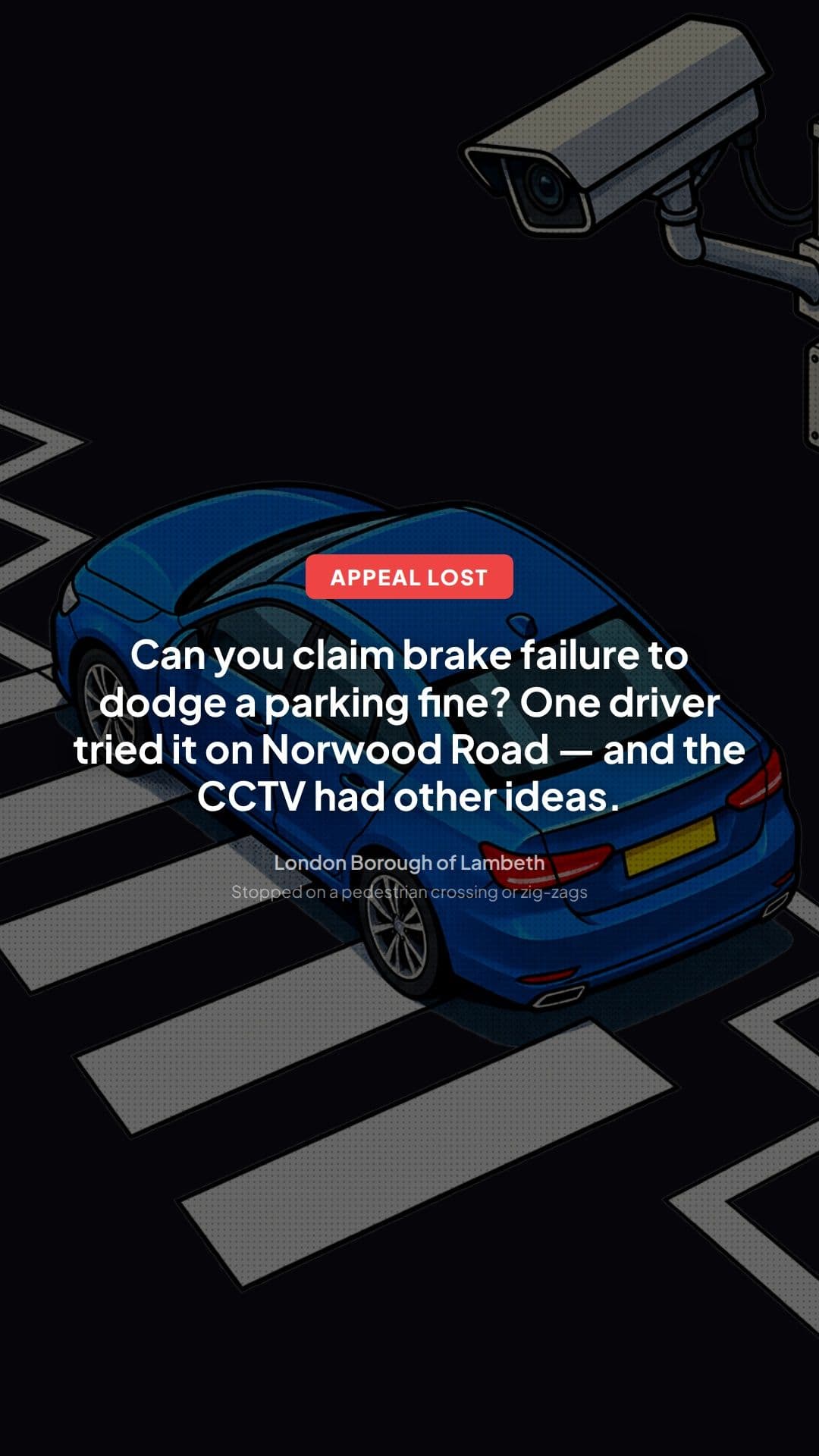
Zigzag Lines and Broken Excuses: Why a Lambeth Driver's "Brake Failure" Story Fell Apart on CCTV
Why This Case Matters
Every driver has had that moment of panic when a parking ticket lands on the doormat and the excuses start forming. "I had no choice." "It was an emergency." "I was only there for a minute." These explanations feel completely reasonable in our own heads. But when they reach a tribunal, they need something our memories can't always provide: evidence.
This Lambeth case is a masterclass in why. A driver stopped on zigzag lines near a pedestrian crossing, one of the most tightly enforced restrictions in the UK's parking rulebook, and tried to argue that a mechanical fault forced him to stop. The adjudicator wasn't convinced. The CCTV told a different story, and an unsigned receipt did nothing to plug the gap. Understanding exactly why this appeal failed offers a useful lesson for any driver tempted to rely on an unverified account of events.
The Case
The London Borough of Lambeth issued a Penalty Charge Notice (PCN) to a driver whose vehicle was caught on CCTV stopped on the zigzag markings associated with a pedestrian crossing. Zigzag lines exist for a simple reason: they keep sightlines clear so pedestrians, particularly those crossing the road, can see approaching traffic and drivers can see them. Stopping on them, even briefly, is treated as a serious contravention because of the safety risk involved.
The driver appealed to the independent tribunal, disputing the penalty. Crucially, he did not dispute that his car had been on the zigzags. The CCTV footage was clear on that point, and he didn't try to argue otherwise.
The Arguments
The driver's defence rested entirely on necessity. In his Notice of Appeal, he explained that his vehicle suffered "brake failure and overheating" and that he stopped where he did specifically "to prevent accident or hurting members of public." In other words, he framed his stop not as a careless contravention but as a responsible emergency response, the safest possible action given a sudden mechanical failure.
To back this up, he submitted a copy of an invoice or cash sale receipt, presumably intended to show that he'd had the vehicle repaired shortly afterwards, supporting the idea that something had genuinely gone wrong with it.
Lambeth's position was implicit in defending the PCN: the contravention was clearly captured on camera, and nothing in the evidence supported the driver's account of a mechanical emergency.
The Decision
The appeal was refused. The adjudicator found the contravention proved and ruled that no exemption applied under the relevant regulations (the Road Traffic Act framework and associated 1997 Regulations that govern how these penalties operate).
Interestingly, the adjudicator did throw the driver one small bone. Despite ruling against him, she found that he had not been "frivolous, vexatious or wholly unreasonable" in bringing the appeal, meaning no costs order was made against him. He lost, but he wasn't penalised further for trying.
The Legal Reasoning, Broken Down
The adjudicator's reasoning hinged on two evidential failures, both worth unpacking.
First: the CCTV didn't match the story. If a driver genuinely experiences brake failure severe enough to force an emergency stop on zigzag lines, you'd expect certain things to follow. Hazard lights. The driver getting out to check the vehicle. Perhaps a call to a breakdown service. Some visible sign of a crisis unfolding.
None of that appeared in the footage. Instead, the adjudicator noted specifically that no one was seen exiting the vehicle, and that it went on to perform a three-point turn before leaving the scene. A three-point turn is a controlled, deliberate manoeuvre. It's very difficult to reconcile with a car that supposedly couldn't be trusted to brake safely moments earlier. This mismatch between the claimed emergency and the observed behaviour was fatal to the appeal.
Second: the paperwork didn't hold up. The invoice submitted to support the brake failure claim was, in the adjudicator's words, "neither signed nor stamped in any way to show that it was actually paid." This is a critical distinction. A blank template invoice, or a document with figures typed onto it, proves very little on its own. Evidence needs to be verifiable. A signature, a stamp, a transaction reference, or a bank statement showing payment would have given the document real weight. Without that, it was just a piece of paper asserting something, not proving it.
Put together, these two gaps meant the driver was asking the tribunal to take his account on trust, while the available evidence pointed the other way. Tribunals don't work on trust. They work on the balance of probabilities, weighing what can actually be demonstrated.
It's also worth understanding why zigzag contraventions are treated so strictly in the first place. These markings exist purely for pedestrian safety, giving people a clear, unobstructed view of the road when crossing. There's no statutory exemption for "I was only there for a moment," and genuine emergencies are one of the few routes to a successful defence, but only when properly evidenced.
Lessons for Drivers
1. If you experience a genuine breakdown, document it immediately. Photos of hazard lights on, a timestamped call log to a breakdown service, or a witness statement all help establish that what happened was a real emergency rather than a convenient explanation after the fact.
2. Unsigned or unstamped paperwork is weak evidence. Any document you submit to support an appeal should be independently verifiable. A receipt that only shows a mechanic could have written up, with nothing confirming it was issued and paid for, is unlikely to carry much weight.
3. Your actions on camera need to match your story. Adjudicators watch footage closely. If your account describes a crisis, but your behaviour on camera looks calm and controlled, that inconsistency will almost always be noticed and count against you.
4. Zigzag and pedestrian crossing contraventions are enforced strictly. These are safety-critical restrictions, not general parking rules, so the bar for a successful appeal is correspondingly high.
5. Losing an appeal isn't automatically costly. This driver avoided a costs order because the adjudicator accepted he wasn't being unreasonable in trying his luck. That said, this shouldn't be relied upon. If you're facing a real penalty and have a genuine case, it's worth reading up on how to put together a proper formal representation, or seeking independent advice, rather than assuming a tribunal will simply take a sympathetic view.
Key Takeaway
An account of what happened, however sincerely believed, is not the same as proof of what happened. If you're appealing a PCN on the basis of an emergency or exceptional circumstance, the strength of your case will almost always come down to whether your evidence, footage, documentation, timing, actually backs up your story, not whether the story itself sounds plausible.
Written by
The Parking Ticket Pal Editorial Team
Source-checked parking guidance
Ready to Challenge Your Ticket?
Let our AI analyse your PCN and generate a professional appeal letter in minutes.
Start Free Appeal