Kia 100k EV sales: hybrids stay until 2035 in UK
Kia UK hits 100,000 EV sales and confirms hybrid Sportage and Sorento will remain until at least 2035—what it means for UK drivers and cleaner air zones.

Emma Thompson
9 April 2026
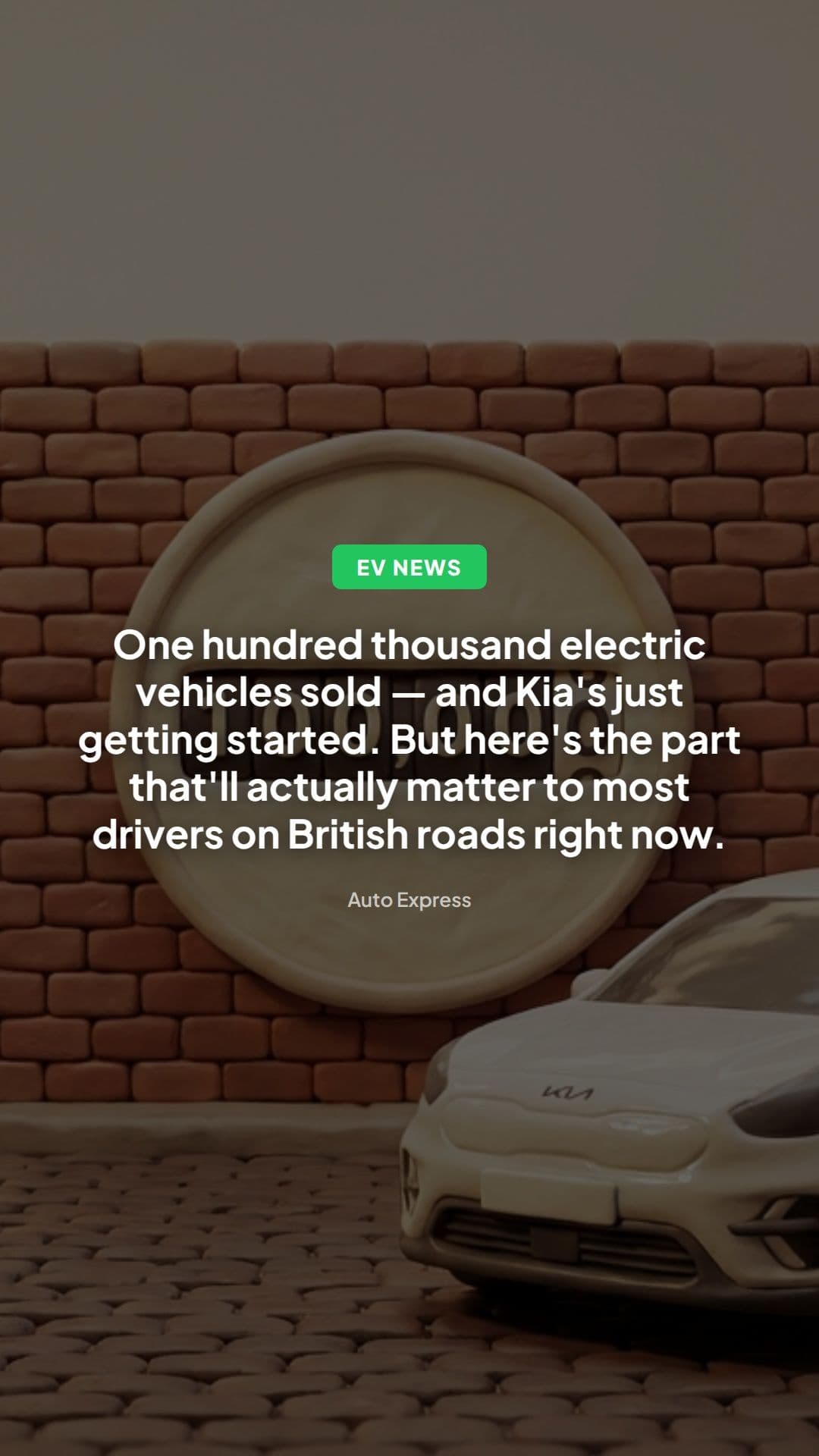
Kia Hits 100,000 EVs: What the Hybrid Survival Plan Means for UK Drivers
The Quiet Revolution Hiding in Plain Sight
Cast your mind back to 2010. Kia was still shaking off its reputation as the budget brand you bought when you couldn't afford anything else. Fast-forward fifteen years, and the South Korean manufacturer has just announced it has sold 100,000 electric vehicles in the UK — a milestone that would have seemed absurd to even optimistic forecasters a decade ago. But buried within the same announcement is something arguably more significant for the millions of British drivers who aren't yet ready to go fully electric: Kia has confirmed that hybrid versions of its most popular SUVs, the Sportage and Sorento, will remain in production and on sale in the UK until at least 2035.
This isn't just a corporate press release. It's a statement about the realistic pace of electrification, the practical needs of everyday drivers, and the regulatory tightrope that manufacturers are walking as the UK's Zero Emission Vehicle mandate tightens its grip. Let's unpack what it all means.
What Happened: The Milestone and the Message
According to Auto Express, Kia UK has reached the landmark figure of 100,000 EV sales — a cumulative total that spans models including the EV6, EV9, and the Niro EV. For context, that's a significant chunk of the UK's overall EV fleet, which the Society of Motor Manufacturers and Traders (SMMT) estimated at around 1.3 million fully electric cars by early 2025.
But the headline figure almost overshadows the more nuanced announcement sitting alongside it. Kia has explicitly stated that hybrid variants of the Sportage — the brand's best-selling model in the UK for several years running — and the larger, seven-seat Sorento will continue to be offered to British buyers until at least 2035. That date is not arbitrary. It aligns precisely with the UK government's revised deadline for ending the sale of new petrol and diesel cars, a target that was pushed back from 2030 to 2035 under Rishi Sunak's government and has since been retained by the current Labour administration.
In other words, Kia isn't abandoning the combustion engine prematurely. It is threading the needle: hitting EV milestones to satisfy regulatory obligations while keeping hybrid options alive for the vast majority of its customer base who aren't yet ready — or able — to make the full switch.
Why It Matters: The Bigger Picture Behind the Numbers
The 100,000 EV sales figure is impressive, but it needs context. The UK has approximately 40 million licensed vehicles on its roads. Even accounting for the fact that EV sales are accelerating year on year, fully electric cars still represent a relatively small proportion of the overall fleet. The government's own data consistently shows that the most common reason drivers cite for not switching to electric is range anxiety, charging infrastructure, and upfront cost — in that order.
Kia's decision to keep hybrids in the mix until 2035 is, in many ways, a direct response to that reality. The Sportage, in particular, is one of the most popular family SUVs in Britain. It sells in enormous volumes precisely because it offers practicality, reliability, and — crucially — a range of powertrains to suit different budgets and driving patterns. Removing hybrid options prematurely would effectively hand customers to rivals who are less aggressive in their electrification timelines.
There is also a broader industrial logic at play. The Zero Emission Vehicle (ZEV) mandate, introduced by the previous government and retained by Labour, requires manufacturers to ensure a rising percentage of their new car sales are fully electric. In 2024, the target was 22%; by 2030, it rises to 80%; by 2035, 100%. Manufacturers who miss their targets face fines of £15,000 per non-compliant vehicle sold above their permitted allowance. Kia's strong EV sales give it the "credits" it needs to continue selling hybrids without incurring penalties — a deliberate, financially calculated strategy.
The Legal Angle: What the ZEV Mandate Actually Means for Drivers
The ZEV mandate is perhaps the most consequential piece of UK automotive legislation in a generation, yet most drivers remain largely unaware of its mechanics. Introduced under the Automated and Electric Vehicles Act 2018 and subsequently reinforced through statutory instruments, the mandate places legal obligations on vehicle manufacturers and importers — not on drivers themselves.
This is a critical distinction. No UK law currently requires you to drive an electric vehicle. The mandate governs what manufacturers can sell, not what you can buy or drive. Hybrid vehicles — including mild hybrids, full hybrids, and plug-in hybrids (PHEVs) — remain entirely legal to purchase new until 2035, and there is no current legislation that restricts their use on public roads beyond existing emissions-related charges such as the Ultra Low Emission Zone (ULEZ) in London.
What the mandate does create, however, is a commercial pressure that filters down to consumers in subtle ways:
- Pricing dynamics: Manufacturers under ZEV pressure may price EVs more competitively (or inflate hybrid prices) to nudge buyers towards electric options and protect their compliance position.
- Model availability: Some manufacturers have already begun withdrawing certain petrol and diesel variants from the UK market ahead of 2035, even where they remain available elsewhere in Europe.
- Finance incentives: Expect to see manufacturer-backed finance deals on EVs become increasingly attractive as brands chase ZEV compliance credits.
For hybrid buyers specifically, it is also worth understanding the distinction between self-charging hybrids and plug-in hybrids under UK tax law. PHEVs with an electric range above a certain threshold attract significantly lower Benefit-in-Kind (BiK) tax rates for company car drivers — a distinction that has driven enormous fleet adoption. The Kia Sportage PHEV, for instance, has been a staple of company car lists for precisely this reason. Changes to BiK rates, which are set by HMRC and reviewed periodically, can materially affect the real-world cost of running these vehicles.
What Drivers Should Know: Practical Takeaways
Whether you are in the market for a new car now, planning a purchase in the next few years, or simply trying to make sense of the shifting landscape, here is what Kia's announcement means in practical terms:
1. Hybrid options are not going away imminently If you have been holding off on buying a Sportage or Sorento because you feared hybrid models were about to be discontinued, you can relax. Kia has given an explicit commitment to 2035. That is a decade of continued availability — longer than most people keep a new car.
2. The 2035 deadline applies to *new* sales only Even after 2035, you will be legally entitled to continue driving your existing petrol, diesel, or hybrid vehicle. The ban applies to the sale of new vehicles, not to ownership or use of existing ones.
3. Check your company car tax position carefully If you are considering a Sportage or Sorento PHEV through a company car scheme, the BiK rates are significantly lower than for a standard hybrid or petrol variant. However, these rates are subject to change in future Budgets. Lock in a deal when the rates are favourable, but model your costs over the full contract term.
4. Charging infrastructure is improving — but unevenly Kia's EV milestone is partly a reflection of improving public charging infrastructure, but the network remains patchy outside major urban centres. If you live in a rural area or lack off-street parking for home charging, a PHEV or full hybrid may genuinely be the more practical choice right now — and Kia's commitment means that choice remains available to you.
5. Resale values are in flux The used EV and hybrid market is evolving rapidly. Some early EVs have seen sharper-than-expected depreciation, while well-specified hybrids from reputable brands have held value reasonably well. Do your research before committing, and factor in the total cost of ownership rather than just the sticker price.
Looking Ahead: What This Tells Us About the Road to 2035
Kia's dual announcement — 100,000 EVs sold alongside a hybrid survival commitment — is a microcosm of where the entire UK automotive market finds itself in 2025. The direction of travel is unambiguously towards electrification. The pace, however, is being dictated not just by government policy but by the genuine readiness of consumers, the adequacy of infrastructure, and the commercial realities facing manufacturers.
The hybrid lifeline for the Sportage and Sorento is not a retreat from electrification. It is an acknowledgement that the transition is a journey, not a switch. For the millions of British drivers who will buy their next car in the next five to ten years, it is a reassurance that they will not be forced into a technology they are not ready for — and that the market will continue to offer genuinely practical, real-world alternatives.
What it also signals, more broadly, is that the most successful manufacturers in the coming decade will be those who manage the transition intelligently: building EV credibility and compliance headroom while keeping existing customers loyal through the hybrid bridge. Kia, it seems, has read that room rather well.
For drivers, the message is simple: you have time, you have options, and the market is listening. Make your next vehicle decision based on your actual driving needs, your charging situation, and your financial circumstances — not on the fear of being left behind. The road to 2035 is longer than the headlines sometimes suggest.
Written by
Emma Thompson
Traffic Law Specialist
Ready to Challenge Your Ticket?
Let our AI analyse your PCN and generate a professional appeal letter in minutes.
Start Free Appeal