JLR pivots to hybrids for US growth — what it means
Jaguar Land Rover is scaling back EV-only plans to build more hybrids for US growth. We unpack the shift’s impact on UK drivers, charging and costs.

James Wilson
20 June 2026
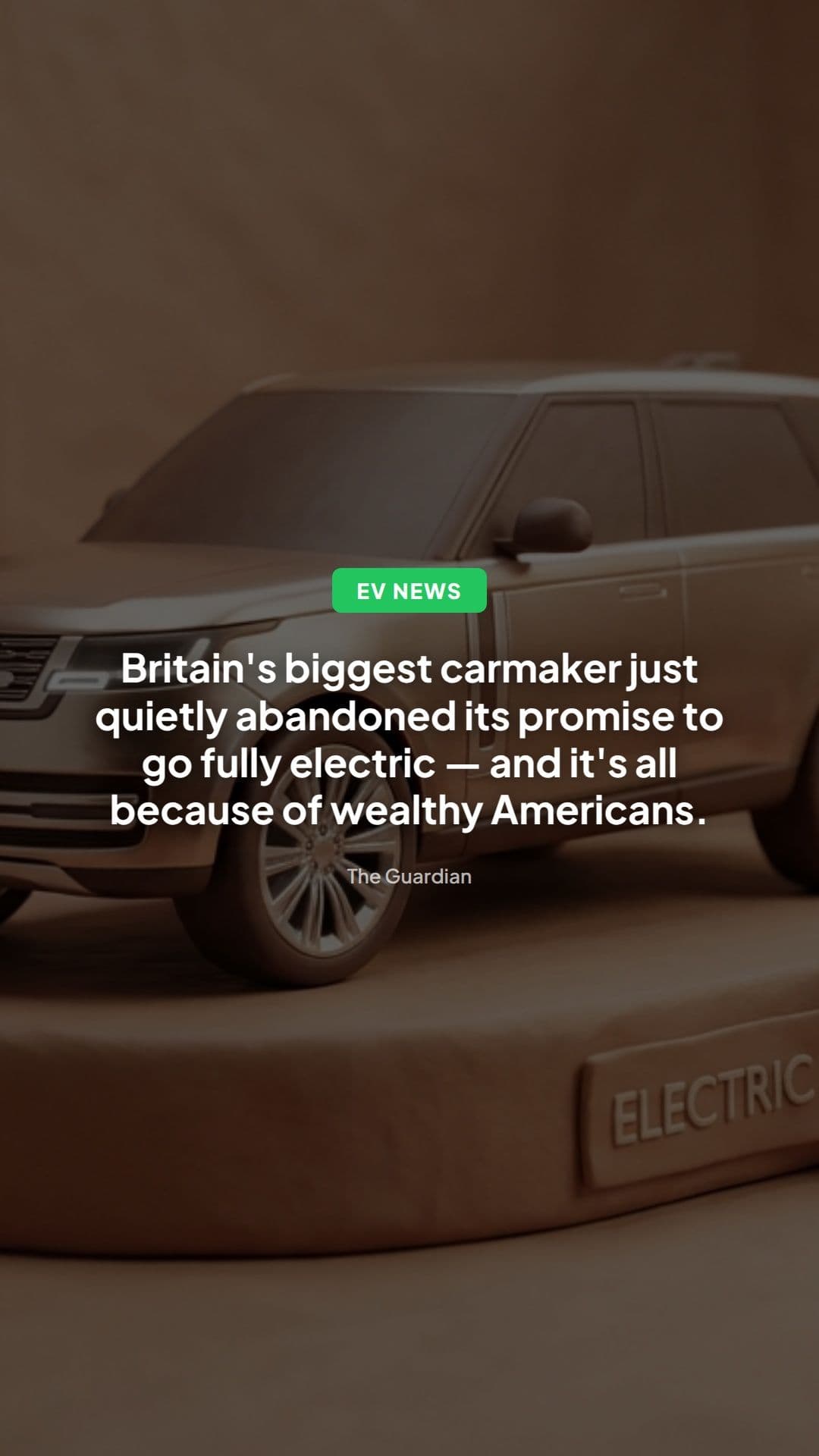
Jaguar Land Rover's Hybrid U-Turn: What It Really Means for UK Drivers and the EV Transition
There's a particular kind of corporate announcement that sounds like a minor operational tweak but actually signals something far more significant about the direction of an entire industry. Jaguar Land Rover's decision to scale back its all-electric production ambitions and pivot towards building more hybrid vehicles is precisely that kind of announcement — and if you're a UK driver weighing up your next vehicle purchase, the implications are worth understanding properly.
What Actually Happened
According to reporting by The Guardian, Jaguar Land Rover has quietly reversed course on its earlier commitment to EV-only factory production, instead announcing plans to manufacture significantly more hybrid models as part of a concerted push into the US market.
This is not a minor footnote. JLR had previously positioned itself as one of the more ambitious British manufacturers on the road to electrification. The Jaguar brand, in particular, had pledged to become fully electric — a bold repositioning that included discontinuing its entire combustion-engine line-up and relaunching with an eye-wateringly expensive, design-forward EV identity. The new Type 00 concept and the forthcoming production models were supposed to represent a clean break with Jaguar's past.
What's changed? In short: the market hasn't cooperated. US consumers — who represent a critical growth opportunity for JLR — have shown persistent appetite for plug-in hybrids and full hybrids rather than pure EVs. Meanwhile, the regulatory environment in America under the current administration has shifted away from aggressive EV mandates, removing some of the urgency that previously pushed manufacturers towards zero-emission targets. Add in supply chain pressures around battery materials and the sheer cost of retooling factories for EV-only production, and the case for a more measured, hybrid-inclusive strategy becomes commercially compelling.
JLR is not alone in this recalibration. Across the industry — from Ford to Volkswagen — manufacturers have been quietly trimming EV production targets and reintroducing or expanding hybrid lines. JLR's announcement is notable primarily because it involves a British manufacturer with significant domestic relevance, and because it comes at a particularly sensitive moment for UK automotive and energy policy.
Why This Matters Beyond the Boardroom
To understand the full weight of this decision, you need to appreciate the regulatory tightrope that UK car manufacturers are currently walking.
The UK Government's Zero Emission Vehicle (ZEV) Mandate, introduced under the Powering Up Britain framework and enshrined in law, requires that a rising percentage of each manufacturer's new car sales in the UK must be zero-emission vehicles. The targets ramp up progressively: 22% in 2024, 28% in 2025, rising to 80% by 2030, and 100% by 2035. Manufacturers who miss their annual ZEV percentage face fines of £15,000 per non-compliant vehicle.
Here's the tension: if JLR is shifting production capacity towards hybrids — which, under the ZEV Mandate, do not count as zero-emission vehicles — then its ability to meet those rising UK compliance thresholds becomes more complicated. Hybrids, including plug-in hybrids (PHEVs), are classified as low-emission vehicles but not zero-emission, meaning they contribute to the manufacturer's overall sales but not to its ZEV quota.
JLR can, under the rules, purchase ZEV credits from other manufacturers who exceed their targets — a trading mechanism built into the legislation. But this adds cost and complexity, and it underscores a broader tension: the UK's domestic regulatory framework is pushing hard towards full electrification, whilst market realities — particularly in export markets — are pulling manufacturers in a different direction.
There is also the question of what this signals for UK manufacturing jobs. JLR employs tens of thousands of people across its Solihull, Castle Bromwich, and Halewood plants. The mix of vehicles produced at each site has direct implications for the workforce skills required, the supply chains involved, and ultimately the long-term viability of those facilities. A hybrid-heavy production strategy requires different battery technology, different drivetrain components, and different supplier relationships than a pure-EV approach.
The Legal Landscape: What UK Regulations Say
For UK drivers, the regulatory picture is genuinely complex — and it matters in practical terms.
The ZEV Mandate is the central piece of legislation here. Passed under the powers of the Climate Change Act 2008 and implemented through statutory instruments, it creates binding obligations on manufacturers rather than on individual drivers. However, its downstream effects — on vehicle availability, pricing, and manufacturer incentives — directly shape what ends up on UK forecourts.
Vehicle Excise Duty (VED) changes from April 2025 mean that battery electric vehicles now pay road tax for the first time, removing one of the financial advantages of going fully electric. PHEVs and full hybrids, depending on their CO₂ emissions, fall into various VED bands. A PHEV with low official emissions might still attract relatively modest VED, but drivers should verify the precise band for any specific model rather than assuming hybrid automatically means cheap to tax.
Benefit-in-Kind (BiK) taxation for company car drivers is another critical consideration. PHEVs currently attract BiK rates of between 5% and 14% depending on their zero-emission range, compared to just 3% for pure EVs (rising gradually through to 2028). This differential continues to make full EVs more tax-efficient for business users — a factor that JLR's fleet sales team will need to navigate carefully if the brand's mix shifts more heavily towards hybrids.
The Consumer Rights Act 2015 is also worth bearing in mind for anyone who has already placed an order for a JLR electric vehicle based on specific promises about the product. If the specification of a vehicle changes materially between order and delivery — including changes to powertrain type — buyers may have grounds to withdraw from the contract and claim a full refund. This would be assessed case by case, but the principle is clear: a contract for a specific vehicle is binding on both parties.
What Drivers Should Know: Practical Takeaways
If you're in the market for a new vehicle — whether from JLR or elsewhere — here's what this news should prompt you to consider:
- Don't assume hybrid means future-proof. Hybrid vehicles, including PHEVs, will face increasing restrictions in Clean Air Zones as local authorities tighten standards. Check the specific CAZ rules for any city you regularly drive through before committing to a PHEV.
- Verify ZEV grant eligibility carefully. The UK Government's current EV grant (£3,750 for eligible vehicles under £35,000) applies only to battery electric vehicles — not hybrids. If a dealer suggests a hybrid qualifies, ask for written confirmation and check the OZEV eligibility list independently.
- If you've ordered a JLR EV, track any specification changes. JLR's production pivot may not affect vehicles already in the order pipeline, but it's worth confirming in writing with your dealer that the vehicle you've ordered will be delivered as specified, particularly if you've paid a deposit.
- Consider the total cost of ownership, not just the sticker price. Hybrids typically cost less upfront than equivalent EVs, but the BiK differential, fuel costs, and potential future CAZ charges can erode that saving over a three-to-five year ownership period.
- For fleet managers: review your company's ZEV commitments against the revised JLR model mix. If you were planning to use JLR vehicles to hit internal sustainability targets or government fleet requirements, a shift towards hybrids may require you to revisit your projections.
Looking Ahead: A More Honest Conversation About the Transition
JLR's hybrid pivot is, in many respects, a symptom of a wider truth that the automotive industry has been reluctant to state plainly: the transition to full electrification is happening more slowly, and more unevenly, than the most optimistic projections suggested.
That doesn't mean electrification is failing. UK EV registrations continue to grow, charging infrastructure is expanding, and battery costs are falling. But the path from here to a fully electric new-car market by 2035 is considerably more complicated than a straight line — and manufacturers are adjusting their strategies accordingly.
For UK drivers, this creates a genuine window of opportunity. The hybrid market is about to become more competitive, with more models, better technology, and — crucially — manufacturers with strong incentives to price aggressively to maintain ZEV compliance through credit trading. If a hybrid genuinely suits your driving patterns, the next 18 to 24 months may represent excellent value.
But the regulatory direction of travel in the UK remains firmly towards zero-emission vehicles. The ZEV Mandate is law. The 2035 deadline for new petrol and diesel sales is confirmed. Local authorities are expanding clean air restrictions. Whatever JLR's short-term production mix looks like, drivers who want to stay ahead of the regulatory curve — and avoid being caught with a vehicle that becomes increasingly expensive to run in urban areas — should keep a clear eye on where the rules are heading, not just where the market is today.
JLR's announcement is a pragmatic response to commercial reality. But it is not a signal that the EV transition has stalled. It is, rather, a reminder that the road to 2035 has more bends in it than the map originally suggested.
Written by
James Wilson
Legal Counsel
Ready to Challenge Your Ticket?
Let our AI analyse your PCN and generate a professional appeal letter in minutes.
Start Free Appeal