
Islington Prohibited Turn Appeal: Lessons From Refusal
A London Borough of Islington prohibited turn PCN appeal was refused. Learn drivers should check signs, evidence and tribunal arguments before appealing.

The Parking Ticket Pal Editorial Team
28 September 2026
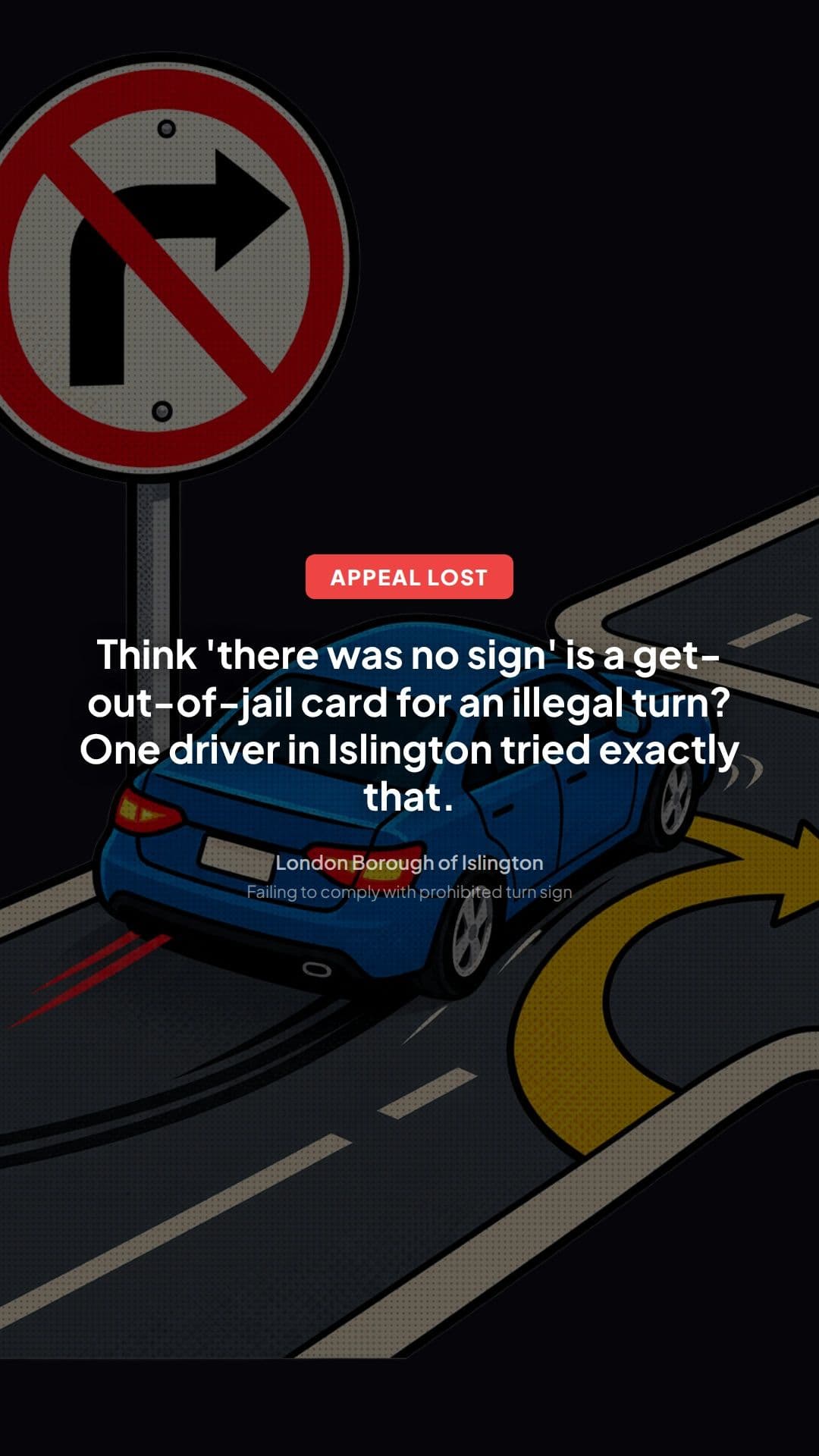
Islington Prohibited Turn Appeal Refused: Why "I Didn't See a Sign" Isn't Enough
Why This Case Matters to Every Driver
Picture this: you're driving down an unfamiliar road, following what looks like a perfectly sensible route, when you turn right and suddenly find yourself with a Penalty Charge Notice (PCN) in the post weeks later. Your defence? "There was no written notice telling me I couldn't turn there."
It sounds reasonable. Many drivers assume that unless a sign explicitly spells out a restriction in words, they can't be penalised for missing it. But this Islington case, decided at the London Tribunal, shows exactly why that assumption can cost you £130 or more.
For anyone who drives through London's increasingly complex road layouts, understanding how adjudicators interpret "adequate signage" is essential. This case is a masterclass in why the type of sign matters less than whether it was reasonably visible and clear.
The Case: What Happened in Newington Green Road
The driver, Mr Miah, was caught by camera enforcement turning right on Newington Green Road in the London Borough of Islington. The contravention was straightforward: failing to comply with a prohibited turn sign.
Mr Miah didn't dispute that it was his car caught on camera. There was no argument about identity or ownership. Instead, his entire case rested on one point: he believed he was allowed to turn right because he saw no written notice prohibiting it.
The Arguments: Words vs Symbols
Mr Miah's position was simple. He turned right at the junction because, in his view, there was nothing explicitly telling him he couldn't. He seemed to be drawing a distinction between a written instruction (something like "No Right Turn" spelled out in text) and symbolic road markings or signage.
The council's position, implicit in the evidence presented, was that the junction was properly signed using standard Department for Transport prescribed signs and markings, and that these were sufficient to inform drivers of the restriction.
The Decision: Adequate Signs, Contravention Confirmed
The adjudicator refused the appeal. In reaching this conclusion, they examined the physical evidence of what was actually on the road and found:
- Road markings stating "Ahead Only" in large letters painted on the carriageway
- Vertical signs on the left-hand side of the road
- Additional signage on the central reservation indicating no right turn
Taken together, the adjudicator found this constituted "adequate signs" warning drivers not to turn right. The PCN was upheld and the penalty charge stood.
The Legal Reasoning in Plain English
This case turns on a point that trips up many drivers: you don't need a sign with written words spelling out a prohibition for it to be legally enforceable.
UK traffic signs operate on a system of standardised symbols, arrows, and markings set out in the Traffic Signs Regulations and General Directions (TSRGD). A blue circular sign with a bent arrow, or road markings combined with directional arrows, carry exactly the same legal weight as a sign that says "No Right Turn" in text. In fact, symbol-based signs are often the preferred format precisely because they're instantly recognisable regardless of language or literacy, and they can be processed by a driver at speed far more quickly than a sentence.
The adjudicator's job in these cases isn't to ask "did the driver personally understand the sign?" but rather "would a reasonably observant driver, exercising ordinary care, have seen and understood the restriction?" This is an objective test, not a subjective one. It doesn't matter that Mr Miah didn't interpret the signage correctly. What matters is whether the signage, viewed as a whole, met the legal standard of being clear and adequate.
In this case, the adjudicator found multiple layers of reinforcement: the "Ahead Only" carriageway markings, a sign on the left, and another on the central reservation. This redundancy strengthened the council's position considerably. It wasn't a single, easily missed sign. It was a combination of visual cues from multiple directions, which is typically how councils try to eliminate ambiguity at complex junctions.
This is a similar principle to what applies in cases involving PCN Code 38 for straight ahead only contraventions or more general prohibited turn penalties. Adjudicators consistently apply this "reasonably observant driver" standard rather than asking whether every individual driver subjectively noticed or understood the restriction.
Lessons for Drivers
1. Symbols count as much as words. Don't assume that only text-based signs are legally binding. A circular sign with an arrow, or road markings like "Ahead Only," carry full legal force. If you're unsure what a symbol means, the Highway Code has a full glossary of UK traffic signs worth refreshing your memory on, especially if you're driving in an unfamiliar city.
2. Look at the whole picture, not just one sign. Councils often layer multiple signs together, such as a carriageway marking plus a vertical sign plus a central reservation sign, specifically to make restrictions hard to miss. If you're appealing a similar PCN, it's not enough to say "I didn't see one sign." You need to consider whether any of the signage present would have alerted a reasonably attentive driver.
3. Camera enforcement doesn't dispute identity, it disputes conduct. In this case, Mr Miah didn't challenge that it was his car. That narrowed the appeal entirely down to the signage question. If you're planning to appeal, be clear about what you're actually disputing: was it your vehicle, was there a valid contravention, or was there a procedural failure by the council?
4. "I didn't understand it" is different from "it wasn't there." Appeals that succeed on signage grounds tend to involve signs that are obscured, faded, contradictory, or genuinely inadequate under the legal signage standards. Appeals that argue purely subjective misunderstanding, without evidence the signage itself was deficient, tend to fail. If you're building a defence, focus on objective faults such as visibility, positioning, or compliance with prescribed sign formats, not personal interpretation. For more detail on this distinction, see our guide on how to use unclear parking signs as a defence against UK parking fines.
5. Photograph the junction if you plan to challenge signage. If you genuinely believe signage was missing or inadequate, the strongest evidence is a timely site visit with photographs from the driver's approach angle. Adjudicators weigh physical evidence heavily, as this case shows, so vague recollection rarely beats a council's photographic record of signs in situ.
Key Takeaway
If a road junction features clear directional arrows, carriageway text such as "Ahead Only," and reinforcing signs on both sides of the road, you cannot successfully argue that you weren't told about a restriction simply because no sign used written prohibition wording. UK traffic law treats standardised symbols and markings as legally equivalent to text, and adjudicators will assess whether the signage was adequate overall, not whether you personally found it clear. When in doubt about a junction's rules, slow down, look for the full picture of markings and signs, and if you do receive a PCN you believe was unfairly issued, seek proper guidance on the formal appeals process before assuming your case will succeed.
Written by
The Parking Ticket Pal Editorial Team
Source-checked parking guidance
Ready to Challenge Your Ticket?
Let our AI analyse your PCN and generate a professional appeal letter in minutes.
Start Free Appeal