
Islington PCN Appeal Won: Restricted Street Parking
Learn why an Islington restricted street parking PCN appeal was allowed, and the practical evidence drivers can use to challenge council penalties.

The Parking Ticket Pal Editorial Team
25 September 2026
Cardboard Clocks and Reasonable Doubt: Why an Islington Blue Badge Appeal Succeeded on a Technicality
Why This Case Matters
If you've ever used a disabled parking badge, you'll know the drill: pop your blue badge on display, set your parking clock to show your arrival time, and hope you're back within the permitted window. But what happens when the very device you're relying on to prove your compliance isn't precise enough to prove anything at all?
That's exactly the question at the heart of a recent Islington parking appeal. It's a short case, but it carries a big lesson about the burden of proof in parking enforcement, and why "probably guilty" simply isn't good enough for a council to win.
The Case
A driver parked in a restricted street in the London Borough of Islington, using a Blue Badge to take advantage of the disabled parking concession that allows badge holders to park for up to three hours in places where other drivers can't stop at all.
To use this concession, badge holders must display a parking clock (sometimes called a disabled parking disc) showing the time they arrived. Traffic wardens, known as Civil Enforcement Officers, check this clock against the actual time to see whether the three-hour limit has been exceeded.
In this instance, Islington Council issued a Penalty Charge Notice (PCN), effectively arguing that the driver had overstayed the three-hour limit. The council's case rested on a photograph taken by the enforcement officer, showing the clock's position at the time of inspection.
The driver appealed, and the case went before an independent adjudicator at the London Tribunals (the body that hears parking appeals for London boroughs).
The Arguments
The council's position was straightforward: the photographic evidence showed the clock set to a time that, when compared with the time the PCN was issued, indicated the driver had overstayed their permitted three hours.
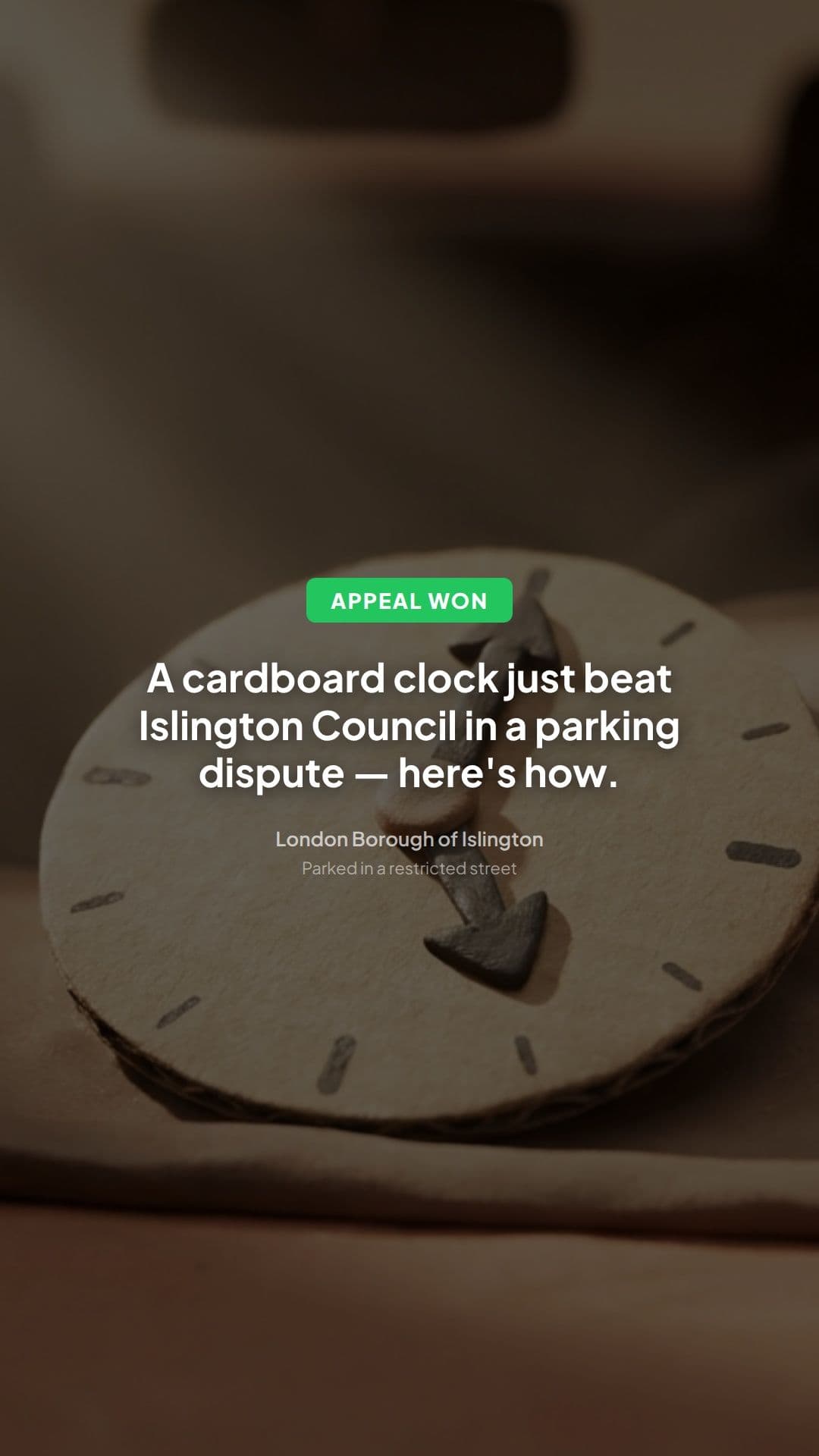
The problem was the clock itself. It wasn't a precision digital timer, it was a cardboard disc, the kind you turn manually to point an arrow at the hour you arrived. These are cheap, simple, and widely used, but they have an inherent flaw: they can only be set to approximate times, not exact minutes.
The adjudicator didn't dispute that the three-hour rule applies to disabled parking, and didn't dispute that the council was entitled to check compliance. What was in question was whether the evidence was precise enough to prove, beyond reasonable doubt, that the limit had actually been breached.
The Decision
The adjudicator allowed the appeal.
Looking at the photograph provided by the enforcement officer, the adjudicator found that the cardboard clock was set somewhere between 14:15 and 14:30. That's a 15-minute window of uncertainty, simply because of how the clock's dial and pointer worked.
Crucially, the adjudicator noted that if the clock might have been set to any point within that window, it was entirely possible it had been set to a time before 14:22, which would have kept the driver within their three-hour allowance. Because the tribunal couldn't be sure the clock indicated an overstay, the benefit of the doubt went to the driver.
The Legal Reasoning, Unpacked
This is a case about the burden of proof, one of the most important concepts in any parking dispute.
Who has to prove what? When a council issues a PCN, it isn't the driver's job to prove innocence. It's the council's job to prove the contravention actually happened. If the evidence doesn't clearly establish that a rule was broken, the appeal succeeds, even if there's a reasonable chance the driver was in the wrong.
Precision matters when time limits are involved Many parking contraventions are time-based: overstaying a limit, parking after a meter expires, or, as in this case, exceeding a disabled parking allowance. When the whole case hinges on minutes, the evidence needs to be capable of showing those minutes accurately.
A cardboard parking clock, by its physical design, can only be set to approximate positions on its dial. It's not like a digital display that shows 14:22 precisely, it's a rotating disc where the "arrow" might sit anywhere within a chunky arc that could represent several different times. The adjudicator recognised this limitation and factored it directly into the decision.
Reasonable doubt in a civil tribunal Parking tribunals aren't criminal courts, but the adjudicator still applied a similar logic here: if there's genuine uncertainty about whether a contravention occurred, that uncertainty should benefit the driver, not the council. Because the clock could plausibly have been showing a time before the three-hour limit expired, the council's evidence wasn't strong enough to stand up.
This is a subtle but important distinction from cases where the evidence is clear-cut, such as a photograph clearly showing a digital ticket display with an expired time. Here, the evidence itself was ambiguous by nature, not just disputed.
Lessons for Drivers
1. Understand the limitations of your equipment. If you're using a cardboard or analogue parking clock, know that it's an imprecise tool. Where possible, set it as accurately as you can, and consider taking a timestamped photo of your dashboard, showing both your clock and a phone or digital display, at the moment you park. This creates your own independent record of arrival time.
2. Keep evidence of your own. Councils rely on photographic evidence taken at the point of inspection. Drivers can do the same. A quick photo when you arrive, and another with the dashboard clock, could be invaluable if a dispute arises later.
3. Ambiguous evidence can work in your favour, but don't rely on it. This case shows that when enforcement evidence is genuinely unclear, adjudicators will scrutinise it carefully. However, this isn't a licence to be careless. It's far better to have your own solid evidence than to hope a council's case falls apart on a technicality.
4. Blue Badge rules are still rules. The adjudicator was clear that the three-hour limit for disabled parking is a legitimate restriction, and this case wasn't about badge holders being exempt from scrutiny. It succeeded because of an evidential gap, not because the rule itself was wrong or unenforceable. If you're a badge holder, understanding your rights and limits properly matters. It's worth reading up on the wider rules around Blue Badge parking to avoid disputes altogether.
5. If you're appealing, focus on what the council actually has to prove. When challenging a PCN, it's not just about telling your side of the story, it's about examining whether the council's evidence genuinely proves its case. Look closely at photographs, timestamps, and any device readings. If there's a genuine flaw or ambiguity, that's worth raising clearly in your appeal.
Key Takeaway
When it comes to parking enforcement, "probably" isn't good enough, the evidence has to prove the contravention, not just suggest it. This case is a reminder that councils carry the burden of proof, and if their evidence is undermined by something as simple as an imprecise cardboard clock, that burden hasn't been met. For drivers facing a PCN, especially one that hinges on exact timings, it's always worth asking: does this evidence really prove what the council says it proves? If you're unsure, the Traffic Penalty Tribunal or London Tribunals process exists precisely to test that question, and as this case shows, sometimes the answer is no.
Written by
The Parking Ticket Pal Editorial Team
Source-checked parking guidance
Ready to Challenge Your Ticket?
Let our AI analyse your PCN and generate a professional appeal letter in minutes.
Start Free Appeal