
Islington Bus Lane PCN Appeal Allowed: Key Lessons
An Islington bus lane PCN appeal was allowed. Learn the practical evidence and procedural points London drivers should check before paying.

The Parking Ticket Pal Editorial Team
14 October 2026
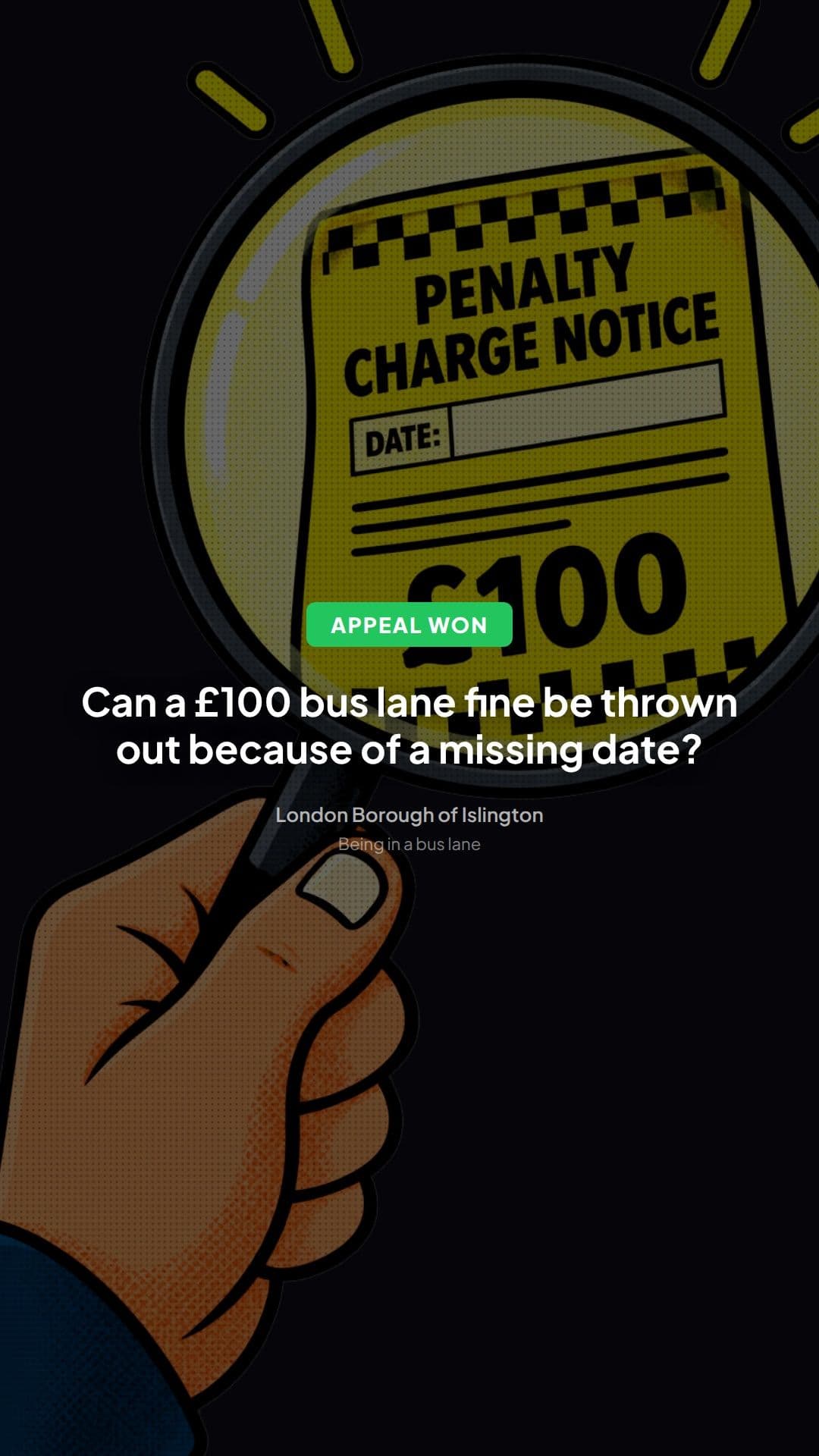
Bus Lane PCN Cancelled Because It Had No "Date of Notice": What One Missing Date Teaches Drivers
Most drivers who receive a bus lane penalty look at the photo, the location and the time. Very few check whether the notice itself is legally sound. This Islington appeal shows why that second check can matter. The driver won, and nobody argued about the bus lane. The council lost because of a missing date on its own paperwork.
The case in a nutshell
The London Borough of Islington issued a Penalty Charge Notice (PCN) for the contravention described as "being in a bus lane". The driver appealed to an independent parking adjudicator, the tribunal that decides disputes between motorists and councils.
The adjudicator allowed the appeal, meaning the PCN was cancelled and the driver did not have to pay. The decision turned on the PCN's contents, not on whether the vehicle was in the bus lane.
The council had filed what it said was a complete copy of the PCN. That copy showed the date the parking attendant saw the vehicle. It did not show a Date of Notice or Date of Issue. The adjudicator held that this made the notice non-compliant with the law, and a non-compliant PCN cannot be enforced.
What each side argued
The adjudicator's reasons contain a surprising detail: neither side raised the missing date. The decision says "neither party has taken this point". So this was not a case where a clever driver spotted a flaw and the council struggled to answer it.
The reasons do not tell us what the driver said in their appeal, and we should not guess. What the decision does show is the following:
- The council filed its copy of the PCN as evidence, presenting it as a complete copy of the notice that was issued.
- The driver challenged the penalty, but the tribunal's decision did not rest on any argument the driver made.
- The adjudicator examined the document the council had supplied and noticed the gap himself.
This reflects how these tribunals work. Adjudicators are not just referees between two arguments. They are expected to check that the council has a valid, enforceable penalty before upholding it. If the foundation is faulty, the case can fail whatever else is said.
The decision
The adjudicator's reasoning ran in four steps:
- The High Court had recently decided a case involving Barnet Council, a Parking Adjudicator and a motorist named Moses (reference CO/3355/2006). It held that a PCN does not comply with section 66 of the Road Traffic Act 1991 if it lacks a Date of Notice or Issue.
- The adjudicator was bound to follow the High Court, even though neither party had mentioned the point.
- The council's copy showed only the date the vehicle was seen by the parking attendant.
- The date of the alleged contravention is not a substitute for the date of the notice. The notice was therefore invalid, and the appeal had to be allowed.
The legal reasoning in plain English
Why does a PCN have to meet strict rules?
A PCN is not just a bill. It is the document that starts a legal process which can end with a registered keeper owing money, and potentially facing enforcement action. Because the consequences are real, Parliament set out what the notice must contain.
Section 66 of the Road Traffic Act 1991 is the provision the adjudicator applied here. In broad terms, it lists what a PCN has to tell the recipient, such as the alleged contravention, the amount payable, how long they have to pay, and the date of the notice. It exists to make sure the person receiving the notice knows what they are accused of and when they must act.
Why does the date matter so much?
The date of the notice is the anchor for everything that follows. Deadlines for paying at a discount, paying in full, and responding all run from it. If the notice does not say when it was issued, the recipient cannot reliably work out how long they have. The law treats that as a fundamental defect, not a typing error.
Why isn't the "date seen" good enough?
This is the sharpest point in the case. It is easy to think, "The notice shows a date, so surely that is close enough." The adjudicator said no. There are two separate moments:
- The date of the contravention, when the vehicle was allegedly in the bus lane.
- The date of the notice, when the PCN was actually issued.
They may be the same day or they may not. A notice that records only the first has not told the driver the second. The law asks for a particular piece of information, and a different date does not satisfy it.
Why was the adjudicator "bound"?
The High Court sits above the parking adjudicators. When it rules on how a statute should be read, an adjudicator must apply that ruling, even if neither party mentions it. This is the principle of precedent. The adjudicator had no discretion here and was not being generous to the driver. He was following the law as the High Court had declared it.
A note on how current this is
This decision dates from the mid-2000s. Since then, the framework for civil parking enforcement has changed, including through the Traffic Management Act 2004 and later regulations, and the rules on what a PCN must contain have been updated. Bus lane enforcement has its own legal footing in different parts of the country. This case should therefore be read as an illustration of a principle, namely that technical compliance matters, rather than as a statement of today's exact requirements. Anyone relying on a specific rule should check the current legislation or take advice.
Lessons for drivers
This is general commentary, not advice on any individual PCN. But the case points to some useful general takeaways.
1. A PCN is a legal document, not just a demand
The notice has to meet statutory requirements. The merits of the alleged contravention are one question. Whether the notice itself is valid is a separate question, and sometimes the more decisive one.
2. Compare the document with the rules
Many drivers go straight to arguing about the photo or the signage. It can be worth reading the PCN carefully, looking at what it states and what it leaves out. Official guidance on current requirements is published by the tribunals and by government, and checking it is a sensible starting point. Our guide to PCN code 34 and bus lane penalties explains how these contraventions are described and enforced.
3. Keep the paperwork
In this case the decision depended on the copy of the PCN the council filed. Keeping the original notice, any envelope, and all correspondence preserves the material you may need. If a tribunal compares what you received with what the council says it sent, you will want the originals.
4. Not every flaw is fatal
It would be a mistake to take away the idea that any small error on a PCN wins an appeal. The omission here was of a specific piece of information the law required. Tribunals distinguish between defects that go to the validity of the notice and minor slips that do not. Which category a particular error falls into is exactly the sort of question where professional or specialist advice can be worth having, especially if the penalty is large or you are facing enforcement.
5. Use the proper process, and watch the deadlines
Even a strong technical point has to be raised through the right channel at the right time. Councils must respond to informal challenges in set ways, and appeals to the tribunal have deadlines. Our guides to formal representations for PCNs and the Traffic Penalty Tribunal process set out the steps. For a wider look at why these notices are so common in the capital, see our piece on London bus lane fines.
What this says about the system
There is a fairness point here too. Councils have significant powers to impose financial penalties without going to court. In return, they are held to strict standards about how they use those powers. A requirement to state the date of notice may sound pedantic, but it is part of the bargain that makes the system legitimate. If the authority wants the benefit of a streamlined process, it must follow the rules that come with it.
For drivers, the case is also a reminder that tribunals look at the whole picture. The adjudicator did not wait for a clever argument. He examined the evidence the council had put forward and applied the law to it.
Key takeaway
Before you argue about what happened on the road, check that the notice itself is legally sound. In this case, a bus lane PCN was cancelled because it recorded when the vehicle was seen but not when the notice was issued. The council had a photograph and an alleged contravention, but it did not have a valid notice, and that was enough to end the case.
This article is general information and commentary on a published tribunal decision. It is not legal advice, and the law on PCN requirements has changed since this case was decided. If you have received a PCN and the stakes are significant, consult the official guidance from the relevant tribunal or take advice from a qualified professional.
Written by
The Parking Ticket Pal Editorial Team
Source-checked parking guidance
Ready to Challenge Your Ticket?
Let our AI analyse your PCN and generate a professional appeal letter in minutes.
Start Free Appeal